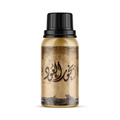
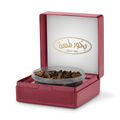
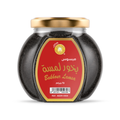
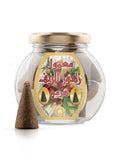
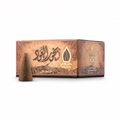

In short: Oud (agarwood) is an aromatic wood from trees of the genera Aquilaria and Gyrinops. A healthy tree does not produce its scent; the aromatic resin forms in the wood after a wound or an infection, and because that is rare in the wild, it is now induced in cultivated trees. Induced oud is real oud, and its quality varies with the method used to induce it. Scented oud, by contrast, is wood saturated with aromatic oils, and “enhanced” is a trade description whose meaning you should ask the seller about. Oud is sold as pieces for burning, oud oil is distilled from it, and its grades and prices vary widely. Its international trade is regulated, since the species of both genera are listed in Appendix II of CITES, the appendix for species that may become threatened with extinction unless their trade is regulated.
Table of contents
- What is oud?
- How does oud form?
- Wild oud and induced oud
- Natural, induced, enhanced and scented oud: what is the difference?
- Where does oud come from?
- Oud grades, prices and adulteration
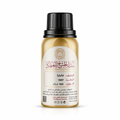
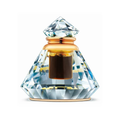
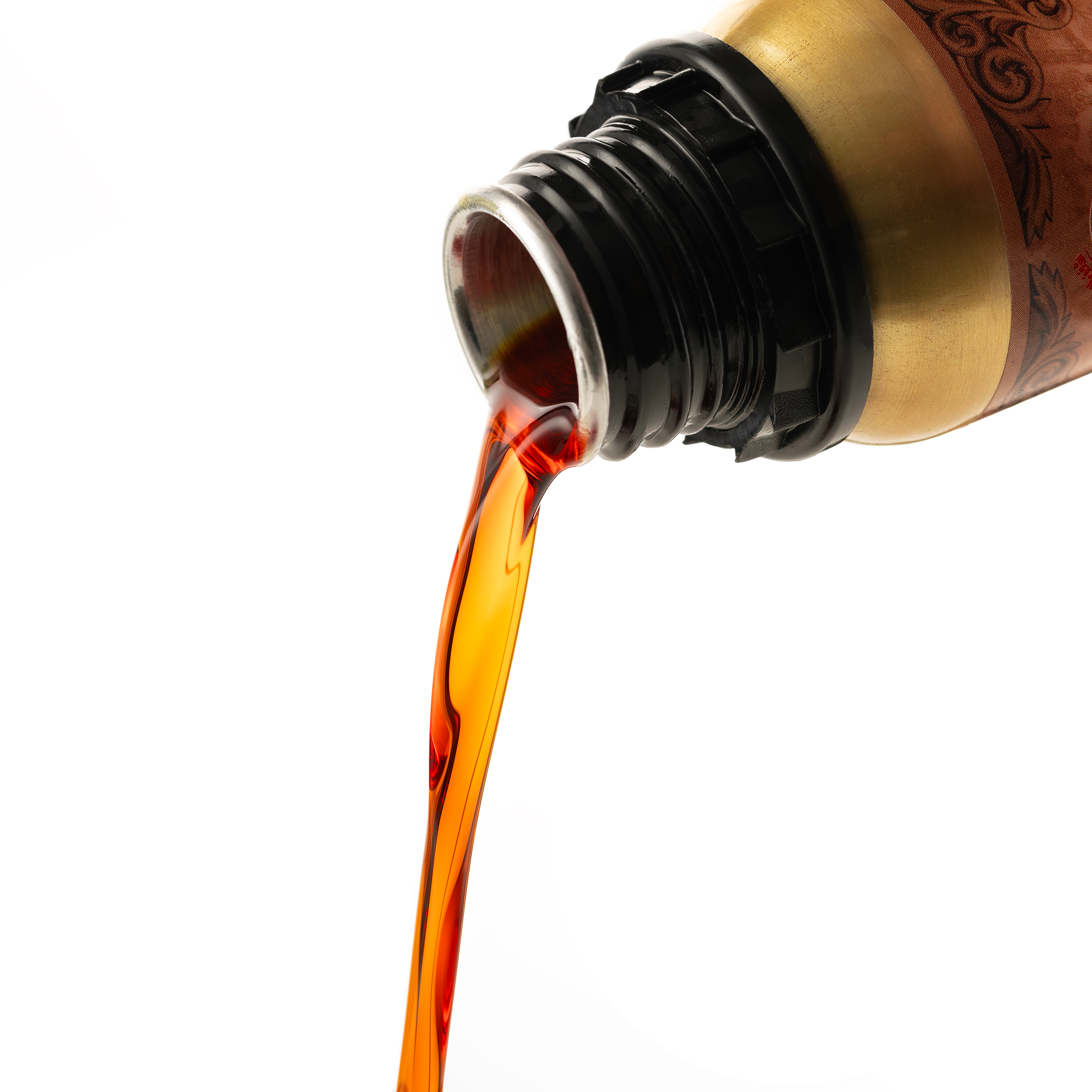
- Oud oil
- Oud in perfumes
- How is oud burned?
- A brief history of the oud trade
- Oud and CITES
- Tips for buying oud
- Frequently asked questions
- Read also
- References
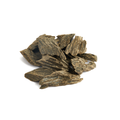
Two pieces of oud sit in the seller's palm, close in color and weight, yet far apart in price. The seller says the first is wild Indian oud and the second is Cambodian. Some of what is said about a piece you can find out from the piece yourself; the rest remains the seller's word, and you have no way to check it.
What is oud?
Oud is an aromatic wood from trees of the genera Aquilaria and Gyrinops [1]. Healthy wood has no scent, because a healthy tree does not produce these aromatic compounds [2]; the resin forms in its wood in response to a wound or an infection [3]. The pieces saturated with this resin are the oud that is burned and from which oil is distilled [2].
Its Arabic names include “oud” and “aluwwa”, the second going back to ancient Indian names for it, such as the Sanskrit agaru [3].
How does oud form?
The aromatic resin forms when the tree is wounded or attacked by insects or fungi, and the tree secretes it to defend itself [2]. In the wild this is rare and slow: the share of wild Aquilaria trees that contain oud is put at between 1% and 2% [4], or about 10% by another estimate [5], and it takes many years to form, as many as ten [4] or twenty and more [5].
The scent of oud varies with many factors [3]:
- The species of the tree and where it grows.
- The part of the tree the piece comes from: the trunk, the branches or the roots.
- The time since the infection.
- The method of harvesting and processing.
Wild oud and induced oud
Wild oud forms without intervention, after the tree is infected in the forest [4]. Induced oud forms in cultivated trees that were deliberately wounded or treated [5]. So drilling holes in the tree, driving nails into it or wounding it deliberately are methods for inducing the resin in cultivated trees, not how natural oud forms [4].
Today's induction methods fall into three categories [4] [5]:
- Physical: such as driving nails, drilling holes, burning, breaking the trunk and removing the bark. They are cheap, but they usually produce lower-quality oud, their yield is uncertain, and the resin stays limited to the wounded spots [4].
- Biological: the tree is inoculated with fungi, and the quality of the result is inconsistent [4].
- Chemical: stimulating substances are injected into the tree, and these methods are faster and more consistent; a carefully studied inducer blend has produced oud close in quality to natural oud [4].
So induced oud is real oud, and its quality depends on the method used to induce it [5].
Wild oud can sometimes be told apart from the oud of cultivated trees, but in the laboratory, not by eye or nose, with an analysis developed to support the enforcement of CITES. In some cases it can also point to the country of origin [6].

Natural, induced, enhanced and scented oud: what is the difference?
| Type | What it is | What to ask about |
|---|---|---|
| Natural oud | Wood in which the resin formed after the tree was wounded or infected in the wild [5] | The source of the piece and its grade |
| Induced oud | Wood from cultivated trees that were deliberately wounded or treated so the resin forms in them. It is real oud, and its quality varies with the method [5] | The source of the piece and its grade |
| Enhanced oud | A trade description for which we found no standard definition in a scientific or regulatory reference | What is meant by enhancement, and the origin of the wood |
| Scented oud | Pieces of wood saturated with aromatic oils [7]; the scent depends on the aromatic blend | Its notes |
If you see the words “natural” and “enhanced” together in a product name, ask the seller whether anything was added to the wood.
Where does oud come from?
The natural range of the genus Aquilaria extends across South and Southeast Asia [1]:
- Assam, Bangladesh and the eastern Himalayas.
- Southern China and Hainan Island.
- Myanmar, Thailand, Laos, Cambodia and Vietnam.
- The Malay Peninsula, Sumatra and Borneo.
- The Philippines, the Moluccas and New Guinea.
The Arabian Peninsula is not part of its natural range [8]. Oud in the Gulf comes from the producing countries through trade, as it has for centuries [3].
On the market, oud pieces are named after their countries, such as Indian, Cambodian and Indonesian, and traders hold that the oud of each country has a scent of its own [8]. In the UAE market, oud is ranked by country, with Indian and Cambodian oud at the top [8]. That is the custom and taste of the market. We found no scientific source that describes a fixed scent for the oud of each country, and the scent is affected by many factors other than the country [3].
So our advice is to take the country name as the seller's description, and to smell the piece and try it before you judge it.
Oud grades, prices and adulteration
There is no standard system for grading oud. Each country has its own traditional grades [4], and they vary by resin content, specific gravity and color, and sometimes scent [2]. Price follows grade: a kilogram ranges from 100 to 100,000 US dollars, by an estimate published in 2019 [2].
Grades are usually judged by experts by sight and smell, so some personal judgment remains [5].
Oud adulteration has been described since at least the eighteenth century [3]. Today, fake or adulterated woods are sold on the market as cheaper oud [2], and pieces may be polished and colored [8]. The more demand has raised prices, the more adulteration and substitution there has been [3].
Oud oil
Oud oil is an oil extracted from oud wood by distillation [3]. Most of it is distilled from lower-grade oud, which has less resin than the pieces that are burned [3] [8]. In traditional hydrodistillation, sun-dried pieces with dark resin are soaked in water for two to three months, then boiled to extract their oil [2].

Not every product called “oud oil” is an oil distilled from oud wood. It may be an oil-based perfume with an oud character, and the proportion of oud in oil products varies widely [8]. Read the product's description and label before you buy.
Oud in perfumes
Oud oil is a cornerstone of Arabian perfumes, and it has also entered modern Western perfumes [3]. It is often used as a base note, because its scent is rich, slow to evaporate and long-lasting [3].
The word “oud” among a perfume's notes describes the character of the scent, and does not by itself show where that scent comes from. Some of the oil imported as oud may have been a compound made from other aromatic oils, or a synthetic oud oil from aroma chemical factories, according to traders in the UAE market [8].
How is oud burned?
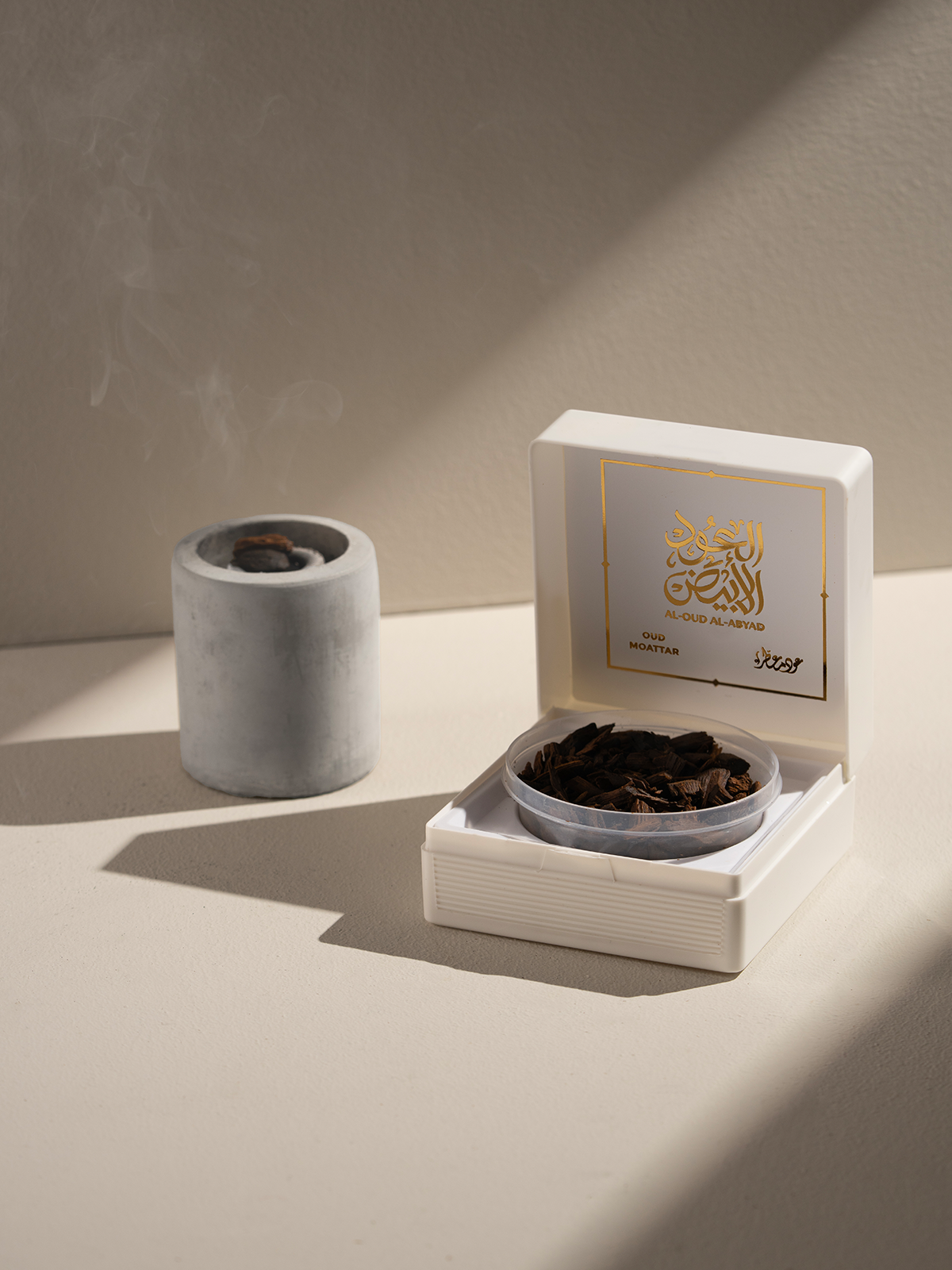
The piece is placed on hot charcoal in an incense burner, or in an electric burner that heats it without charcoal [7]. Here, as in the markets of Asia, oud pieces rich in resin are burned directly, without processing or added fragrances, while oud with less resin is often mixed with other aromatic ingredients in bakhoor (incense) blends [3].
Heat is part of the scent. The vapors of heated oud contain aromatic compounds of low molecular weight that are not present in the wood, and one of their sources is a compound in the wood called agarotetrol, which turns into them when heated. In distillation, that compound remains the main component of the water left in the vessel [9]. This, it appears, is why the scent of a piece on the burner does not exactly match the scent of its oil.
An electric burner is a better choice than charcoal or an open flame, but it does not eliminate the smoke: long burning sessions with it have also been linked to respiratory symptoms [7].
Lit charcoal gives off carbon monoxide, a gas with no color or smell [10]. So do not light it in a closed room or in a bedroom, do not leave it lit while you sleep, and open a window or a door for as long as it is lit. An electric burner has no charcoal, so it spares you the charcoal gas, but the bakhoor smoke remains with it. If a headache, dizziness or nausea appears while the charcoal is lit, go out into the fresh air at once, put it out on your way if you can do so without delay, and get medical advice as soon as possible, and do not go back until you have had it. If there is difficulty breathing, sudden confusion, loss of consciousness, weakness, or chest or muscle pain, call an ambulance [14].
Start with a small piece of oud, then add more if needed. The danger of charcoal, with what has been measured in rooms, is covered in the charcoal incense burner section of our guide to making bakhoor scent last.
A brief history of the oud trade
Oud was described as an aromatic material in Sanskrit texts from about 1400 BCE [3], and its trade is more than two thousand years old [2], carrying it from the producing regions of Southeast Asia to the Middle East, India, China and Japan [3]. Between the seventh and eleventh centuries CE, Arabs and Indians were among the most prominent traders of the Indian Ocean, and it is reported that an Ibadi merchant of Omani origin traveled to China in the mid-eighth century and bought oud there [3].
Here, as in many Middle Eastern countries, oud is present on religious and social occasions, scents the home and personal belongings, and is counted a sign of status [3].
Oud and CITES
The international oud trade is regulated by CITES, the Convention on International Trade in Endangered Species of Wild Fauna and Flora. Oud was listed under it in two stages [1] [11]:
- The species Aquilaria malaccensis alone, in Appendix II since 16 February 1995.
- All species of the genera Aquilaria and Gyrinops, by a decision of the Conference of the Parties in 2004, with the listing in effect since 12 January 2005.
Listing in Appendix II does not necessarily mean that a species is threatened with extinction, but that it may become so unless its trade is strictly regulated [3].
Today the listing covers all parts and derivatives of the tree, except those exempted by name, including seeds, leaves and fruits, exhausted agarwood powder, and finished products packaged and ready for retail sale. This exemption does not cover wood chips, prayer beads or carvings, which remain regulated. The text in force has applied since 23 February 2023 [11].
Travelers are treated differently. The Parties have agreed not to require export permits for oud carried by a traveler as personal effects, if it does not exceed one kilogram of wood chips, 24 ml of oil, and two sets of prayer beads, or two necklaces or bracelets, per person. If the amount exceeds this, or if the other country has notified that it requires the documents, this exemption does not apply [12]. The safer course is to ask about the destination country's rules before you travel with a quantity of oud.
The reason for this regulation is that rising demand increased illegal harvesting from forests and the depletion of wild oud [3]. Some Aquilaria species are classified as “Critically Endangered” on the Red List of the International Union for Conservation of Nature (IUCN), such as A. malaccensis, A. crassna and A. rostrata, and some are classified as “Vulnerable”, such as A. sinensis, according to the 2018 assessments [13]. High prices, for their part, have encouraged planting the trees and inducing oud in them [3].
Tips for buying oud
- Do not judge by color or weight alone, or by price alone: pieces may be polished and colored [8], and adulteration exists on the market [2].
- Ask the seller where the oud comes from, and how it formed, if they know. Then smell and try, starting with a small amount.
Frequently asked questions
What is the difference between oud and bakhoor?
Bakhoor is the broader term, covering oud, frankincense and prepared blends. Oud is one of them: specifically, the wood of Aquilaria and Gyrinops trees [1].
How should I store oud and oud oil?
The details are in our guide How to Store Bakhoor, Oud and Oud Oil.
Read also
- Types of Bakhoor: A Guide to Oud, Frankincense, Maamoul and Mabsous
- Making Bakhoor Scent Last at Home: Amount, Ventilation and Safety
- How to Store Bakhoor, Oud and Oud Oil: A Storage Guide
- How to Choose Bakhoor and Oud for Home and Occasions
References
- Layola MRR, Sengupta S, Mallick B, Shil T, Shaw R, Banu F, Chakraborty S, Sardar S, et al. Phylogenetic analysis of the Critically Endangered Aquilaria khasiana (Thymelaeaceae) using barcode markers and chloroplast genome, with updated conservation status. Scientific Reports. 2025;15(1):21511. doi:10.1038/s41598-025-08606-x. PMC12214818. Accessed 27 September 2026.
- Naziz PS, Das R, Sen S. The Scent of Stress: Evidence From the Unique Fragrance of Agarwood. Frontiers in Plant Science. 2019;10:840. PMC6646531. Accessed 27 September 2026.
- López-Sampson A, Page T. History of Use and Trade of Agarwood. Economic Botany. 2018;72(1):107–129. doi:10.1007/s12231-018-9408-4. Open access: researchonline.jcu.edu.au/58720. Accessed 27 September 2026.
- Tan CS, Isa NM, Ismail I, Zainal Z. Agarwood Induction: Current Developments and Future Perspectives. Frontiers in Plant Science. 2019;10:122. PMC6374618. Accessed 27 September 2026.
- Shivanand P, Arbie NF, Krishnamoorthy S, Ahmad N. Agarwood—The Fragrant Molecules of a Wounded Tree. Molecules. 2022;27(11):3386. PMC9181942. Accessed 27 September 2026.
- Espinoza EO, Lancaster CA, Kreitals NM, Hata M, Cody RB, Blanchette RA. Distinguishing wild from cultivated agarwood (Aquilaria spp.) using direct analysis in real time and time of-flight mass spectrometry. Rapid Communications in Mass Spectrometry. 2014;28(3):281–289. doi:10.1002/rcm.6779. PMID: 24375879. Accessed 5 October 2026.
- Bu-Olayan AH, Thomas BV. Exposition of respiratory ailments from trace metals concentrations in incenses. Scientific Reports. 2021;11(1):10210. PMC8140077. Accessed 27 September 2026.
- Antonopoulou M, Compton J, Perry LS, Al-Mubarak R. The Trade and Use of Agarwood (Oudh) in the United Arab Emirates. Petaling Jaya, Selangor, Malaysia: TRAFFIC Southeast Asia; 2010. traffic.org. Accessed 27 September 2026.
- Takamatsu S, Ito M. Agarotetrol: a source compound for low molecular weight aromatic compounds from agarwood heating. Journal of Natural Medicines. 2018;72(2):537–541. doi:10.1007/s11418-018-1185-y. PMID: 29464509. Accessed 5 October 2026.
- Centers for Disease Control and Prevention (CDC). Carbon Monoxide Poisoning Basics. cdc.gov/carbon-monoxide/about. Accessed 27 September 2026.
- UNEP-WCMC, CITES Secretariat. Species+: Aquilaria malaccensis. speciesplus.net. Accessed 5 October 2026.
- CITES. Resolution Conf. 13.7 (Rev. CoP17): Control of trade in personal and household effects. Paragraph 3(b). cites.org. Accessed 5 October 2026.
- International Union for Conservation of Nature (IUCN), The IUCN Red List of Threatened Species, assessments of the four species: Harvey-Brown Y. Aquilaria malaccensis. The IUCN Red List of Threatened Species 2018: e.T32056A2810130. doi:10.2305/IUCN.UK.2018-1.RLTS.T32056A2810130.en; Harvey-Brown Y. Aquilaria crassna. The IUCN Red List of Threatened Species 2018: e.T32814A2824513. doi:10.2305/IUCN.UK.2018-1.RLTS.T32814A2824513.en; Harvey-Brown Y. Aquilaria rostrata. The IUCN Red List of Threatened Species 2018: e.T31810A88301971. doi:10.2305/IUCN.UK.2018-1.RLTS.T31810A88301971.en; Harvey-Brown Y. Aquilaria sinensis. The IUCN Red List of Threatened Species 2018: e.T32382A2817115. doi:10.2305/IUCN.UK.2018-2.RLTS.T32382A2817115.en. Accessed 17 October 2026.
- NHS. Carbon monoxide poisoning. Last reviewed: 16 December 2025. nhs.uk. Accessed 15 October 2026.
Prepared and edited by: Sedr Al-Khaleej Perfumes team
Last reviewed: 14 October 2026
Was this article helpful?
Leave a comment
Comments are reviewed before they appear. Your email address won’t be shown.