In short: Choose a perfume by your own taste first, then by the occasion, the place and the weather, and know its concentration and its notes, that is, the smells it is made of. Test it somewhere with few other smells: on a paper strip first, then on your skin, and wait at least half an hour before you judge it. Do not test more than three perfumes at a time. When you wear it, spray it from a distance onto a few spots and start with a moderate amount. Do not keep spraying because you can no longer smell it: it may still be there, and your nose has simply got used to it.
Table of contents
- How to choose a perfume
- Taste before categories
- Concentration: what do parfum and eau de toilette mean?
- Does your choice change with the time, place and season?
- How to test a perfume before buying
- How to apply perfume
- Where to apply it, and how much
- On skin or on clothes?
- What about perfume oils?
- Layering: should you combine two perfumes?
- Where to keep your perfume
- Frequently asked questions
- Read also
- References
At the perfume counter, the seller sprays one strip after another for you, and after the fourth the smells start to blur. You pick the one you liked at the first sniff, and an hour later it smells like something else on your hand. At home you can barely smell it, while the people around you say it is strong.
How to choose a perfume
Start with the fragrance family, the group in which perfumes with similar smells are classed. The perfumes a person likes usually fall into one or two of the fourteen families in the classification of Michael Edwards, author of the Fragrances of the World reference [1]. List the perfumes you have liked before, find out which family each belongs to from our guide to fragrance families, then try others from that family.
Taste before categories
Put your own taste before what a perfume's description promises, such as suiting a certain “personality” or changing your mood. People differ in which smells they find pleasant far more by personal taste than by culture, as was seen when people from nine cultures ranked the smells of single substances [2].
Calling a perfume masculine or feminine is the perfume house's choice; the fragrance family does not decide it. Here too, choose by your own taste [1]; many perfumes are shared. If a perfume's scent is one that people around you consider specific to the other sex, it is better to avoid it.
Concentration: what do parfum and eau de toilette mean?
The name on the bottle indicates the proportion of perfume material in the alcohol solution. These are the proportions for each type in one reference [3]:
| Type | Perfume material |
|---|---|
| Parfum (extrait de parfum) | Up to 40% |
| Eau de parfum | 10–15% |
| Eau de toilette | 5–10% |
| Eau de Cologne | 3–8% |
These ranges are not the same in every source [1]. And one type does not mean one longevity, because a perfume's longevity also depends on its notes [4].
Does your choice change with the time, place and season?
Yes. The place decides who will smell your perfume along with you, and heat makes it fade faster. At work, on public transport and in closed spaces we choose a lighter perfume and a smaller amount, out of consideration for those around you, while in the evening and on occasions you can widen your choice to heavier perfumes such as oud and amber if you wish. In hot weather, a lighter perfume that you reapply more often works better [1].
A woman wears perfume at home, for her husband and among women, and does not go out wearing a scent that men can smell.
How to test a perfume before buying
- Choose a place with few smells: stay away from food smells and other perfumes as far as you can. This is a requirement for the rooms where products are tested scientifically by the senses [5].
- Start with a paper strip: paper is not as good as skin, but it is the closest substitute for it [1], and it lets you rule out what you do not like before anything goes on your skin. Your judgment on paper is approximate: skin may hold some components of a perfume longer than a hard surface such as glass does, and lose others faster [6].
- Then apply it to your skin: a little on the wrist or the back of the hand [1].
- Wait before you judge: a perfume does not keep one smell. The first thing you smell is the “top”, then the “heart”, then the “base”, which is the last to remain. The top is estimated to stay on the skin for a quarter to half an hour, the heart for three to four hours, and the base longer [4]. So do not judge from the first minutes, and if you can, smell it again after a few hours to know its base.
- Three perfumes at a time at most: so that the smells do not blur together [1]. The nose adapts to a smell it meets for a long time or repeatedly; its sensitivity to that smell drops for a while, then returns once it has been away from it [7].
- Do not judge by how it smells on someone else: if you like a perfume on another person, try it on your own skin first [1]. A perfume may smell different from one skin to another: the roughness of the skin surface, its hydration and the water it loses were found, when measured, to affect how some components of a perfume evaporate [6].
- Ask someone who has not been with you all along: after a while you adapt to your own perfume, so you can barely smell it while others can [7] [1]. Someone who has just walked in has not adapted to it yet, and their opinion tells you how strong the perfume is and how long it lasts.
- When buying online: stick to the families and notes you know you like [1], and read what the seller says about its concentration and notes.

If you have a known allergy to perfumes, read the evidence we gathered in our article on the harms of perfume and bakhoor before testing.
How to apply perfume
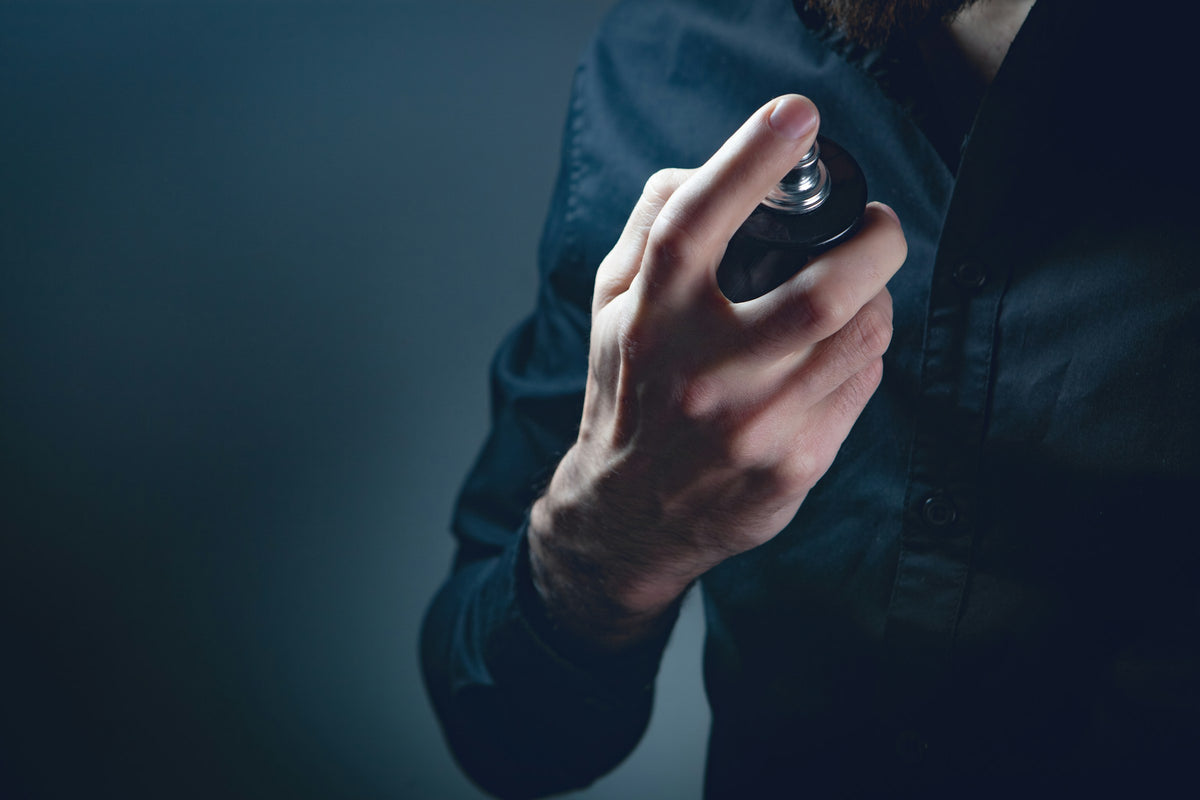
Spray it from a distance onto a few spots, and let it dry on its own without rubbing. Rubbing appears to weaken the way its smells unfold from the top to the base [1].
Where to apply it, and how much
Apply it to spots such as the inner wrists, the inside of the elbows, below the earlobes, and the base of the neck [1]. The skin there is warmer, and warmth is said to help the scent spread [1], so these spots help the perfume show, not last longer. Spray from about 20 cm away and spread it out, since a spray spread over a wider area may last longer than a large amount in a small spot [1].
As for the amount, we advise starting with a moderate amount, then adding more the next time if you need to. Do not measure the amount by your nose alone: after a while it adapts to your perfume, and you may think it has gone when it is still there [7], or it may really have faded. So ask someone else before adding more.

On skin or on clothes?
- Apply it to clean skin. Some of the less volatile components may evaporate more slowly from skin that is naturally better hydrated [6], but this does not show that applying a moisturizer makes a perfume last longer.
- If you put it on your clothes, test it first on a hidden spot of the fabric. We advise against putting perfume oils on clothes, as they may leave oily stains [3].
What about perfume oils?
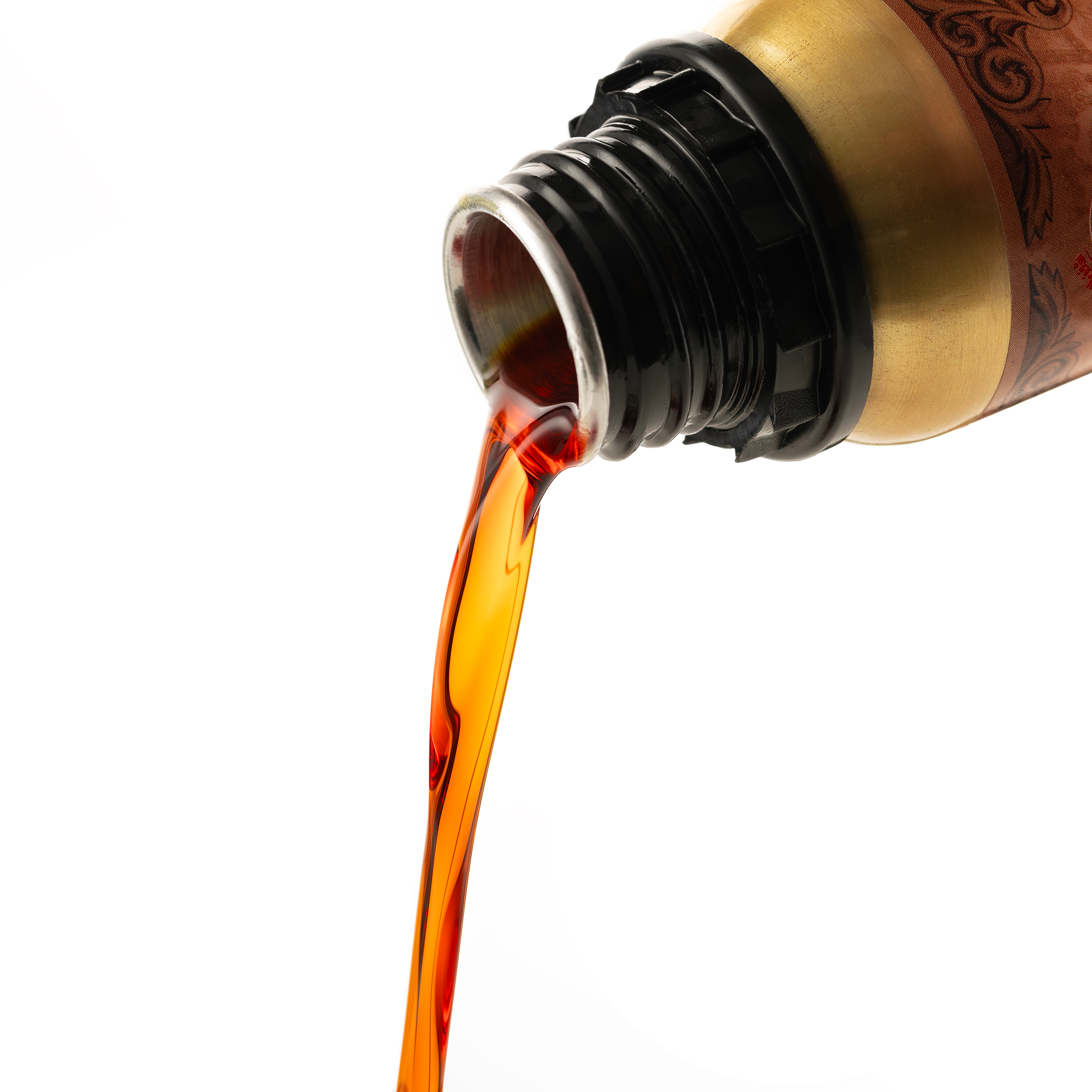
Perfume oils (dihn al-ʿitr) are estimated to last longer on the skin than alcohol-based perfumes, and they seem heavier because they often lack the light top smells [3]. They contain no alcohol; the perfume material in them is usually dissolved in an oil that carries it, such as jojoba oil [3]. Start with a small amount and add more if you need to. Oud oil is something other than a perfume oil.
Layering: should you combine two perfumes?
Combining two different perfumes more likely gives a discordant smell than a new blend, because each perfume is a complete, balanced composition, unless the house designed it to be combined with another [1]. Layering, on the other hand, builds up one perfume's scent where it comes in other forms: a scented soap or lotion first, then the perfume [1].
If you want to try a combination, such as oud oil or musk under a spray perfume, try it on an ordinary day before wearing it to an occasion, and start with a small amount of both.
Where to keep your perfume
Keep it in a cool, dry place, away from the sun and sources of heat [1]. Do not leave it in the car, and close the bottle after each use.
Frequently asked questions
Do coffee beans help between testing one perfume and the next?
This has not been shown. In a preliminary experiment, coffee beans were no better than plain air for telling the next perfume apart [8]. The simpler way is to stay away from smells for a while until your sensitivity returns, and the time needed grows with the strength of the smell and the length of exposure [7].
Read also
- Fragrance Families: A Guide to Perfume Scent Types and Their Classification
- Perfume Ingredients: From Raw Material to Note
- How to Store Perfume: Where to Keep It, How Long It Lasts, and How to Tell It Has Changed
- Perfume Oils: Concentration, Longevity and Safe Use
- Harms of Perfume and Bakhoor: What the Evidence Says on Allergy and Smoke
- Autumn Fragrance Notes: How to Choose Your Perfume in Saudi Weather
- Winter Fragrance Notes: How to Choose and Wear Perfume in Saudi Arabia
References
- Edwards M. Fragrance Q&A. Fragrances of the World. fragrancesoftheworld.com. Accessed 5 October 2026.
- Arshamian A, Gerkin RC, Kruspe N, Wnuk E, Floyd S, O'Meara C, Garrido Rodriguez G, Lundström JN, Mainland JD, Majid A. The perception of odor pleasantness is shared across cultures. Current Biology. 2022;32(9):2061–2066.e3. doi:10.1016/j.cub.2022.02.062. Accessed 1 October 2026.
- Sikora E, Miastkowska M, Wolinska Kennard K, Lason E. Nanoemulsions as a Form of Perfumery Products. Cosmetics. 2018;5(4):63. doi:10.3390/cosmetics5040063. Accessed 1 October 2026.
- Rodrigues AE, Nogueira I, Faria RPV. Perfume and Flavor Engineering: A Chemical Engineering Perspective. Molecules. 2021;26(11):3095. doi:10.3390/molecules26113095. PMC8196857. Accessed 1 October 2026.
- International Organization for Standardization. ISO 8589:2007 Sensory analysis — General guidance for the design of test rooms. Clause 6.1.4 (Odours). Standard page. Accessed 1 October 2026.
- Hadjiefstathiou E, Savary G, Malhiac C, Terescenco D, Picard C. Exploring the impact of fragrance molecular and skin properties on the evaporation profile of fragrances. International Journal of Cosmetic Science. 2025;47(6):981–995. doi:10.1111/ics.13085. PMC12666731. Accessed 1 October 2026.
- Dalton P. Psychophysical and Behavioral Characteristics of Olfactory Adaptation. Chemical Senses. 2000;25(4):487–492. doi:10.1093/chemse/25.4.487. Accessed 1 October 2026.
- Grosofsky A, Haupert ML, Versteeg SW. An Exploratory Investigation of Coffee and Lemon Scents and Odor Identification. Perceptual and Motor Skills. 2011;112(2):536–538. doi:10.2466/24.PMS.112.2.536-538. Accessed 1 October 2026.
Prepared and edited by: Sedr Al-Khaleej Perfumes team
Last reviewed: 16 October 2026
Was this article helpful?
Leave a comment
Comments are reviewed before they appear. Your email address won’t be shown.