
In short: A fragrance family describes the character of a perfume as a whole, and notes are the individual smells it is made of. The two best-known classifications today are that of the French Society of Perfumers, with its seven families: citrus, floral, Fougère (the family of lavender, coumarin and oakmoss), Chypre (the family of oakmoss and bergamot), woody, amber and leather [1], and Michael Edwards’ wheel, with its fourteen [2]. In these classifications “oriental” is a second name for the amber family [1] [3], and in Arabic descriptions it is also used for a perfume in which materials such as oud, musk and rose stand out. Neither classification divides its families between men and women [1] [2]. If you want to choose, start with the family of the perfumes you have liked, then try the families next to it [4].
Table of contents
- What is a fragrance family?
- Who classifies perfumes?
- What are the main fragrance families?
- What sets each family apart?
- Do the families differ in longevity?
- What does “oriental” mean in Arabic descriptions?
- Are fragrance families masculine and feminine?
- How do you choose your perfume by family?
- Read also
- References
You read the description of the same perfume on two websites. The first says it is “woody amber”, and the second says it is “oriental”. Then you find it in a third store among the “woody perfumes”. All three may be right, because each follows a classification of its own, and the same word may mean something different to each of them.
What is a fragrance family?
A fragrance family is a group of perfumes that share a dominant scent character; floral perfumes, for example, have a flower or a bouquet of flowers as their main theme [1]. A perfume is assigned to its family by its overall character, and a sub-descriptor is then added for what accompanies that character, as in “fruity floral” or “spicy woody” [1].
What is the difference between a family and a note?
A note is the smell of a material or of a character within a perfume, such as bergamot, jasmine or sandalwood, and the family describes what results when all the notes come together. Notes are arranged into top, heart and base according to how quickly they evaporate [4], so a woody perfume may open with lavender and citrus notes [1] and still be woody.
Who classifies perfumes?
There is more than one classification of fragrance families. The two best known are the classification of the French Society of Perfumers (Société Française des Parfumeurs) and the fragrance wheel devised by Michael Edwards in his guide Fragrances of the World.
The French Society of Perfumers classification
This classification has seven main families: citrus, floral, Fougère, Chypre, woody, amber and leather [1]. The Osmothèque perfume archive classifies its collection mostly by these names, giving each perfume a family and a subfamily, and adds some names from outside the classification, such as “oriental”, “marine” and “gourmand” (a sweet character reminiscent of desserts) [5].
Michael Edwards’ Fragrance Wheel
The wheel arranges perfumes into fourteen adjacent families: Floral, Soft Floral, Floral Amber, Soft Amber, Amber, Woody Amber, Woods, Mossy Woods, Dry Woods, Aromatic Fougère, Citrus, Water, Green and Fruity [2]. These families fall into four groups: Floral, Amber, Woody and Fresh [3]. Any two families that sit next to each other on the wheel are close in scent [4].

Why do the names differ between sources?
Because each classification divides smells in its own way. In the French classification “aromatic” is a subfamily that comes under citrus, Fougère, Chypre and woody [1], while on the wheel it is part of a family called “Aromatic Fougère” [2]. “Water” is a family of its own on the wheel [2], but in the French classification it is no more than a sub-descriptor, as in marine floral and marine woody [1]. So if you find the same perfume described in two ways on two websites, most likely each one follows a different classification.
Do the families have a scientific basis?
Most likely some of them have support in how people perceive smells, and they are a practical division, not a fixed division found in nature. Perfumers built these classifications from experience, not in the laboratory, and research on odor perception has since found a division close to some of them in the way people describe what they smell. When a map of smells was drawn from descriptions of hundreds of perfumery materials, it bore a striking resemblance to a diagram a perfumer had drawn from experience [6]. In another analysis, descriptions of smells clustered into ten categories that are closer to being separate than to forming a continuous gradient, among them woody/resinous, lemon and sweet [7].
This does not make one classification scientifically right and the other wrong. The ten categories were never compared with perfumers’ classifications [7], and agreement on a single map of smells is difficult unless specialists first agree on which materials represent each odor [6].
What are the main fragrance families?
In the French classification there are seven, and the table summarizes them with their character and materials [1]. The historical examples come from the Osmothèque collection list, with the name, house and year of launch as given there [5].
| Family | Character | Typical materials | Historical example |
|---|---|---|---|
| Citrus (Hespéridée) | Fresh, from citrus peel oils | Bergamot, lemon, orange, mandarin, and materials from the orange tree | 4711, Muelhens, 1792 |
| Floral (Florale) | A single flower or a bouquet | Jasmine, rose, lily of the valley, violet | N°5, Chanel, 1921 |
| Fougère | A fanciful name that does not refer to the smell of fern | Lavender, woods, oakmoss, coumarin, bergamot, geranium | Fougère Royale, Houbigant, 1884 |
| Chypre | Mossy woody | Oakmoss, labdanum, patchouli, bergamot | Chypre, Coty, 1917 |
| Woody (Boisée) | Warm and rich, or dry | Sandalwood, patchouli, cedar, vetiver | Vétiver, Guerlain, 1959 |
| Amber or “oriental” (Ambrée) | Sweet, soft and powdery | Vanilla, labdanum, animalic notes | Shalimar, Guerlain, 1925 |
| Leather (Cuir) | Dry, imitating the smell of leather | Smoke, burnt wood, birch, tobacco | Cuir de Russie, Chanel, 1924 |
What sets each family apart?
Citrus
This family is built on oils pressed from citrus peel, such as bergamot, lemon, orange and mandarin, together with materials from the orange tree [1]. The first eaux de Cologne belong to it, and they were worn by men and women alike [1]; it was in the German city of Cologne that the perfumer Johann Maria Farina launched his “wonderful water” in 1709 [4]. Its perfumes include 4711 by Muelhens (1792) and Eau Sauvage by Dior (1966) [5].
Floral
Its theme is a single flower or a bouquet, and among its best-known materials are jasmine, rose, lily of the valley and violet [1]. In the French classification it has nine branches, among them single flower, aldehydic floral, green floral and musky floral [1]. An example of a single flower is Diorissimo by Dior (1956), whose flower is lily of the valley [5]. As for aldehydic floral, Chanel N°5 (1921) is regarded as the first of its kind: a bouquet dominated by notes of synthetic aldehydes, with jasmine and rose [4].
Fougère and aromatic
“Fougère” is the French word for fern, but in perfumery it is a fanciful name that does not refer to the smell of fern [1]. The family is built on lavender, woods, oakmoss, coumarin, bergamot and geranium [1]. One of its first perfumes is Fougère Royale by Houbigant, created by Paul Parquet, which the Osmothèque dates to 1884 [5] and counts among the perfumes that founded modern perfumery or left their mark on their era [8]. Jicky by Guerlain (1889) also belongs to the family [5].
One perfume of the aromatic branch (Aromatique) under Fougère is Azzaro pour homme (1978) [5]. The “Aromatic Fougère” family on the wheel has lavender and geranium alongside citrus, herbs and woods [2].
Chypre
“Chypre” is the French name for the island of Cyprus [4], and the family takes its name from Chypre, the perfume François Coty launched in 1917 [1] [4]. That perfume is built on oakmoss, labdanum, patchouli and bergamot [1], and is regarded as the first important mossy woods perfume [4]. The branches of the family include fruity Chypre, for example Mitsouko by Guerlain (1919), as well as leather Chypre and green Chypre [1] [5].
Modern Chypre perfumes are not the same as the old ones, and the reason is oakmoss. Its extract can cause skin sensitization, so the International Fragrance Association (IFRA) sets a maximum level for it that varies by product category [9]. The restriction is tied to two substances in the moss, atranol and chloroatranol [9], and chloroatranol triggers a reaction in people who are allergic to it at very small amounts [10]. When a material is restricted, the perfumer may replace it with another, and the effect on the scent depends on the substitute and on how much of the original was in the formula [4].
Woody
Its woods are warm and rich, such as sandalwood and patchouli, or dry, such as cedar and vetiver, and it may open with notes of lavender and citrus [1]. On the wheel it is three families: Woods; Mossy Woods, which brings together oakmoss and patchouli; and Dry Woods, which adds leather and tobacco notes and a hint of smoke [2]. Vétiver by Guerlain (1959) belongs here [5].
Amber, or “oriental”
The French classification calls it “amber”, and it is sometimes called “oriental” [1]. Its character is sweet, soft and powdery, with vanilla, labdanum and pronounced animalic notes [1], and the wheel describes it as golden resins, rich flowers and sweet vanilla [2]. Shalimar by Guerlain (1925) and Opium by Yves Saint Laurent (1977) are from this family [5].
The “amber” in the name of this family describes a scent character made by resins and vanilla. It is not ambergris, the animal material that comes from the sperm whale; on the wheel, ambergris is a supporting note that can appear in any family [11]. The name “Amber” was chosen instead of “Oriental” because the word was already well established in perfumery [11]. Even so, the industry also uses the word for ambergris and for materials known as “amber woods”, and the team behind the wheel has called for these names to be clarified so that people do not confuse them [11].
Leather
It imitates the smell of leather with dry, sometimes very dry, notes: smoke, burnt wood, birch and tobacco, and it may open with a floral note [1]. In the French classification it has three branches, leather, floral leather and tobacco leather [1], and its older perfumes include Tabac Blond by Caron (1919) and Cuir de Russie by Chanel (1924) [5]. The wheel does not give it a family of its own: leather notes there fall under “Dry Woods” [2].
Newer descriptors: aquatic, green, fruity and gourmand
These are common names in perfume descriptions, but they are not among the seven families of the French classification [1].
- Aquatic or marine: the scent of a sea breeze, a waterfall or the damp air after a storm. It is a family of its own on the wheel [2], added in 1998 after perfumes with marine notes had become common [11]. In the French classification it appears as a sub-descriptor: marine floral and marine woody [1]. The smell of the sea in perfumes is usually attributed to a synthetic material called Calone 1951, together with other compounds [12]. A marine floral example is L’Eau d’Issey by Issey Miyake (1992) [5].
- Green: the smell of cut grass, violet leaves and cucumber. A family on the wheel [2], and a subfamily under floral and Chypre in the French classification [1].
- Fruity: orchard fruits and berries with some flowers, which is how the wheel describes its Fruity family [2]. In the French classification it is a subfamily under floral, Fougère, Chypre, woody and amber [1].
- Gourmand: not a family in either classification [1] [2]. The Osmothèque list uses the word as a family or subfamily for a small number of recent perfumes, such as Gourmand Coquin by Guerlain (2008), which it lists as an amber perfume of the gourmand subfamily [5]. These sources give no single definition of the word.
Do the families differ in longevity?
Usually yes, though the family alone does not settle it. What is described as fresh usually evaporates faster: citrus and green notes are among the quickest materials to fade, and oriental, powdery and animalic notes among the longest-lasting [13]. So a citrus perfume fades faster than an amber one in most cases, although longevity also depends on the concentration of the perfume, the skin and the weather.
What does “oriental” mean in Arabic descriptions?
“Oriental perfume” in an Arabic description may mean the amber family in its international sense, or it may mean a perfume in which materials such as oud, musk and rose stand out. The word “oriental” was the name of a family in Western classifications, and the French classification still gives it as a second name for the amber family [1]. In 2021 the oriental families on the wheel became “amber”: Soft Oriental became “Soft Amber” and Woody Oriental became “Woody Amber” [3]. The change came after years of consultation with fragrance materials companies, perfumers and perfume houses, and after a debate in which many felt the old name was no longer appropriate [3].
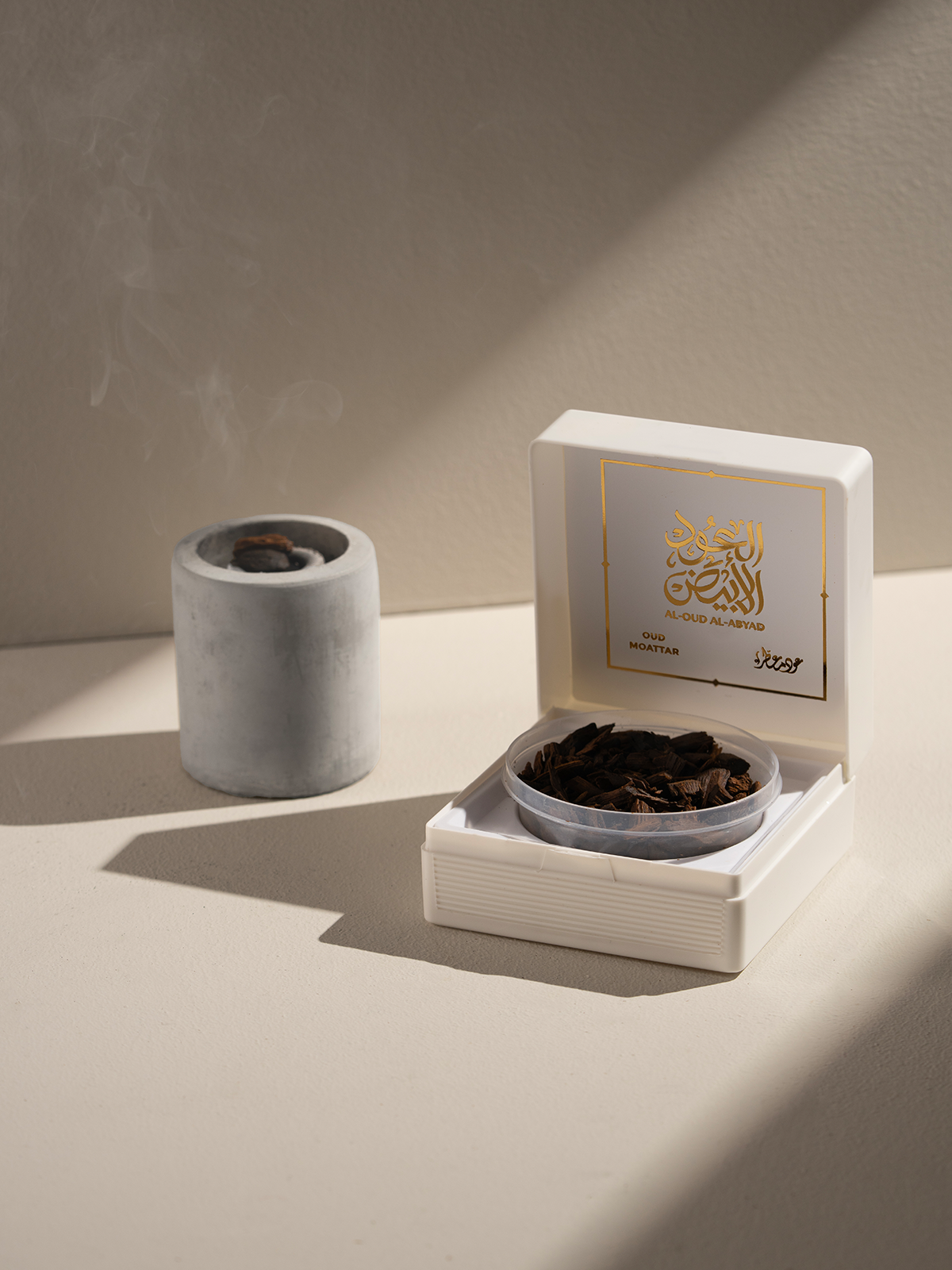
In our own Arabic descriptions, however, “oriental” is often used for a perfume in which materials such as oud, amber, musk, saffron, frankincense and rose stand out, the materials explained in our guide to oriental ingredients.

Where does oud fit?
Oud has no family of its own in either classification, and where an oud perfume falls depends on what accompanies it in the formula. The wheel mentions it in the description of “Woody Amber”, along with patchouli and sandalwood [2], and in the Osmothèque list there are oud perfumes classified as woody, such as Secret Oud by Caron (2010), and others classified as amber, such as Al Oudh by L’Artisan Parfumeur (2009) [5].
Where does musk fit?
Musk is like oud: it has no separate family, and on the wheel its place is “Soft Floral”, with aldehydes and flowers [2]. In the French classification it appears as a sub-descriptor under three families, as musky citrus, musky floral and musky woody, and there it means synthetic musk, not the smell of animal musk [1].
Are fragrance families masculine and feminine?
No. The seven families of the French classification include feminine, masculine and unisex perfumes, as the classification itself states [1], and the wheel describes its families by their materials and character, not by who wears them [2]. In the Osmothèque list, perfumes with “for men” in their names belong to different families, such as Azzaro pour homme in Fougère and Acqua di Gio pour Homme by Armani in woody [5].
As for a perfume aimed at the opposite sex, choose it by your own taste if you like it [4]. Woody notes traditionally associated with men’s perfumes now appear in unisex and women’s perfumes, and independent houses are less inclined to assign a gender to their perfumes [4].
Still, the link between smells and gender is present in people’s perception. In perfumers’ descriptions of perfumery materials, the second most important dimension separated the smells of feminine and masculine cosmetics [14]. The label matters too: in a Japanese experiment, participants found a scent with no gender association more feminine when they were told it was a women’s scent [15]. So whether a perfume is described as masculine or feminine is set by the house, not by the family, and the label may change what we smell.
How do you choose your perfume by family?
Start with the perfumes you know you like.
- Make a list of the perfumes you have liked, and look up the family of each one. What a person likes usually falls within two or three families [4].
- Try other perfumes from that family, then from the two families next to it on the wheel, because neighboring families are close to each other [4].
- Put a little perfume on your wrist or the back of your hand, and wait for it to develop on your skin before you judge it. Do not judge a perfume by how it smells on someone else [4].
- If you buy online without smelling first, stick to the families and notes you know you like, and ask for a sample if one is available [4].
Telling smells apart improves with training: training non-experts on smells improved their ability to distinguish, remember and name them [16]. The easiest training, in our view, is to name what you smell and link it to its family.
Hot weather makes notes evaporate from the skin faster [4], so keep the season in mind when you choose, especially in the hot summer.
Read also
- Perfume Ingredients: From Raw Material to Note
- Why Doesn’t Your Perfume Last? Longevity, Sillage and Olfactory Adaptation
- Oriental Ingredients in Perfume: Oud, Amber, Saffron, Frankincense and Rose
- Oud (Agarwood): A Reference Guide to Its Formation, Types, Oil and Trade
- Musk in Perfumery: Animal, Synthetic and Its Types
- Essential Oils in Perfumery: The Main Oils, Their Scents and Safety
- The History of Perfume: From the Incense Route to Synthetic Materials
- The Effect of Perfume on Mood: What Research on Smell Says
- How to Choose, Test and Apply Perfume: A Practical Guide
- Autumn Fragrance Notes: How to Choose Your Perfume in Saudi Weather
References
- Société Française des Parfumeurs. Les familles olfactives. sfp-parfumeurs.com. Accessed 3 October 2026.
- Edwards M. Michael Edwards' Fragrance Wheel. Fragrances of the World. fragrancesoftheworld.com. Accessed 1 October 2026.
- Edwards M. It's Time to Change. A statement on the renaming of the families in Fragrances of the World, published by the British Society of Perfumers in June 2021. Statement (PDF). Accessed 1 October 2026.
- Edwards M. Fragrance Q&A. Fragrances of the World. fragrancesoftheworld.com. Accessed 1 October 2026.
- Osmothèque. Collection Osmothèque, juin 2015: the collection list by name, house, year of launch, family, subfamily and perfumer. List (PDF). Accessed 3 October 2026.
- Zarzo M, Stanton DT. Understanding the underlying dimensions in perfumers' odor perception space as a basis for developing meaningful odor maps. Attention, Perception, & Psychophysics. 2009;71(2):225–247. doi:10.3758/APP.71.2.225. Accessed 3 October 2026.
- Castro JB, Ramanathan A, Chennubhotla CS. Categorical dimensions of human odor descriptor space revealed by non-negative matrix factorization. PLoS ONE. 2013;8(9):e73289. doi:10.1371/journal.pone.0073289. Accessed 3 October 2026.
- Osmothèque, Conservatoire International des Parfums. La collection. osmotheque.fr. Accessed 3 October 2026.
- IFRA. IFRA Standard: Oakmoss extracts. Amendment 49. 2020. In force under Amendment 51 (2023). Standard (PDF). Accessed 3 October 2026.
- Johansen JD, Andersen KE, Svedman C, Bruze M, Bernard G, Giménez-Arnau E, Rastogi SC, Lepoittevin JP, Menné T. Chloroatranol, an extremely potent allergen hidden in perfumes: a dose-response elicitation study. Contact Dermatitis. 2003;49(4):180–184. doi:10.1111/j.0105-1873.2003.0214.x. Accessed 3 October 2026.
- Ilolahia C. From Oriental, to Amber. Retail Beauty. Spring 2021: pp. 68–69. Published on the Fragrances of the World website. Archived copy on the Internet Archive. Accessed 16 October 2026.
- Riad N, Zahi MR, Bouzidi N, Daghbouche Y, Touafek O, El Hattab M. Occurrence of Marine Ingredients in Fragrance: Update on the State of Knowledge. Chemistry. 2021;3(4):1437–1463. doi:10.3390/chemistry3040103. Accessed 1 October 2026.
- Zarzo M. What is a fresh scent in perfumery? Perceptual freshness is correlated with substantivity. Sensors. 2013;13(1):463–483. doi:10.3390/s130100463. Accessed 3 October 2026.
- Zarzo M. Relevant psychological dimensions in the perceptual space of perfumery odors. Food Quality and Preference. 2008;19(3):315–322. doi:10.1016/j.foodqual.2007.10.007. Accessed 3 October 2026.
- Iseki S, Motoki K, Sakata R, Kitagami S. How semantically labeled scent-gender associations influence the evaluations of scent and texture. Frontiers in Psychology. 2021;12:713329. doi:10.3389/fpsyg.2021.713329. Accessed 3 October 2026.
- Royet JP, Plailly J, Saive AL, Veyrac A, Delon-Martin C. The impact of expertise in olfaction. Frontiers in Psychology. 2013;4:928. doi:10.3389/fpsyg.2013.00928. Accessed 3 October 2026.
Prepared and edited by: Sedr Al-Khaleej Perfumes team
Last reviewed: 16 October 2026
Was this article helpful?
Leave a comment
Comments are reviewed before they appear. Your email address won’t be shown.