In short: In most of Saudi Arabia, spring is short. In Riyadh and Dhahran, mild weather is almost confined to March, and in May the maximum reaches 30°C or more on nearly every day. In Jeddah and Jazan the heat starts in March, and Abha has the longest spring of the five cities. In temperate climates, flowers are the scents most associated with spring, and in perfume they include rose, jasmine and orange blossom. We advise changing your perfume in stages: flowers with a little winter warmth in March, lighter flowers in April, then summer notes in May.
Table of contents
- What is spring like in Saudi Arabia?
- Why are flowers linked with spring?
- Flowers in spring perfume
- Taif rose
- Jasmine and Arabian jasmine (full)
- Orange blossom: three scents from one tree
- Fruit, between floral and fresh
- How do you move your perfume from winter to summer?
- How do you test and wear a floral perfume?
- Read also
- References
In April, Riyadh may get a passing cloud and a short shower, then a wind carrying dust the next day, and a few weeks later the heat of May. In Jeddah there is less rain and dust, and the heat has been there since March. Spring here is closer to a short transition between your winter perfume and your summer one.
What is spring like in Saudi Arabia?
Short and warm, and very different from one city to another. These are the average daily maximum and minimum temperatures, in degrees Celsius, at five stations, according to the World Meteorological Organization climate normals for 1991–2020 [1]. The first figure is the maximum and the second the minimum:
| City | March | April | May |
|---|---|---|---|
| Riyadh | 27.8 / 15.2 | 33.6 / 20.7 | 39.4 / 26.1 |
| Dhahran | 27.7 / 15.2 | 33.5 / 20.0 | 39.7 / 25.2 |
| Jeddah | 31.7 / 20.2 | 34.5 / 22.8 | 37.1 / 25.0 |
| Jazan | 32.9 / 24.4 | 35.4 / 26.6 | 37.7 / 28.4 |
| Abha | 23.5 / 11.7 | 25.9 / 13.5 | 29.0 / 15.4 |
How short spring is shows most clearly in the number of days on which the maximum reaches 30°C or more: in Riyadh and Dhahran it does so on most days of April and on almost all of May, in Jeddah on most days of March, and in Jazan on almost every day of March. In Abha hardly a day reaches it in March and April, and it does so on about a third of the days in May [1].

In Riyadh and Abha it is also the rainy season, and April is the wettest month of the year in both cities. Jeddah, by contrast, gets very little rain on average over the three months [1].
Spring is the dust season too: dust storms are most frequent in spring, most common in the east of the country and least common in the south and west, according to observations from stations in Saudi Arabia between 2000 and 2016 [2].
The air in Riyadh is as dry in spring as it is in winter, while the air in Jeddah and Jazan is much more humid [1]. So in Riyadh, skin and perfume may be affected in some of the same ways as by dry winter air.
Why are flowers linked with spring?
The link probably began with the fact that flowers are what people smell most during spring in temperate countries [3].
Spring in Saudi Arabia is hotter than that [1], so its perfume need not be floral. We choose flowers for it all the same, because they often sit in the heart of a perfume, that is, what comes through once the opening fades and lasts longer than it [4], and because they are lighter than the spices and resins common in autumn and winter perfumes.
Flowers in spring perfume
Taif rose, jasmine and orange blossom are flowers that appear often in perfumes, and each has a link to the region or to spring.
Taif rose
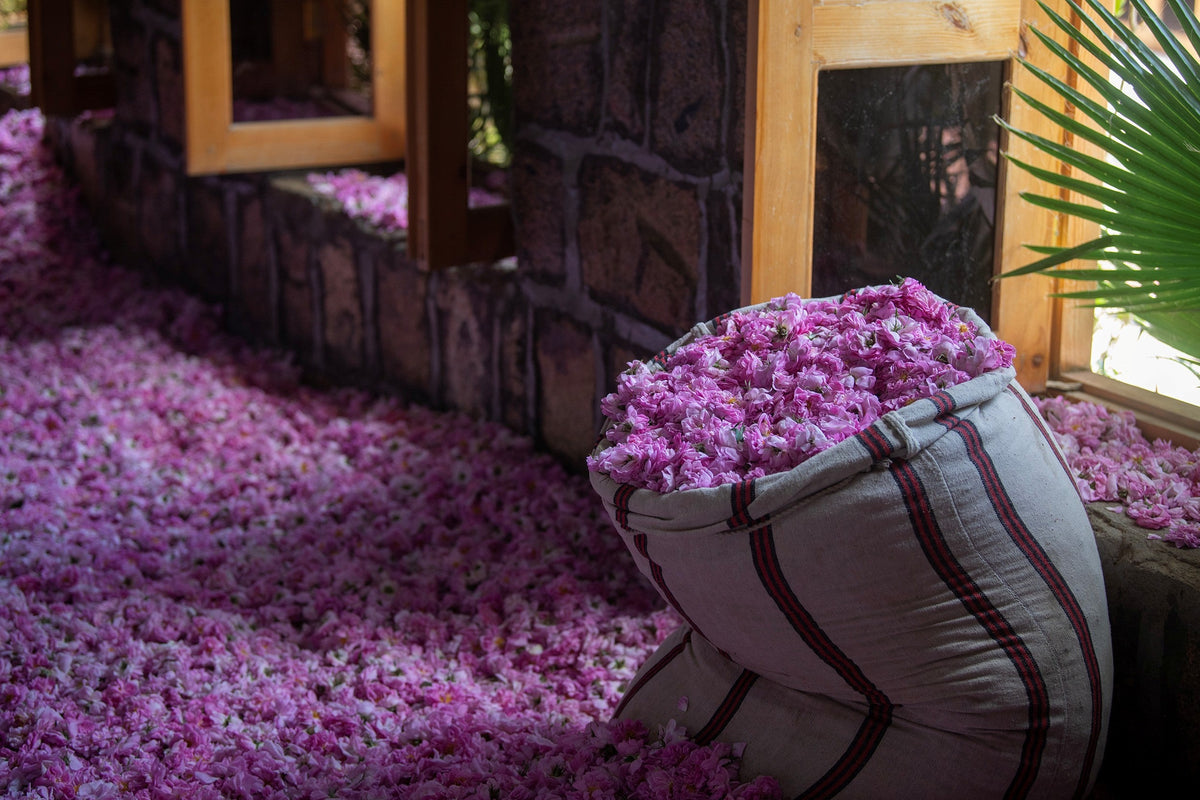
Taif rose season is spring. The harvest begins in March; the flowers are picked in the early morning, then made into rose water and rose oil [5].
Jasmine and Arabian jasmine (full)
Two kinds of jasmine come up most often in perfumery: large-flowered jasmine (Jasminum grandiflorum) and Arabian jasmine (Jasminum sambac), the local full for which the Jazan region is known [11] [6] [7].
The large-flowered jasmine does not make its scent compounds at a steady rate; this changes between night and day, and capturing its scent in an extract is hard [7]. So the scent of its extract may not match the scent of the flower on the branch.
Orange blossom: three scents from one tree
The bitter orange tree (Citrus aurantium) gives three different oils: neroli oil from the blossom, oil from the leaves, known in perfumery as petitgrain, and peel oil from the fruit [8].
So if you see "bitter orange" in a perfume description, the name alone does not tell you which part of the tree is meant, and each part gives an oil of different composition: peel oil is mostly limonene, blossom oil is mostly linalool, and leaf oil is richer in linalool than blossom oil, according to an analysis of oils from bitter orange trees in Greece [8].

Fruit, between floral and fresh
Fruity scents sit between floral and fresh, so much so that some classifications count them in the fresh family [3]. We lean towards them in spring, especially in April, with a light flower such as orange blossom.
How do you move your perfume from winter to summer?
Move in stages, according to the month and your city.
In Riyadh and Dhahran the minimum in March stays around 15°C and evenings are still pleasant, so we advise flowers for this month, and a little winter warmth in the evening, such as amber or musk, does no harm, or your winter perfume, which usually still suits the evening, as long as you use less of it during the day. In April the maximum reaches about 33 to 34°C, so choose lighter flowers, such as orange blossom, with citrus or fruit. May is summer by the numbers, with a maximum of nearly 40°C [1], so move to summer notes.
In Jeddah and Jazan the heat starts in March, so in both cities begin with light summer perfumes from the start of spring, and if you want flowers, choose the lightest. Abha has the longest spring of the five cities, with a maximum of 29°C in May [1], so flowers work there for the whole of spring, your winter perfume usually still suits its March evenings, and summer perfumes can wait until after spring.
The higher the temperature, the more of a perfume evaporates [9], so its opening can be expected to seem stronger and shorter-lived in May than in March. If your perfume seems weaker to you in May, the opening may have faded faster in the heat, or your nose may have grown used to its scent.
How do you test and wear a floral perfume?
- Wait about half an hour before you judge a floral perfume, because flowers often sit in the heart, and the heart only comes through once the opening fades [4].
- If you are sensitive to fragrance, read the ingredient list. In 2023, the European Union added named flower extracts, including Damask rose, jasmine, orange blossom and narcissus, to what must be listed in the ingredient list of cosmetic products when their concentration exceeds a set threshold [10].
- On dusty days, if you spend your time indoors, we advise a moderate amount of perfume.
- As summer approaches, do not leave perfume in the car, and keep it away from heat and light.
Read also
- Summer Fragrance Notes: How to Choose and Wear Perfume in the Heat
- Autumn Fragrance Notes: How to Choose Your Perfume in Saudi Weather
- Winter Fragrance Notes: How to Choose and Wear Perfume in Saudi Arabia
- Fragrance Families: A Guide to Perfume Scent Types and Their Classification
- How to Choose, Test and Apply Perfume: A Practical Guide
- Oriental Ingredients in Perfume: Oud, Amber, Saffron, Frankincense and Rose
References
- World Meteorological Organization. WMO Climate Normals for 1991–2020, Kingdom of Saudi Arabia: single station data sheets (Riyadh Old 40438, Dhahran 40416, Jeddah KAIA 41024, Gizan 41140, Abha 41112). NOAA NCEI archive, accession 0253808. Data for the Riyadh Old station cover 21 to 22 years of the period in the spring months, and for Dhahran 24 years. Data files. Accessed 6 October 2026.
- Albugami S, Palmer S, Cinnamon J, Meersmans J. Spatial and Temporal Variations in the Incidence of Dust Storms in Saudi Arabia Revealed from In Situ Observations. Geosciences. 2019;9(4):162. doi:10.3390/geosciences9040162. Accessed 6 October 2026.
- Zarzo M. What is a Fresh Scent in Perfumery? Perceptual Freshness is Correlated with Substantivity. Sensors (Basel). 2013;13(1):463–483. doi:10.3390/s130100463. PMC3574685. Accessed 6 October 2026.
- Rodrigues AE, Nogueira I, Faria RPV. Perfume and Flavor Engineering: A Chemical Engineering Perspective. Molecules. 2021;26(11):3095. PMC8196857. Accessed 27 September 2026.
- UNESCO Intangible Cultural Heritage. Cultural practices related to Taif roses. Representative List of the Intangible Cultural Heritage of Humanity, 2024 (19.COM). ich.unesco.org. Accessed 6 October 2026.
- Chen G, Mostafa S, Lu Z, et al. The Jasmine (Jasminum sambac) Genome Provides Insight into the Biosynthesis of Flower Fragrances and Jasmonates. Genomics, Proteomics & Bioinformatics. 2023;21(1):127–149. PMC10372924. Accessed 6 October 2026.
- Joulain D. Jasminum grandiflorum flowers—Phytochemical complexity and its capture in extracts: a review. Flavour and Fragrance Journal. 2021;36(5):526–553. doi:10.1002/ffj.3672. Accessed 6 October 2026.
- Sarrou E, Chatzopoulou P, Dimassi-Theriou K, Therios I. Volatile Constituents and Antioxidant Activity of Peel, Flowers and Leaf Oils of Citrus aurantium L. Growing in Greece. Molecules. 2013;18(9):10639–10647. doi:10.3390/molecules180910639. Accessed 6 October 2026.
- LibreTexts Chemistry. 13.8: Vapor Pressure. Introductory Chemistry (CK-12). Link. Accessed 27 September 2026.
- Commission Regulation (EU) 2023/1545 of 26 July 2023 amending Regulation (EC) No 1223/2009 as regards labelling of fragrance allergens in cosmetic products. Official Journal of the European Union. eur-lex.europa.eu. Accessed 6 October 2026.
- Saudi Press Agency (SPA). Arabian jasmine (full) has adorned the courtyards of Jazan homes for hundreds of years [in Arabic]. spa.gov.sa. Accessed 6 October 2026.
Cover photo: Saudi Press Agency (SPA), via Wikimedia Commons, licensed under CC BY-SA 4.0.

Prepared and edited by: Sedr Al-Khaleej Perfumes team
Last reviewed: 14 October 2026
Was this article helpful?
Leave a comment
Comments are reviewed before they appear. Your email address won’t be shown.