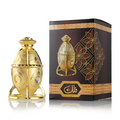
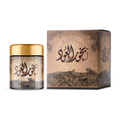
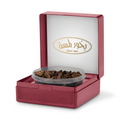
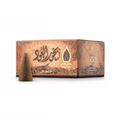
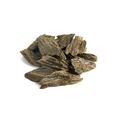
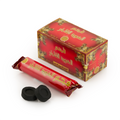
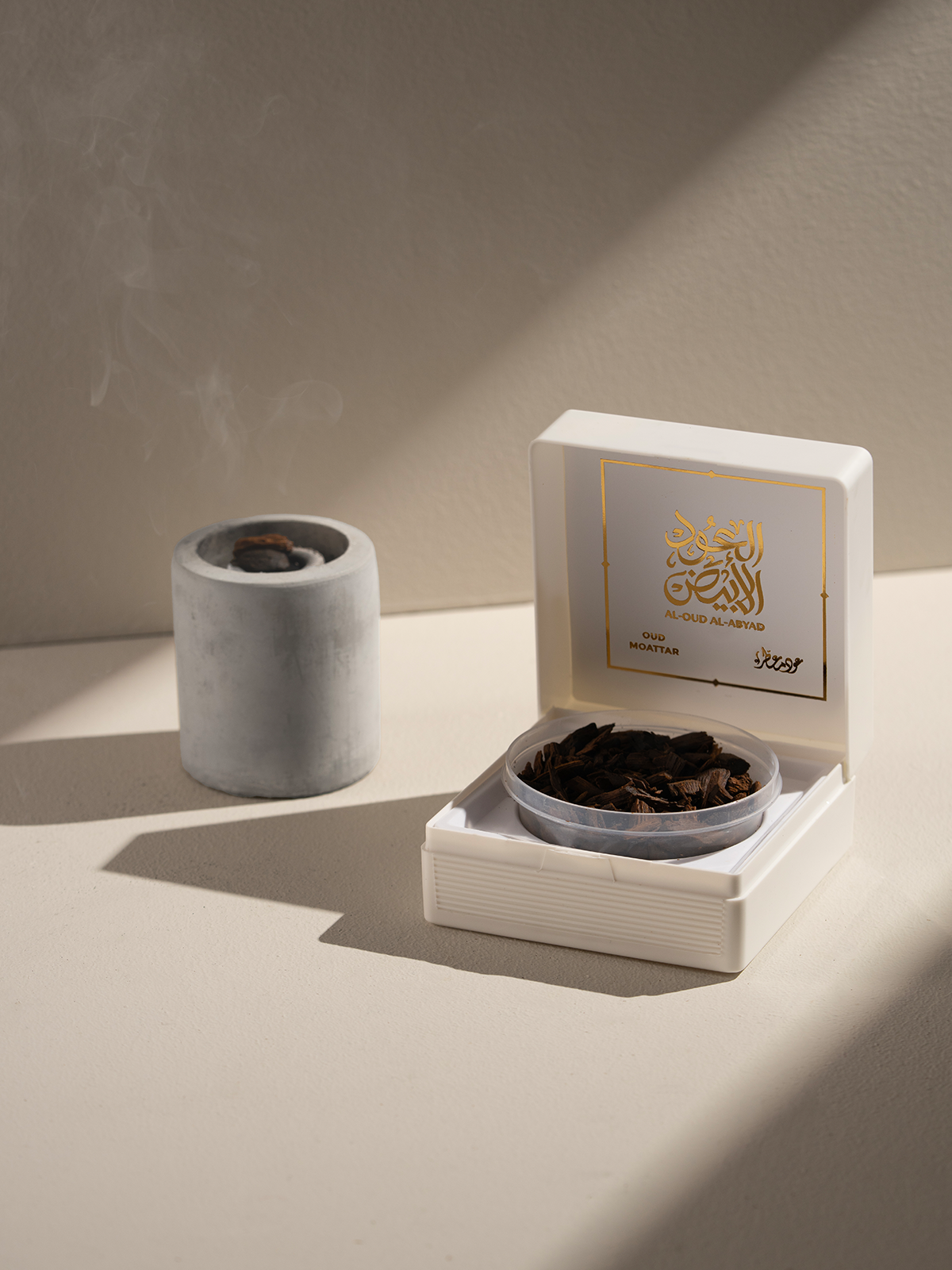
In short: Bakhoor, the Arabic word for incense, is an aromatic material that is burned or heated so its smoke can be smelled. Its best-known materials in the Gulf are oud (agarwood) and frankincense, along with prepared blends such as scented oud, maamoul and mabsous (local names for incense blends), and pyramid bakhoor. Oud is a wood in which aromatic resin forms after the tree is injured, and its international trade is subject to the CITES convention. Because bakhoor smoke carries fine particles and gases, we suggest a small amount, good ventilation, and an electric burner instead of charcoal when it is enough.
Table of contents
- What is bakhoor?
- Types of bakhoor by material
- Oud
- Frankincense
- Sandalwood and scent blends
- Types of bakhoor by form
- Natural, induced, enhanced and scented oud: what is the difference?
- How to burn bakhoor: charcoal or an electric burner?
- Safety and ventilation
- How to choose the right bakhoor
- Frequently asked questions
- Read also
- References
What is bakhoor?
Bakhoor is any aromatic material that is burned or heated so its smoke can be smelled. Most of it is made from gums, resins, wood powders, herbs and spices [1]. The exact composition of incense sticks is usually a trade secret [1].
In many Middle Eastern countries, including the Gulf, two broad kinds are burned: aromatic wood, either scented with oils or unscented, and natural resins such as frankincense [2].
Bakhoor comes in many forms: sticks, cones, coils, powders, and pieces placed on charcoal [1]. So in this guide we classify the types twice: by material, then by form.
Types of bakhoor by material
Oud
Oud, also called agarwood, is an aromatic wood from trees of the genera Aquilaria and Gyrinops [3]. A healthy tree does not produce this scent. The aromatic resin forms in its wood after a wound or an infection by insects or fungi [4] [5]. Because it forms rarely in the wild, it is now induced in cultivated trees by physical, chemical and biological methods [5].

The oud trade is ancient, more than two thousand years old, and its largest markets are in the Middle East and East Asia [4]. It is sold as pieces for burning, and oud oil is distilled from it [4] [3].
Its grades vary by resin content, specific gravity and color, and sometimes scent. The price per kilogram ranges from 100 to 100,000 US dollars depending on quality, according to a scientific review published in 2019 [4]. Grades are usually judged by experts by sight and smell, so some personal judgment remains [5]. Fake or adulterated woods are often sold on the market as cheaper oud [4].
Trees of both genera have been listed since 2005 in Appendix II of the Convention on International Trade in Endangered Species of Wild Fauna and Flora (CITES), because of heavy trade in them and their depletion in the wild. So their international trade is regulated [3] [4].
Frankincense
Frankincense, called luban in Arabic, is a gum resin from trees of the genus Boswellia. One of its most important species is Boswellia sacra, in Oman and Yemen [6]. It usually consists of 5 to 9% essential oil, 65 to 85% alcohol-soluble resin, and the rest water-soluble gums [6]. It has been burned as incense on charcoal for centuries [6].
In Dhofar, Oman, frankincense is sold in four commercial grades: Hoojri, Najdi, Shathari and Shaabi. Their prices are set by the color, size and texture of the pieces. One study found that Hoojri and Shaabi are similar in the composition of their oil, although their prices differ greatly [7].
Sandalwood and scent blends
Sandalwood is an aromatic wood from trees of the genus Santalum. Its oil is extracted from the heartwood of mature trees, and overexploitation has depleted its supply [8]. Sandalwood appears as a note in many of our bakhoor blends.
Much of the bakhoor on the market is blends: wood or powder with added aromatic oils. In incense sticks, for example, aromatic materials are estimated at about 35% by weight [1]. So we suggest reading a product's notes rather than relying on its name alone, because a name such as “Oud” may describe the character of the scent rather than what the product is made of.
Types of bakhoor by form
| Type | What it is | How to use it |
|---|---|---|
| Oud pieces | Pieces of oud wood in which the resin has formed [4] | On charcoal or an electric burner [2] |
| Scented oud | Pieces of wood saturated with aromatic oils [2] | On charcoal or an electric burner [2] |
| Enhanced oud | A trade description for which we found no standard definition in a scientific or regulatory reference. It may mean oud with something added to strengthen its scent | Ask the seller what was added to it |
| Maamoul | A compounded Arabian incense blend [1]; our store sells a pyramid-shaped maamoul | Follow the directions on the package |
| Mabsous | A local trade name for a type of incense blend | A small amount, following the directions on the package |
| Pyramid (cone) bakhoor | Bakhoor shaped as a cone or pyramid [1] | Follow the directions on the package |
| Incense sticks | A thin bamboo stick coated with the incense blend [1] | Light the tip and let it smoke |
| Frankincense | Pieces of resin from Boswellia trees [6] | On charcoal or an electric burner [2] |
These terms are local, and their meaning may vary from one country to another and from one shop to another. If you come across a name you do not know, ask the seller what it is made of and how to use it.
Natural, induced, enhanced and scented oud: what is the difference?
- Natural oud: wood in which the resin formed after the tree was wounded or infected in the wild [5].
- Induced oud: wood from cultivated trees that were deliberately wounded or treated so the resin forms in them. It is real oud, but its quality varies with the induction method. Traditional physical wounding usually produces oud of low quality and low yield [5].
- Enhanced oud: a trade description for which we found no standard definition in a scientific or regulatory reference. It may mean oud with something added to strengthen its scent, so ask the seller.
- Scented oud: pieces of wood saturated with aromatic oils [2], and its scent depends on the aromatic blend.

How to burn bakhoor: charcoal or an electric burner?
The traditional method is to place bakhoor on hot charcoal in an incense burner. The alternative is an electric burner that heats the bakhoor without charcoal.
In a study in which two types of Emirati bakhoor were burned in a 22-cubic-meter test chamber designed to simulate a living room, charcoal emissions were the main contributor to carbon monoxide and nitrogen oxides [9]. A Kuwaiti study recommended an electric burner instead of charcoal or an open flame [2]. So we suggest an electric burner when it is enough for your purpose.
If you use charcoal, we suggest the following:
- Light the charcoal in an open place, keep the room well ventilated while the embers are burning, and do not leave it in a closed room or a bedroom. The US CDC advises never burning charcoal indoors and fitting a carbon monoxide detector near sleeping areas [13].
- Place the burner on a stable, heat-resistant surface, away from curtains and out of children's reach.
- Start with a small piece of bakhoor, and add more if needed.
- Do not leave the charcoal unattended, and put it out completely after use.
Safety and ventilation
Bakhoor smoke, like all combustion smoke, carries fine particles and gases. These include carbon monoxide, nitrogen dioxide and sulfur dioxide, volatile organic compounds such as benzene, aldehydes, and polycyclic aromatic hydrocarbons [1]. This is what studies in the Gulf found:
- In a test chamber: the time-weighted averages of particulate matter, carbon monoxide and nitrogen oxides during the Emirati bakhoor test exceeded government regulatory values [9].
- In homes: in a survey of Emirati homes, 86% of residents of the homes surveyed were exposed to bakhoor at least once a week, and 44% every day. More frequent burning was associated with higher concentrations of fine and coarse particles in the home [10].
- In bakhoor shops: in a study in the Eastern Province of Saudi Arabia, respiratory symptoms such as wheezing were more common among bakhoor shop workers than in the comparison group, and exposure was also associated with impaired lung function. The sample was small (125 people) and the study was cross-sectional, so it shows an association, not a proven cause [11].
A Kuwaiti study suggested that incense use should not exceed 0.5–1 g per day [2]. These studies did not describe any amount as safe, and their recommendations point toward reducing exposure. We suggest the following:
- Ventilate the room while burning bakhoor, and reduce the time you spend in the smoke [1].
- Use a small amount, and avoid burning bakhoor for a long time in a small, closed or crowded room [2].
- If someone at home has asthma or a chest allergy, ask their doctor about burning bakhoor.
How to choose the right bakhoor
We suggest starting from the purpose:
- For the home: a lightly scented blend, in a small amount, on an electric burner.
- For guests and occasions: oud pieces, scented oud or maamoul, depending on the scent you prefer.
Then we suggest:
- Read the notes, not just the name: a name may describe the character of the scent rather than the material.
- Do not judge by price alone: oud grades are judged by sight and smell [5], and two grades of frankincense can be similar in composition yet differ greatly in price [7].
- Ask the seller where the oud comes from: adulterated woods are sold on the market [4].
- Try a small amount first: before you buy a large quantity.
Frequently asked questions
What is the difference between oud and bakhoor?
Oud is an aromatic wood from Aquilaria and Gyrinops trees [3]. Bakhoor is a broader term that covers oud, frankincense and prepared blends [1] [2].
Does every product called “Oud” contain oud wood?
Read the product's notes and ingredients, or ask the seller.
Is an electric burner better than charcoal?
We suggest it when it is enough for your purpose. In an Emirati study, charcoal emissions were the main contributor to carbon monoxide and nitrogen oxides [9], and a Kuwaiti study recommended an electric burner instead of charcoal [2]. It reduces some emissions but does not eliminate the smoke, so ventilation is still needed.
How should I store bakhoor?
In an airtight container, away from heat and light. The aromatic oils in it can be affected by heat, light and oxygen [12].
Read also
- Musk in Perfumery: Animal, Synthetic and Its Types
- The History of Perfume: From the Incense Route to Synthetic Materials
References
- Lin TC, Krishnaswamy G, Chi DS. Incense smoke: clinical, structural and molecular effects on airway disease. Clinical and Molecular Allergy. 2008;6:3. PMC2377255. Accessed 27 September 2026.
- Bu-Olayan AH, Thomas BV. Exposition of respiratory ailments from trace metals concentrations in incenses. Scientific Reports. 2021;11(1):10210. PMC8140077. Accessed 27 September 2026.
- Layola MRR, Sengupta S, Mallick B, Shil T, Shaw R, Banu F, Chakraborty S, Sardar S, et al. Phylogenetic analysis of the Critically Endangered Aquilaria khasiana (Thymelaeaceae) using barcode markers and chloroplast genome, with updated conservation status. Scientific Reports. 2025;15(1):21511. PMC12214818. Accessed 27 September 2026.
- Naziz PS, Das R, Sen S. The Scent of Stress: Evidence From the Unique Fragrance of Agarwood. Frontiers in Plant Science. 2019;10:840. PMC6646531. Accessed 27 September 2026.
- Shivanand P, Arbie NF, Krishnamoorthy S, Ahmad N. Agarwood—The Fragrant Molecules of a Wounded Tree. Molecules. 2022;27(11):3386. PMC9181942. Accessed 27 September 2026.
- Baeten J, Deforce K, Challe S, De Vos D, Degryse P. Holy Smoke in Medieval Funerary Rites: Chemical Fingerprints of Frankincense in Southern Belgian Incense Burners. PLoS One. 2014;9(11):e113142. PMC4229304. Accessed 27 September 2026.
- Al-Saidi S, Rameshkumar KB, Hisham A, Sivakumar N, Al-Kindy S. Composition and antibacterial activity of the essential oils of four commercial grades of Omani luban, the oleo-gum resin of Boswellia sacra Flueck. Chemistry & Biodiversity. 2012;9(3):615–624. doi:10.1002/cbdv.201100189. PMID: 22422529. Accessed 27 September 2026.
- Zha W, Zi J. Advances in biotechnological production of santalenes and santalols. Chinese Herbal Medicines. 2021;13(1):90–97. PMC9476758. Accessed 27 September 2026.
- Cohen R, Sexton KG, Yeatts KB. Hazard assessment of United Arab Emirates (UAE) incense smoke. Science of the Total Environment. 2013;458–460:176–186. doi:10.1016/j.scitotenv.2013.03.101. PMID: 23648447. Accessed 27 September 2026.
- Yeatts KB, El-Sadig M, Leith D, et al. Indoor Air Pollutants and Health in the United Arab Emirates. Environmental Health Perspectives. 2012;120(5):687–694. PMC3346777. Accessed 27 September 2026.
- Al Khathlan N, Al-Dabbus Z, Al-Khdir N, Al-Matar M, Al-Nusaif S, Al Yami B. Incense (bakhour) smoke exposure is associated with respiratory symptoms and impaired lung function among adults: A cross-sectional study in Eastern Province of Saudi Arabia. Indoor Air. 2021;31(5):1577–1582. doi:10.1111/ina.12833. PMID: 33826757. Accessed 27 September 2026.
- Turek C, Stintzing FC. Stability of Essential Oils: A Review. Comprehensive Reviews in Food Science and Food Safety. 2013;12(1):40–53. doi:10.1111/1541-4337.12006. Accessed 27 September 2026.
- Centers for Disease Control and Prevention (CDC). Carbon Monoxide Poisoning Basics. cdc.gov/carbon-monoxide/about. Accessed 27 September 2026.
Prepared and edited by: Sedr Al-Khaleej Perfumes team
Last reviewed: 27 September 2026
Was this article helpful?
Leave a comment
Comments are reviewed before they appear. Your email address won’t be shown.