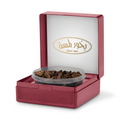
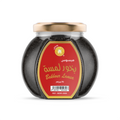
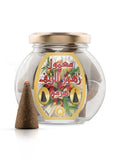
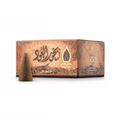
In short: In perfumery, the word "amber" means one of three things, and a fourth, fossil amber, is confused with them. Ambergris is a mass that forms in the rectum of the sperm whale, in about one whale in a hundred, and its smell turns pleasant after a long time at sea. The amber accord is a warm, sweet scent that the perfumer composes from vanilla and resins, and there is no whale in it. Ambrox is a synthetic material, the most prominent odorant in ambergris, and the two best-known ways of making it today are from a plant, and by a biotechnological route that starts with fermentation. Amber, the stone, is fossilized tree resin; in Europe it came to share the name of ambergris, and the two were confused. In the industry today the synthetic material has replaced ambergris, and in perfume descriptions the word also covers the accord.
Table of contents
- Three things, one name, and a fourth confused with them
- Ambergris: how it forms
- What the sea does to it
- Ambrein and what forms from it
- Ambergris among the Arabs
- Where does it come from? What the early authors said
- A name for the perfume and a name for the whale
- Fossil amber is not ambergris
- The amber accord in perfumes
- Ambrox: the smell of ambergris without the whale
- From clary sage to fermentation
- Is trade in ambergris allowed?
- How to read "amber" in a perfume description
- Frequently asked questions
- Read also
- References
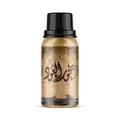
Three bottles on one shelf, and the description of each says "amber". The first is sweet and warm, with vanilla in it. The second is dry and clean, close to the smell of wood. The third is a heavy oil that its seller says comes from the sea. The three smells are nothing alike, yet the word is the same. The reason is that "amber" began as the name of a single material from the sea, and over the centuries translation and industry carried it to other things.
Three things, one name, and a fourth confused with them
Today the name covers an animal material, a fragrance accord and a synthetic material, as well as a fossilized resin that the European word "amber" also names.
| Name | What it is | Where it comes from |
|---|---|---|
| Ambergris | A waxy mass that forms in the rectum of the sperm whale | The sea and its shores |
| Amber accord | A composed scent, warm and sweet | Vanilla, resins and balsams, blended by the perfumer |
| Ambrox (synthetic ambergris) | A single material, the most prominent odorant in ambergris | The plant Salvia sclarea, or a biotechnological route that starts with fermentation |
| Amber, the stone | Fossilized tree resin, a gemstone | The ground, and the coasts of the Baltic Sea |

Ambergris: how it forms
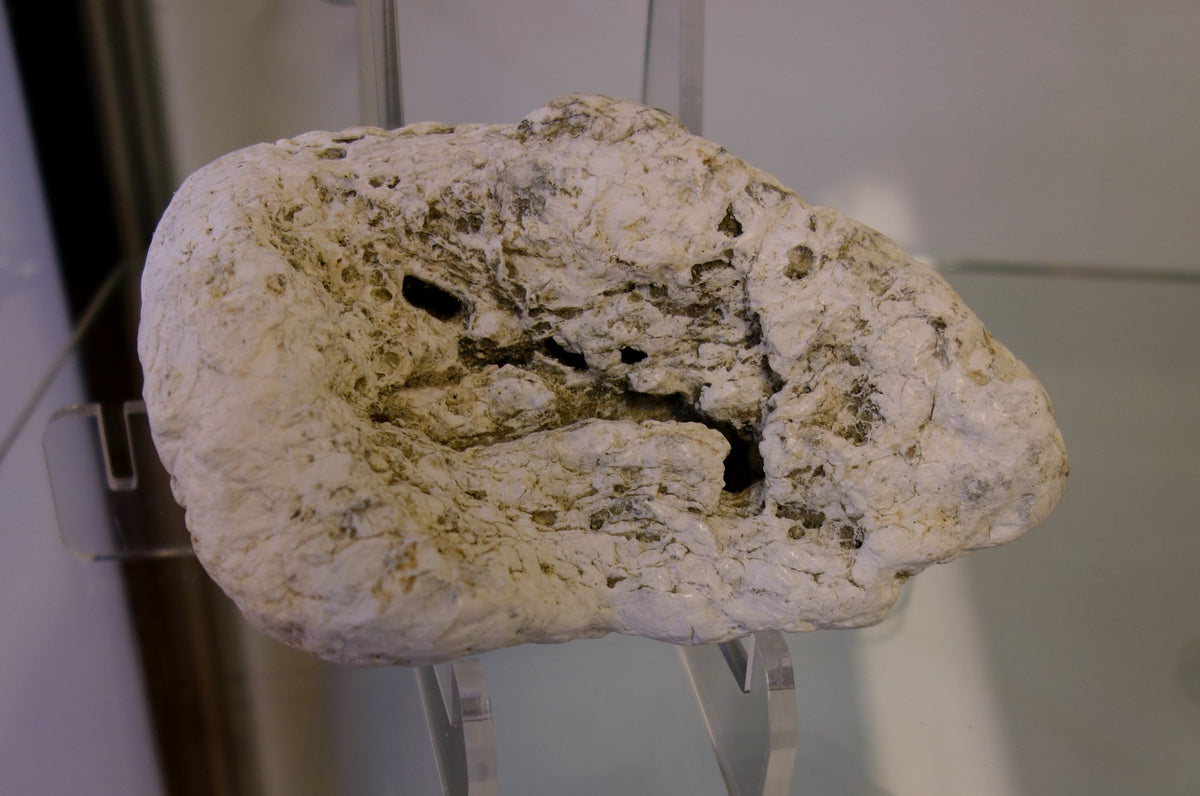
Ambergris forms in the rectum of the sperm whale, not in its stomach, and it is not vomit, as is commonly said [1]. The whale eats squid, and it normally vomits the parts it cannot digest, such as the beaks, so that only liquid feces reach its intestines. When some of those remains do leak into the intestines and obstruct the passage, they are pushed on to the rectum. There the feces build up around them, layer upon layer, until they form a smooth mass; then the waste begins to pass again, the cycle repeats, and the mass grows [1].
This happens in about one whale in a hundred, male or female, and ambergris has also been found in the pygmy sperm whale [1]. The mass is not a sign of disease in the whale and does not cause one, but it may grow until the rectum finally ruptures, and then the whale dies and the mass passes into the sea [1]. The largest mass on record weighed 455 kilograms and was sold in 1914 [1].
What the sea does to it
The ambergris that perfumers seek is not the fresh mass but one that has spent a long time at sea [3] [5]. The time is longer than was once thought. The usual figure was decades; then samples washed up on various shores were radiocarbon-dated, and some turned out to have been in the environment for about a thousand years [2].
Ambrein and what forms from it
The smell of ambergris does not come directly from its main constituent, but from what that constituent breaks down into. Ambergris contains a substance called ambrein, which by a common estimate makes up 25 to 45% of it [3], and reached about 68% in two samples analyzed in another study [4], along with 40 to 46% steroids related to cholesterol [3]. Under the action of seawater, air and sunlight, ambrein oxidizes and gives rise to smaller, volatile compounds, and these are what we smell [3] [4]. The yield of this conversion is small: in the laboratory only about 1% of the ambrein became odor compounds, and the yield reached 8 to 15% when visible light and photosensitizers were used [4].

Ambergris among the Arabs
The Arabs knew ambergris as a perfume before they knew where it came from. Ghaliya, a perfume containing ambergris and musk, is mentioned in pre-Islamic poetry, and one of the earliest mentions of ambergris concerns a gift (itawa, a tribute) carried from Yemen to the king of the Persians in the early seventh century CE [5]. In the ninth century, the physician Ibn Masawayh in Baghdad counted it as one of five principal perfume materials, with musk, oud, camphor and saffron, and it ranked after musk [5]. Nadd, a blended perfume, was made from it together with musk and camphor [5].
Where does it come from? What the early authors said
Arab authors disagreed about the origin of ambergris, and the best known of their accounts is that it comes from the seabed, either as a plant or as a substance that flows from springs there. Akhbar al-Sin wa-l-Hind (Accounts of China and India), a book of the ninth century, says that it grows on the seabed as mushrooms grow and is then cast up by the waves, and al-Mas‘udi followed it. Others said that it flows from springs in the sea as petroleum does, and al-Idrisi relates that Harun al-Rashid sent someone to ask the people of Aden about it, and that this was their answer. Ibn Masawayh mentioned a third account, that it is the dung of a sea creature, and Ibn Sina (Avicenna) and al-Idrisi rejected it [5].
Some linked it to the whale. Al-Jahiz and al-Ya‘qubi related that the whale swallows ambergris and dies, and that it is then taken out of its belly. Al-Jahiz mentioned that sailors and perfumers find birds' beaks in it, which modern researchers identify as squid beaks [5]. Al-Mas‘udi knew that what is taken out of the whale's belly is foul-smelling [5].
Most of it came from the Indian Ocean, from the coast of al-Shihr in southern Arabia and the Zanj coast in East Africa. The geographers of al-Andalus mentioned ambergris cast up on its coasts by the Atlantic Ocean. Al-Sirafi and al-Mas‘udi relate that the people of the Indian Ocean coasts trained camels to search for it at night by the light of the full moon, and that a camel would kneel when it found some; al-Mas‘udi attributed this specifically to the Mahri camels of the al-Shihr region [5].
They graded it by color: white and ashhab (ash-gray) at the top, black below them, and what they called mablu‘ ("swallowed") or samaki ("fishy") was unfit for perfume because of the smell of fish in it [5]. These grades are in fact ages, since the dark, foul-smelling mass becomes, with time at sea, the pale, fragrant one. The early authors did not know this, or did not mention it, so they counted them as two kinds [5].
A name for the perfume and a name for the whale
In Arabic, one word has long carried two meanings: ‘anbar is a name for the perfume and a name for the whale. The Arabic dictionary Taj al-‘Arus says that ‘anbar is a kind of perfume said to be the dung of a sea creature, and that ‘anbar is also a large fish whose skin is used to make shields [6]. The name survives in hut al-‘anbar (حوت العنبر), the Arabic name of the sperm whale.
Fossil amber is not ambergris
Fossil amber, called kahraman (كهرمان) in Arabic, is fossilized tree resin. It has nothing to do with the whale, and nothing to do with the sea except that the waves cast it up on the shore. The best known is Baltic amber, whose age, according to the most recent review of its dating, is between 34 and 37.7 million years [7].
The confusion between it and ambergris is European, not Arabic. The English word "amber" is taken from the Arabic ‘anbar, and it used to mean ambergris. In Europe its meaning then widened to include Baltic resin; this sense entered English around 1400 [8], and later became the main sense of the word [8]. That is why the French distinguished "gray amber" (ambre gris) from "yellow amber" (ambre jaune), and the word "ambergris" comes from the former [8]. The early Arabic sources do not appear to have confused the two: in them the resin has another name, kahruba (كهربا), and the confusion arose in Latin texts [5].
The confusion then came back to Arabic through translation. When the word "amber" in a perfume description is translated into Arabic as kahraman, readers take it to mean an ornamental stone, whereas what is meant is most often the amber accord. An oil is indeed distilled from Baltic amber, and it was in use as early as the seventeenth century [9], but it is not what the word means in perfume descriptions today.
The amber accord in perfumes
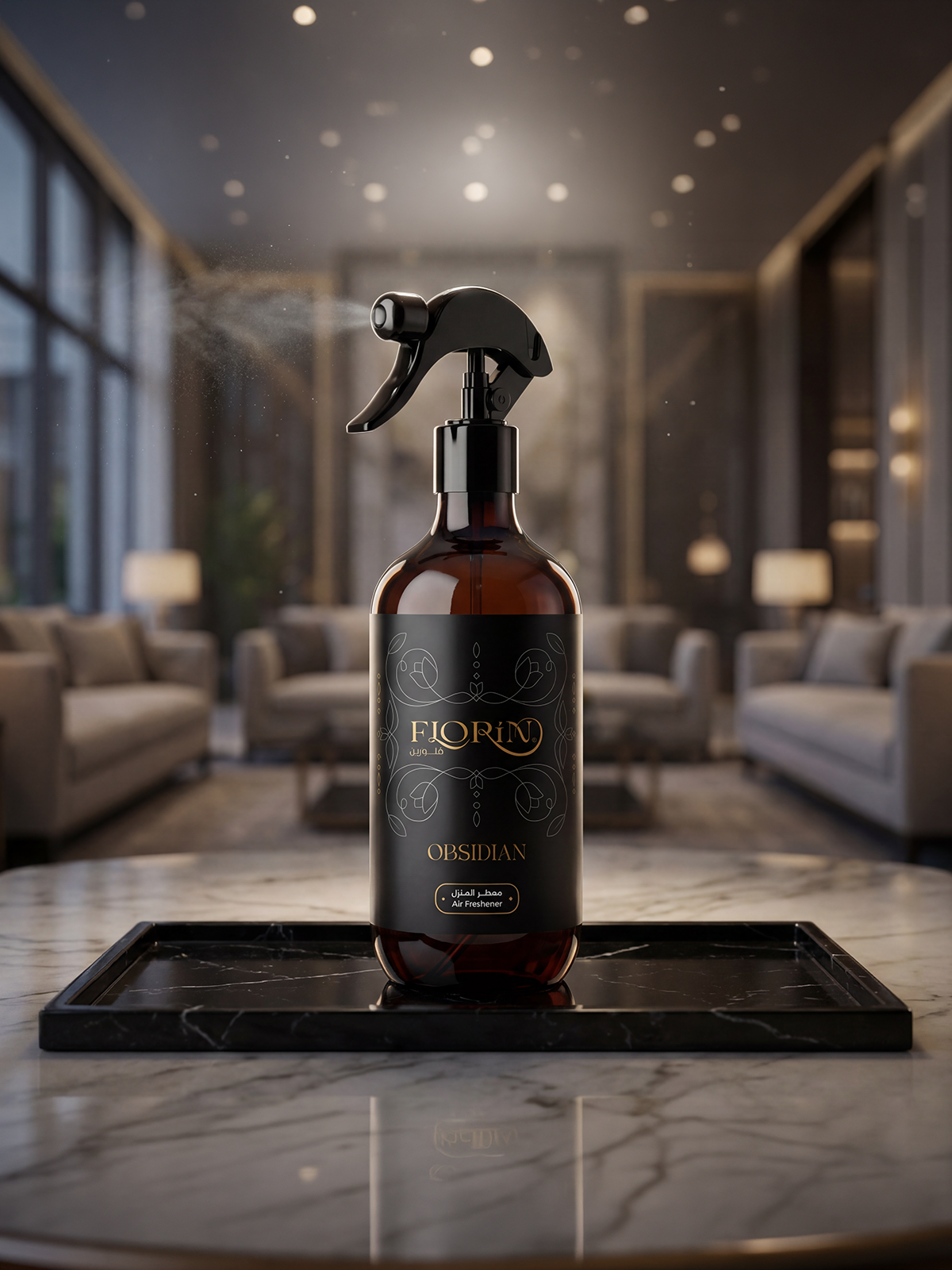
The industry now does without ambergris, using a synthetic material instead [3], and in perfume descriptions the word "amber" has come to cover an accord composed by the perfumer as well [9]. The accord is an old one in the industry. The French house de Laire launched a fragrance base called Ambre 83, built on synthetic vanillin with natural materials. Symrise, to which the house's bases passed, places it among the events of 1889 [15]. In 1931 a formula was published under the name Ambre Synthétique No 3, that is, "synthetic amber no. 3", and it is an accord, not a single material. It contains synthetic musk, vanillin, benzoin and tolu balsam, with a little incense, vetiver and patchouli leaf oil [9]. The French classification describes the amber family as soft and powdery, with vanilla, labdanum and pronounced animalic notes [10].
So the smell of this accord is sweet, warm and resinous, and it is not the smell of ambergris. In June 2021, the name Amber replaced Oriental in the Fragrances of the World classification; the details are in the article Fragrance Families. Those behind that classification acknowledge that the industry also uses the word as shorthand for ambergris and for a group of modern materials called "woody-amber", and they recommend more precise language so that the buyer is not confused [9].
Ambrox: the smell of ambergris without the whale
Ambrox is a single material, the most prominent odorant in ambergris, and today it is made without the whale [3] [11]. In the scientific literature it goes by other names, including ambrafuran and ambroxide [3], and on the market by trade names, including Ambroxan [18] and Ambrofix [12]. It is the material that has replaced ambergris in the perfume industry, because the sperm whale is a protected, threatened species [3].
From clary sage to fermentation
There are two well-known ways of making it today. The first starts from clary sage (Salvia sclarea), a plant of the sage genus from which a substance called sclareol is extracted and then converted chemically, in steps, into Ambrox [3]. The newer one is biotechnological, with an engineered enzyme doing the final step [11] [16]. Givaudan says that its method starts with the fermentation of sugar cane [12].
People differ in how well they smell this material; the details, and the source for them, are in the article Longevity, Sillage and Olfactory Adaptation.
Is trade in ambergris allowed?
The answer differs from country to country, and there is no single rule. The sperm whale is listed in Appendix I of CITES, the Convention on International Trade in Endangered Species [17]. Even so, a resolution of its Conference of the Parties states that urine, feces and ambergris "that has been naturally excreted" are waste products not covered by the provisions of the Convention [13]. The text of the resolution is limited to what has been naturally excreted, and it does not mention what is taken from inside the whale.
Some countries are stricter than that. In the United States, ambergris may not be collected, kept or sold, because the relevant authority regards it as a part of an endangered marine animal [14]. The regulations of other countries vary, so anyone who finds a piece or wants to trade in it should ask the relevant authority in their country before anything else.
How to read "amber" in a perfume description
The word alone does not tell you which of them it is; the clues around it do. If it comes with vanilla, resins and incense, or the perfume is described as warm and sweet, it is most likely the accord. If Ambrox or Ambroxan is mentioned, or the smell is described as dry and woody, it is most likely the synthetic material. Kahraman, in a perfume description translated into Arabic, is a rendering of the word "amber", which most often means the accord, not the stone.
Ambergris itself is rare, and the perfume industry today uses the synthetic material in its place [3]. A fragrance description is not a list of ingredients, because a note is the name of a smell that may be built from materials that do not carry its name, which is the subject of Perfume Ingredients: From Raw Material to Note. If the source matters to you, whether for animal protection or any other reason, ask the seller a specific question: is the "amber" here an accord, a synthetic material, or ambergris?
Frequently asked questions
Is ambergris whale vomit?
No. It forms in the rectum, at the end of the digestive tract, from remains that leak into the intestines and around which feces build up. The whale normally vomits what it cannot digest, and ambergris forms from the remains it does not vomit [1].
Are ambergris and fossil amber the same thing?
No, and they are not related. The first comes out of a whale, and the second is tree resin tens of millions of years old [7]. What joined them is the European word "amber"; in Arabic the resin has a name of its own [5] [8].
Does Ambroxan come from the whale?
No. It is one of the trade names of Ambrox, a material made from a plant or by a biotechnological route, and no whale goes into making it [3] [11] [18].
Why does "amber" smell completely different in two perfumes?
Because one may be a sweet accord of vanilla and resins, and the other a dry synthetic material close to ambergris. The industry calls both "amber" [9].
I found a lump on the beach. Can I sell it?
Ask the relevant authority in your country first. A resolution of the CITES Conference of the Parties counts naturally excreted ambergris among the waste products not covered by the provisions of the Convention [13], yet some countries, such as the United States, still prohibit collecting and selling it [14].
Read also
- Oriental Ingredients in Perfume: Oud, Amber, Saffron, Frankincense and Rose
- Musk in Perfumery: Animal, Synthetic and Its Types
- Fragrance Families: A Guide to Perfume Scent Types and Their Classification
- The History of Perfume: From the Incense Route to Synthetic Materials
References
- Clarke R. The origin of ambergris. Latin American Journal of Aquatic Mammals. 2006;5(1):7–21. doi:10.5597/lajam00087. Accessed 10 October 2026.
- Rowland SJ, Sutton PA, Knowles TDJ. The age of ambergris. Natural Product Research. 2019;33(21):3134–3142. doi:10.1080/14786419.2018.1523163. Accessed 10 October 2026.
- Ncube EN, Steenkamp L, Dubery IA. Ambrafuran (Ambrox™) Synthesis from Natural Plant Product Precursors. Molecules. 2020;25(17):3851. PMC7504449. Accessed 10 October 2026.
- Yamabe Y, Kawagoe Y, Okuno K, Inoue M, Chikaoka K, Ueda D, Tajima Y, Yamada TK, Kakihara Y, Hara T, Sato T. Construction of an artificial system for ambrein biosynthesis and investigation of some biological activities of ambrein. Scientific Reports. 2020;10:19643. doi:10.1038/s41598-020-76624-y. PMC7661701. Accessed 10 October 2026.
- Buquet T. De la pestilence à la fragrance. L'origine de l'ambre gris selon les auteurs arabes. Bulletin d'études orientales. 2016;64:113–133. doi:10.4000/beo.4692. Accessed 10 October 2026.
- Murtada al-Zabidi. Taj al-‘Arus min Jawahir al-Qamus (تاج العروس من جواهر القاموس). Entry ‘anbar (عنبر). Edited by Husayn Nassar, reviewed by ‘Abd al-‘Alim al-Tahawi and ‘Abd al-Sattar Ahmad Farraj. Kuwait: Ministry of Information (al-Turath al-‘Arabi series, 16), 1394 AH/1974 CE. Vol. 13, pp. 147–150. shamela.ws. Accessed 10 October 2026.
- Ross AJ, Bojarski B, Szwedo J. A critical review of the age of Baltic amber from the Samland Peninsula, Russia. Earth and Environmental Science Transactions of the Royal Society of Edinburgh. 2026:1–14. doi:10.1017/S1755691025100960. Accessed 10 October 2026.
- Online Etymology Dictionary. Amber; Ambergris. etymonline.com (archived at the Wayback Machine, 17 September 2026). Accessed 10 October 2026.
- Ilolahia C. From Oriental, to Amber: Why it was time to rename the Oriental fragrance families. Retail Beauty. Spring 2021:68–69. Fragrances of the World. fragrancesoftheworld.com. Accessed 10 October 2026.
- Société Française des Parfumeurs. Les familles olfactives. sfp-parfumeurs.com. Accessed 10 October 2026.
- Eichhorn E, Schroeder F. From Ambergris to (−)-Ambrox: Chemistry Meets Biocatalysis for Sustainable (−)-Ambrox Production. Journal of Agricultural and Food Chemistry. 2023;71(13):5042–5052. doi:10.1021/acs.jafc.2c09010. What is cited from it here comes from the article's abstract. Accessed 10 October 2026.
- Givaudan. Givaudan presents a new biotechnology approach for synthesising the most widely used biodegradable fragrance ingredient, Ambrofix. Press release, 30 October 2019. givaudan.com. Accessed 10 October 2026.
- CITES. Resolution Conf. 9.6 (Rev. CoP19): Trade in readily recognizable parts and derivatives. Paragraph 3 (b). Text of the resolution. Accessed 10 October 2026.
- NOAA Fisheries. Protected Species Parts. fisheries.noaa.gov. Accessed 10 October 2026.
- Symrise. Excellence in Perfumery. symrise.com. Accessed 10 October 2026.
- Eichhorn E, Schilling B, Bombrun A, Schroeder F. Sustainable (–)-Ambrox Production: Chemistry Meets Biocatalysis. CHIMIA. 2024;78(7–8):468–475. doi:10.2533/chimia.2024.468. Accessed 10 October 2026.
- NOAA Fisheries. Sperm Whale. fisheries.noaa.gov. Accessed 10 October 2026.
- He N, Yu H, Ye L. Efforts toward Ambergris Biosynthesis. Chem & Bio Engineering. 2024;1(2):91–98. PMC11835145. Accessed 10 October 2026.
Prepared and edited by: Sedr Al-Khaleej Perfumes team
Last reviewed: 14 October 2026
Was this article helpful?
Leave a comment
Comments are reviewed before they appear. Your email address won’t be shown.