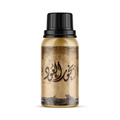
In short: What lingers of the scent of bakhoor (the Arabic word for incense) in a home is most likely what has clung to its walls, floors and other surfaces and is now evaporating from them again, as was found with wood smoke, and we see no need for thick smoke. Put a small amount on medium heat in an electric burner before you sit down or your guests arrive, keep the room ventilated while it is on, then close the windows if you like once you have switched it off and the smoke has cleared. Burning charcoal gives off carbon monoxide, so it should be used outside the home and never brought in while alight. Do not leave the incense burner unattended, keep it away from children, curtains and pets, and do not burn bakhoor in a room with birds. If you can no longer smell the scent, your nose may simply have grown used to it, so do not add more for that reason alone.
Table of contents
- What do we mean by making the scent of bakhoor last?
- How do you make the scent last in a room?
- The incense burner: electric or charcoal?
- The electric burner
- The charcoal incense burner
- Pyramid bakhoor
- How much bakhoor should you use? And for how many minutes?
- Scenting clothes and fabrics
- Ventilation: during burning and after
- Fire and charcoal safety
- Children, people with asthma and pets
- Children
- People with asthma and chest allergies
- Pets and birds
- Read also
- References
Shortly before guests arrive, a piece of oud goes on the charcoal and the windows are shut so the fragrance stays. The guest walks into a pleasant scent, sometimes with heavy smoke that stings the eyes, while the host can barely smell anything, because their nose has been used to the scent since the burning began.
What we want is a scent that stays after the smoke has gone, without burning charcoal in a closed room.
What do we mean by making the scent of bakhoor last?
We mean that the scent stays in the room after the incense burner has gone out and the smoke has cleared. What stays is most likely what has clung to the surfaces of the home, such as walls, floors and furnishings, and is now evaporating from them again, and with it come some of the compounds in the smoke, not the pleasant scent alone.
In an unfurnished test house whose surfaces were mostly painted walls and wooden floors, the surfaces absorbed the volatile compounds of wood smoke and then released them back into the air little by little, so they stayed in the house for days [1], and bakhoor smoke most likely behaves the same way. How long the scent of bakhoor lasts, though, has no documented figure that we know of, and it varies from one bakhoor to another and from one room to another.
The studies of bakhoor smoke that we read advise cutting down the amount and the time spent exposed to the smoke [2] [3], and we see no need for thick smoke to make the scent last.
How do you make the scent last in a room?
With a small amount and brief burning before you sit down, then by closing the windows if you like once the burner is off and the smoke has cleared. This is how we go about it:
- We start by airing out the room before burning so the bakhoor does not mix with cooking or other smells.
- Put the incense burner somewhere stable, on a surface that does not burn and out of the direct airflow of the air conditioner or fan, without closing up the room.
- Choose a scent that suits the space, a light one for a small room and a stronger one for a spacious majlis (reception room).
- Use a small amount on medium heat, follow the instructions for the burner and the bakhoor, and do not add more smoke in the hope of a longer-lasting scent.
- Burn before guests arrive or before you settle in the room, so you spend less time exposed to the smoke [3].
The incense burner: electric or charcoal?
Inside the home we choose an electric burner. Burning charcoal, by contrast, gives off carbon monoxide, a gas with no color or smell [4].
The electric burner
It heats the bakhoor without charcoal. Among people in Kuwait who were asked about their bakhoor burning, respiratory symptoms appeared with charcoal at a shorter daily burning time than with an electric burner, so the researchers recommended electric burners instead of charcoal [2]. An electric burner does not do away with the smoke, though, and symptoms appeared with it too when burning went on longer [2], so ventilate the room with it as well.
Many electric burners have more than one heat setting, and we use the medium one, unless the burner's maker specifies another.
The charcoal incense burner
If you use charcoal, light it and use it outside the home, somewhere open such as a courtyard, and do not bring it in while it is burning. Opening the windows is no substitute for this: the US CDC advises never burning charcoal indoors at all, and fitting a carbon monoxide detector near every sleeping area [4].
There, wait until the charcoal glows and its first smoke dies down, then put a small amount on it. Charcoal gives off carbon monoxide whether it is glowing red or gray [4], and when Emirati bakhoor was burned in a test chamber, charcoal emissions were the largest source of carbon monoxide and nitrogen oxides [5].
Most cases of carbon monoxide poisoning that reached the emergency department in Al Ain, in the UAE, between 2007 and 2009 came from charcoal burned in poorly ventilated dwellings, and almost all of them came in the winter months [6].
Pyramid bakhoor
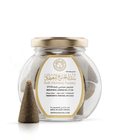
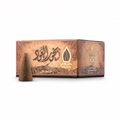
Pyramid bakhoor is lit and then burns on its own without charcoal. Follow the lighting method on its package, stand it on a heat-resistant base in a well-ventilated place, and do not leave it unattended, because it burns right down to the end. The closest thing to it that has been studied is bakhoor lit directly by a flame, and in Kuwait respiratory symptoms appeared with it at a longer daily burning time than with charcoal and a shorter one than with an electric burner [2].

How much bakhoor should you use? And for how many minutes?
The researchers in Kuwait suggested no more than 0.5–1 g of bakhoor a day, with burning cut right back in small, unventilated rooms [2]. None of the studies we reviewed describes any amount as safe; their recommendations all point toward less exposure [2] [3]. Start with a small amount, and add more only if you need to.
The eye cannot weigh what you put on the burner, so weigh it once on an accurate kitchen scale, whether it is a piece of oud or anything else, to know how much of it makes half a gram to a gram.
We prefer brief burning, a few minutes for the scent to spread, then switch off the electric burner. For a small, unventilated room, under about 15 square meters, the suggestion is to keep burning under 10 minutes a day, to reduce exposure and not as a safe limit [2]. Fine bakhoor burns faster than coarse [2].
The smoke has been found to have a stronger effect in smaller rooms, especially with more people in them and less ventilation [2]. In a large majlis, spread small amounts over several spots rather than a large amount in one.
If you can no longer smell the scent, do not add more for that reason alone. When a scent is constant, the nose gets used to it and senses it less, and the sense comes back once the scent stops [7]. So a person who burns bakhoor at home every day may get used to it and think it has faded, while a guest smells it the moment they walk in.
Scenting clothes and fabrics
For scenting clothes, ghutras (men's head cloths) and shaylas (women's scarves), we advise an electric burner, since it has no exposed charcoal. Hold the fabric above it at a distance, in a ventilated room, keep it moving rather than still, and do not let it touch the heating surface, or the charcoal if you are using charcoal. Keep the edge of a garment, ghutra or shayla away from the charcoal while you are wearing it.
Never cover the incense burner with fabric or leave fabric on top of it or next to it. When you are not scenting anything, keep clothing, covers and curtains at least about a meter from it, the distance recommended around heaters [8].
Ventilation: during burning and after
While the bakhoor is burning, ventilate the room and keep your exposure to the smoke short [3]. After the electric burner is off and the smoke has cleared, you may close the windows if you like, and what the room's walls, floors and furnishings give off stays in its air, along with some of the compounds in the smoke.
If the scent then becomes too heavy, opening the windows and doors lightens it right away, though it may come back to close to what it was once they are closed, because the surfaces of the home, such as walls and floors, release what they have absorbed, as was found with wood smoke [1]. Cleaning the home lasts longer: dusting, vacuuming and mopping the floors, and in that experiment the effect of cleaning lasted at least 12 hours [1].
Do not bring a lit charcoal burner into a room and then shut it to make the scent last, because the charcoal gives off carbon monoxide as long as it is burning [4].

If anyone in the room gets a headache, dizziness, nausea, weakness or confusion while charcoal is burning, these may be symptoms of carbon monoxide poisoning [4] [9]. The UK National Health Service (NHS) then advises stopping use of the source of the gas, leaving the place, getting medical advice quickly, and not going back until you have had that advice. It advises calling an ambulance if there is difficulty breathing, sudden confusion, loss of consciousness, weakness, or chest or muscle pain [9].
Fire and charcoal safety
Choose a heat-resistant incense burner and put it on a stable surface that does not burn, away from curtains, rugs and cushions [8] [10] and out of walkways. Do not leave it unattended, and put it out before going to bed or leaving the home [8] [10].
The main risks with an incense burner are burning charcoal close to something that can catch, and a burner left unattended. The recommendations here are those for heaters and open flames, which we apply to the incense burner.
Do not empty the ash from the burner or leftover charcoal until they have cooled completely; then put them in a metal container and keep the container away from the home [10]. Unplug an electric burner after use, and let it cool before you clean it.

Children, people with asthma and pets
We advise burning bakhoor when children and people with asthma are out of the room, and airing the space before they come back.
Children
Keep children about a meter from the incense burner, the distance recommended around open fires and space heaters [10], and do not put it where a child can reach it or trip over it.
In Oman, parents of children with asthma reported that bakhoor made wheezing worse in some of them [11]. Infants are more likely to be affected by carbon monoxide [4]. So do not burn bakhoor in a child's room or while the child is there.
People with asthma and chest allergies
If someone at home has asthma or a chest allergy, ask their doctor about burning bakhoor, and burn it while they are away; if they become short of breath after burning, know when to see a doctor and when to call an ambulance. People with breathing problems are more likely to be affected by carbon monoxide [4], which gives them more reason than anyone to stay away from charcoal.
Pets and birds
Do not burn bakhoor in a room with birds, keep cats and other animals away from the incense burner and its smoke, and never leave them alone near a lit one. If your pet shows respiratory symptoms, see a veterinarian.
Little has been measured in cats and dogs; what there is found that exposure to incense was more common among sick dogs, though it was not shown to be an independent risk factor [12]. Caged birds may be irritated or poisoned by aerosol sprays, perfumes, deodorizers and candles [13], though incense is not named among these.
Read also
- Types of Bakhoor: A Guide to Oud, Frankincense, Maamoul and Mabsous
- How to Choose Bakhoor and Oud for Home and Occasions
- How to Store Bakhoor, Oud and Oud Oil: A Storage Guide
- Harms of Perfume and Bakhoor: What the Evidence Says on Allergy and Smoke
- Why Doesn't Your Perfume Last? Longevity, Sillage and Olfactory Adaptation
References
- Li J, Link MF, Pandit S, Webb MH, Mayer KJ, Garofalo LA, et al. The persistence of smoke VOCs indoors: Partitioning, surface cleaning, and air cleaning in a smoke-contaminated house. Science Advances. 2023;9(41):eadh8263. doi:10.1126/sciadv.adh8263. PMC10575580. Accessed 3 October 2026.
- Bu-Olayan AH, Thomas BV. Exposition of respiratory ailments from trace metals concentrations in incenses. Scientific Reports. 2021;11(1):10210. doi:10.1038/s41598-021-89493-w. PMC8140077. Accessed 28 September 2026.
- Lin TC, Krishnaswamy G, Chi DS. Incense smoke: clinical, structural and molecular effects on airway disease. Clinical and Molecular Allergy. 2008;6:3. PMC2377255. Accessed 28 September 2026.
- Centers for Disease Control and Prevention (CDC). Carbon Monoxide Poisoning Basics. Last reviewed: 12 January 2026. cdc.gov/carbon-monoxide/about. Accessed 28 September 2026.
- Cohen R, Sexton KG, Yeatts KB. Hazard assessment of United Arab Emirates (UAE) incense smoke. Science of the Total Environment. 2013;458–460:176–186. doi:10.1016/j.scitotenv.2013.03.101. PMID: 23648447. Accessed 28 September 2026.
- Al Kaabi JM, Wheatley AD, Barss P, Al Shamsi M, Lababidi A, Mushtaq A. Carbon monoxide poisoning in the United Arab Emirates. International Journal of Occupational and Environmental Health. 2011;17(3):202–209. doi:10.1179/107735211799041940. PMID: 21905387. Accessed 3 October 2026.
- Dalton P. Psychophysical and Behavioral Characteristics of Olfactory Adaptation. Chemical Senses. 2000;25(4):487–492. doi:10.1093/chemse/25.4.487. PMID: 10944515. Accessed 3 October 2026.
- U.S. Fire Administration (USFA), FEMA. Heating Fire Safety (handout). usfa.fema.gov. Accessed 28 September 2026.
- NHS. Carbon monoxide poisoning. Last reviewed: 16 December 2025. nhs.uk. Accessed 28 September 2026.
- North Carolina Office of State Fire Marshal (OSFM). Heating. ncosfm.gov. Accessed 28 September 2026.
- Al-Rawas OA, Al-Maniri AA, Al-Riyami BM. Home exposure to Arabian incense (bakhour) and asthma symptoms in children: a community survey in two regions in Oman. BMC Pulmonary Medicine. 2009;9:23. doi:10.1186/1471-2466-9-23. PMC2693130. Accessed 28 September 2026.
- Lin CH, Lo PY, Wu HD, Chang C, Wang LC. Association between indoor air pollution and respiratory disease in companion dogs and cats. Journal of Veterinary Internal Medicine. 2018;32(3):1259–1267. doi:10.1111/jvim.15143. PMC5980393. Accessed 28 September 2026.
- Hoppes SM. Toxicoses of Pet Birds. Merck Veterinary Manual. Last reviewed: May 2026. merckvetmanual.com. Accessed 28 September 2026.
Prepared and edited by: Sedr Al-Khaleej Perfumes team
Last reviewed: 14 October 2026
Was this article helpful?
Leave a comment
Comments are reviewed before they appear. Your email address won’t be shown.