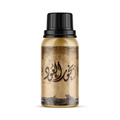
In short: Choose bakhoor (incense) for the place and the occasion before the name and the price. Oud pieces are for those who want the scent of the wood; scented oud and blends are for those who want a scent they know from its notes; and all of them suit the majlis and receiving guests. At home, burn a small amount, with ventilation, and on an electric burner if you have one. Before buying, read the notes, smell, ask the seller where the oud comes from, and try a small amount first. Do not judge by price or by color alone.
What are the types of oud? Oud for burning comes in three forms: oud pieces, which are the wood itself; scented oud, which is pieces of wood saturated with aromatic oils; and blends such as maamoul and mabsous, which often contain oud. On the market, the pieces are named after their countries, such as Indian, Cambodian and Indonesian oud, and the way traders rank them is a market preference, not a scientific standard. More on this in Where does oud come from? in our oud guide.
Table of contents
In many Gulf homes bakhoor is a weekly habit, and in some a daily one: 86% of the residents covered by a survey of Emirati homes were exposed to bakhoor smoke at home at least once a week, and 44% every day [1]. Even so, many people stand puzzled in front of the bakhoor shelf, torn between oud pieces named after countries at prices far apart, scented oud, maamoul and mabsous. The choice gets easier when you start from the place and the occasion, then look at scent and budget.
Oud pieces, scented oud or blends?
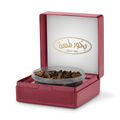
Three kinds of bakhoor are burned most in homes:
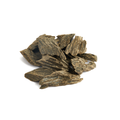
- Oud pieces: oud (agarwood) is an aromatic wood in which resin has formed after the tree was injured, and it is burned in pieces [2]. The pieces richest in resin are usually burned as they are, with no added perfume [3]. Its scent is the scent of the wood, and part of it appears only with heat: the vapor rising from heated oud contains aromatic compounds that are not present in the wood itself [4].
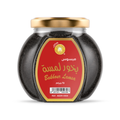
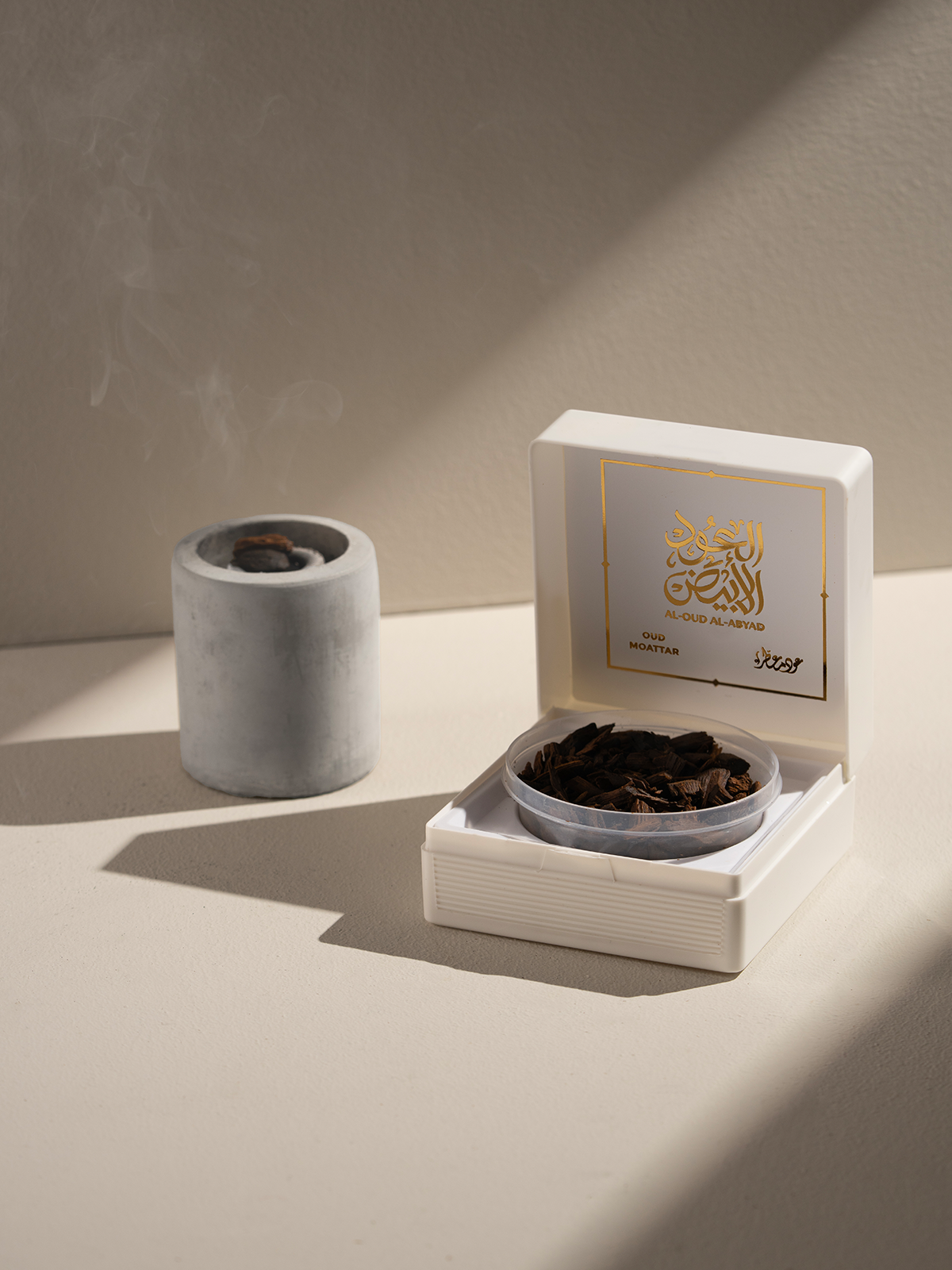
- Scented oud: pieces of wood saturated with aromatic oils [5]. It smells of the blend it was soaked in.
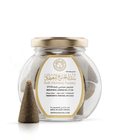
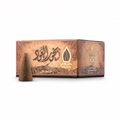
- Blends: such as maamoul and mabsous, some of which are shaped as a pyramid, known as pyramid (cone) bakhoor. These are mixed aromatic materials, each used in its own way, and they often contain oud with less resin alongside other aromatic ingredients [3].
These types and their materials are explained in detail in our guide Types of Bakhoor: A Guide to Oud, Frankincense, Maamoul and Mabsous.
Oud pieces are for those who want the scent of the wood, and they are our choice for occasions. Scented oud and blends are for those who want a specific scent they know from its notes.
On the market, oud pieces are named after their countries, such as Cambodian, Indian and Indonesian oud [6]. Oud production is concentrated in South and Southeast Asia [2], and its value depends in part on its quality and where it comes from [7]. Traders attribute a distinctive scent to the oud of each country, and in the UAE market they rank it by country, with Indian and Cambodian oud at the top [6]. But most of the volume in that market comes from Malaysia and Indonesia, and many of the country names likely work as trade names for a particular scent, look and price rather than as an accurate indication of where the oud came from [6]. We found nothing to show that oud from any one country is better for the home, so trust your nose, not the name of the country.
Start with the place
How much you burn depends on the size of the place, its ventilation and the number of people in it, and sometimes the type does too [5].

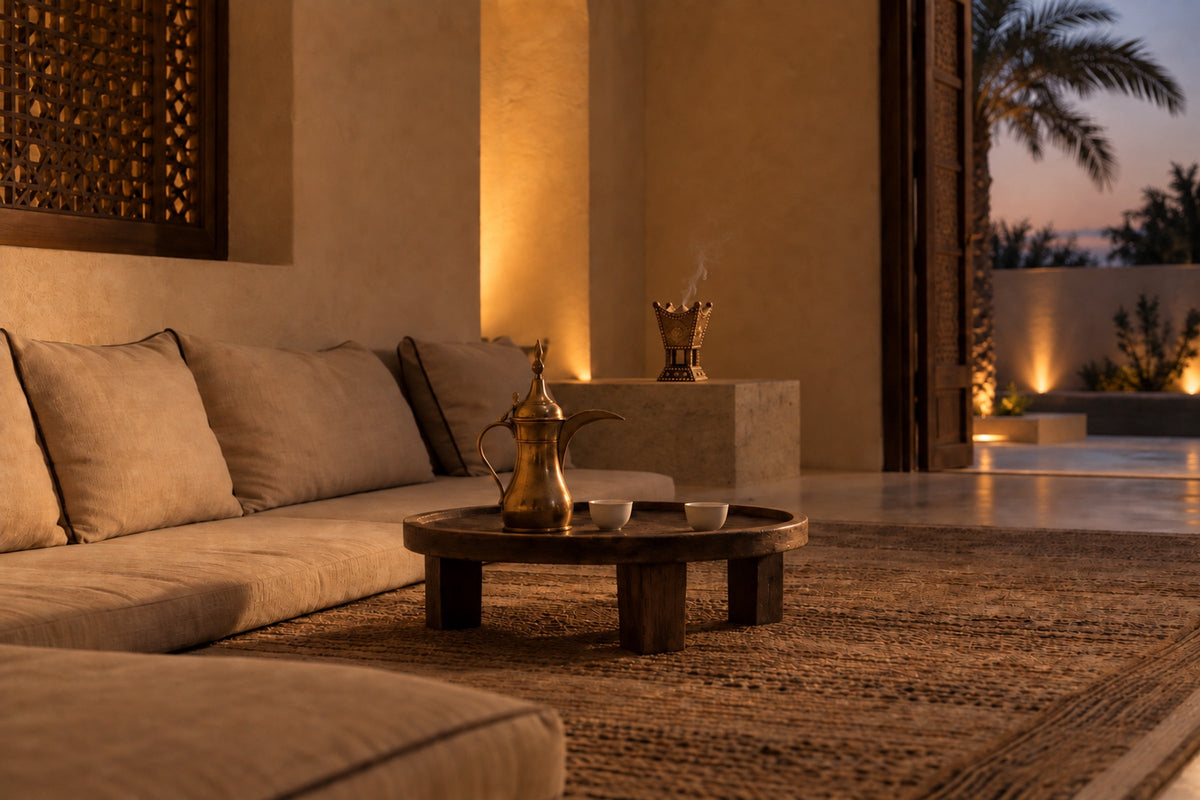
The majlis and receiving guests
For a spacious majlis (reception room) when guests are expected, we choose oud pieces, scented oud or maamoul. All of them work there, and what decides between them is the scent you prefer. Start burning shortly before the guests arrive, with ventilation, so that the smoke and the guests do not fill the room at the same time.
In the UAE market, buyers prefer large pieces for occasions where a lot of bakhoor is burned to honor many guests, even though they do not regard the size of a piece as a sign of its quality [6].
Rooms and small spaces
Smoke appears to have a stronger effect in a small room, especially with more people in it and less ventilation [5]. The advice, then, is to reduce the amount and the exposure time and to burn far less in small rooms that are not ventilated, with a suggested limit of 0.5–1 gram of bakhoor a day [5]. So in a room, burn a small piece for a short time, with the window open.
Do not leave the burner on in the bedroom while you sleep, especially a charcoal burner: burning charcoal gives off carbon monoxide, a gas with no color or smell, and a sleeping person can die from carbon monoxide poisoning before showing any symptoms [8].
Large spaces
In a large space, spread small amounts over more than one spot, or burn in stages. To our mind that is better than a large amount in a single burner.
By occasion
Choosing for an occasion is mostly a matter of taste, and this is where ours leans. For visitors at home, scented oud or a blend whose scent the household already knows; if you use an air freshener alongside it, pick one that does not clash. In the morning, a light floral or citrus scent, and in the evening something warmer, such as oud, amber and musk. For a formal occasion, a calm scent that does not overpower the space, and for a celebration a more noticeable one.
At Eid, in Ramadan and on Fridays, family and guests spend long hours at home, so burn for a shorter time and use less.
If you are giving bakhoor as a gift, choose a type the recipient knows how to use. Someone without a charcoal burner may be better served by a type that goes on an electric burner, if they have one, or a type that is lit directly without charcoal.
At weddings and wedding celebrations: if the venue is large and there are many guests:
- Try the bakhoor before the celebration in a place similar to the venue, to find the right amount.
- Start burning shortly before the guests arrive.
- Spread moderate amounts over more than one spot and at intervals during the celebration, and air the space between rounds.
- Set the burners securely, away from fabrics, dresses and the reach of children.
Light or strong scent, and less smoke
Bakhoor smoke is like any combustion smoke: it carries fine particles and gases [9]. Homes where bakhoor is burned more often have more fine and coarse particles in the air, and measurable formaldehyde is about three times more likely to be found in those that burn it twice a week or more [1]. That is why we control the scent through the amount and the time, not by adding more smoke.
For a clearer scent with less smoke:
- Put the electric burner ahead of charcoal. When bakhoor is burned on charcoal, the charcoal is the main source of the carbon monoxide and nitrogen oxides given off [10], and charcoal burners have been associated with respiratory symptoms at shorter burning times than electric burners or direct flame [5]. An electric burner does not eliminate the smoke, so open the window with it too.
- Use less [5]: start with a small piece and add more when needed.
- Go easy on bakhoor saturated with a high concentration of oils. After burning, scented bakhoor holds on average about three times the metallic elements of unscented bakhoor, in what has been measured of bakhoor from the Kuwaiti market, and this is put down to what is added to it [5].
- Ventilate the space while burning, and do not linger in the smoke [9].
If someone at home has asthma or a chest allergy, ask their doctor about burning bakhoor. The Emirati survey showed no consistent pattern between bakhoor burning and respiratory symptoms, though households with someone with asthma burned bakhoor less [1]. The evidence is covered in detail in our guide Harms of Perfume and Bakhoor: What the Evidence Says on Allergy and Smoke, and safety and ventilation in our guide Types of Bakhoor.
By budget
Prices of oud pieces are very far apart: a kilogram costs anywhere from 100 to 100,000 US dollars depending on quality [2].
So decide on your purpose before you buy. Everyday home fragrance does not call for the most expensive oud pieces; a little of a type whose scent you like does the job, and when the budget is tight we save oud pieces for occasions. If you want oud pieces, start with a small amount of more than one grade, and compare them before buying a large quantity.
Signs that help you before buying
- Read the notes, not just the name: the name may describe the character of the scent rather than what the product is made of. The notes describe the scent as its maker presents it; what they mean is explained in our guide Perfume Ingredients: From Raw Material to Note.
- Smell before you buy: scent is the main thing oud buyers in the UAE market judge by. Traders there regard oud richer in resin as better. They say lower-quality oud smells more like plain wood and may irritate the nose and eyes more when burned, and that good oud burns slowly and evenly, so its scent lasts longer [6].
- Do not judge by price alone: oud grades vary by resin content, specific gravity and color, and sometimes scent [2]. Experts usually grade them by sight and smell, which leaves room for personal judgment [7].
- Do not judge by color alone: traders link the color of oud to the age of the tree and the amount of resin, but pieces on the market are usually polished, and often colored to look darker [6].
- Size is not a sign of quality: the same grade includes large and small pieces. Thickness can be one: very thin pieces usually come from the outer layer of the trunk, and burn faster with a scent closer to plain wood [6].
- Ask the seller where the oud comes from: fake or adulterated woods are often sold on the market as cheaper oud [2]. Forms of adulteration described by traders in the UAE include low-grade oud coated with oud powder mixed with wax and then heated, and low-grade oud or substitute wood soaked in a mixture of oud oil and alcohol [6].
- Ask what trade descriptions mean: such as "enhanced", since we found no standard definition for them in a scientific or regulatory reference.
- Try a small amount first: before you buy a large quantity, and in the place where you will use it.
Burning tools and steps
You need a stable incense burner and tongs to move the charcoal, or an electric burner that heats the bakhoor without charcoal.
Burning charcoal gives off carbon monoxide, and the US CDC advises never burning it indoors [8]. If you do use it, follow these steps:
- Light the charcoal in a well-ventilated place until it glows red.
- Put it in the burner, and wait a little until its first smoke settles.
- Put a small amount of bakhoor on the charcoal, and add more when needed.
- Place the burner on a stable, heat-resistant surface, away from curtains and the reach of children.
- Do not leave burning charcoal unattended, and put it out completely after use.
With an electric burner, add a small amount once it has heated up. Some bakhoor is lit directly, with no charcoal or electricity: you set the bakhoor itself alight, and the burning then spreads through the rest of it [5]. Follow its maker's instructions, and place it on a heat-resistant base.

Frequently asked questions
What is the best bakhoor for the home?
No single type suits every home. Take whatever scent you like and burn a little of it, and less still if it is saturated with oils [5].
Should I choose oud pieces or scented oud?
If you want the scent of the wood, oud pieces, bearing in mind how widely their grades and prices vary [2]. If you want a specific scent you can read in the notes, scented oud, which is wood saturated with aromatic oils [5].
What does "enhanced oud" mean?
A trade description with no standard definition that we know of. Ask the seller what it means for their product.
How often should I burn bakhoor at home?
None of the studies we consulted describes any amount as safe, and one of them suggests no more than 0.5–1 gram a day [5]. Headaches and difficulty concentrating are more common among people who burn bakhoor every day than among those who burn it once a week or less [1], though that is an association and does not prove cause. Less is better: fewer times, and for a shorter time.
Read also
- Types of Bakhoor: A Guide to Oud, Frankincense, Maamoul and Mabsous
- Oud (Agarwood): A Reference Guide to Its Formation, Types, Oil and Trade
- Bakhoor Ingredients: What It Is Made Of and How to Read Its Label
- Harms of Perfume and Bakhoor: What the Evidence Says on Allergy and Smoke
- Musk in Perfumery: Animal, Synthetic and Its Types
- The History of Perfume: From the Incense Route to Synthetic Materials
References
- Yeatts KB, El-Sadig M, Leith D, et al. Indoor Air Pollutants and Health in the United Arab Emirates. Environmental Health Perspectives. 2012;120(5):687–694. PMC3346777. Accessed 5 October 2026.
- Naziz PS, Das R, Sen S. The Scent of Stress: Evidence From the Unique Fragrance of Agarwood. Frontiers in Plant Science. 2019;10:840. PMC6646531. Accessed 27 September 2026.
- López-Sampson A, Page T. History of Use and Trade of Agarwood. Economic Botany. 2018;72(1):107–129. doi:10.1007/s12231-018-9408-4. Open-access text: researchonline.jcu.edu.au/58720. Accessed 28 September 2026.
- Takamatsu S, Ito M. Agarotetrol: a source compound for low molecular weight aromatic compounds from agarwood heating. Journal of Natural Medicines. 2018;72(2):537–541. doi:10.1007/s11418-018-1185-y. PMID: 29464509. Accessed 3 October 2026.
- Bu-Olayan AH, Thomas BV. Exposition of respiratory ailments from trace metals concentrations in incenses. Scientific Reports. 2021;11(1):10210. PMC8140077. Accessed 5 October 2026.
- Antonopoulou M, Compton J, Perry LS, Al-Mubarak R. The Trade and Use of Agarwood in the United Arab Emirates. TRAFFIC Southeast Asia; 2010. TRAFFIC. Accessed 5 October 2026.
- Shivanand P, Arbie NF, Krishnamoorthy S, Ahmad N. Agarwood—The Fragrant Molecules of a Wounded Tree. Molecules. 2022;27(11):3386. PMC9181942. Accessed 27 September 2026.
- Centers for Disease Control and Prevention (CDC). Carbon Monoxide Poisoning Basics. Last reviewed: 12 January 2026. cdc.gov/carbon-monoxide/about. Accessed 5 October 2026.
- Lin TC, Krishnaswamy G, Chi DS. Incense smoke: clinical, structural and molecular effects on airway disease. Clinical and Molecular Allergy. 2008;6:3. PMC2377255. Accessed 5 October 2026.
- Cohen R, Sexton KG, Yeatts KB. Hazard assessment of United Arab Emirates (UAE) incense smoke. Science of the Total Environment. 2013;458–460:176–186. doi:10.1016/j.scitotenv.2013.03.101. PMID: 23648447. Accessed 27 September 2026.
Prepared and edited by: Sedr Al-Khaleej Perfumes team
Last reviewed: 14 October 2026
Was this article helpful?
Leave a comment
Comments are reviewed before they appear. Your email address won’t be shown.