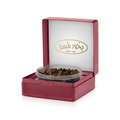
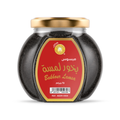
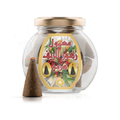
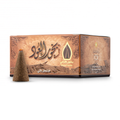
In brief: Pyramid bakhoor is a piece of incense blend shaped into a cone. You light its tip with a flame and put the flame out, and a small ember stays in the tip, working its way down the piece and giving off smoke, with no charcoal and no burner. The closest blend to the cone's that has been described is that of incense sticks, usually aromatic materials, sawdust and a binder, with charcoal powder or potassium nitrate. Place it on a heat-resistant base on a stable surface, away from curtains and papers, and stay with it until it finishes, in a ventilated room that is not small and closed.
Table of contents
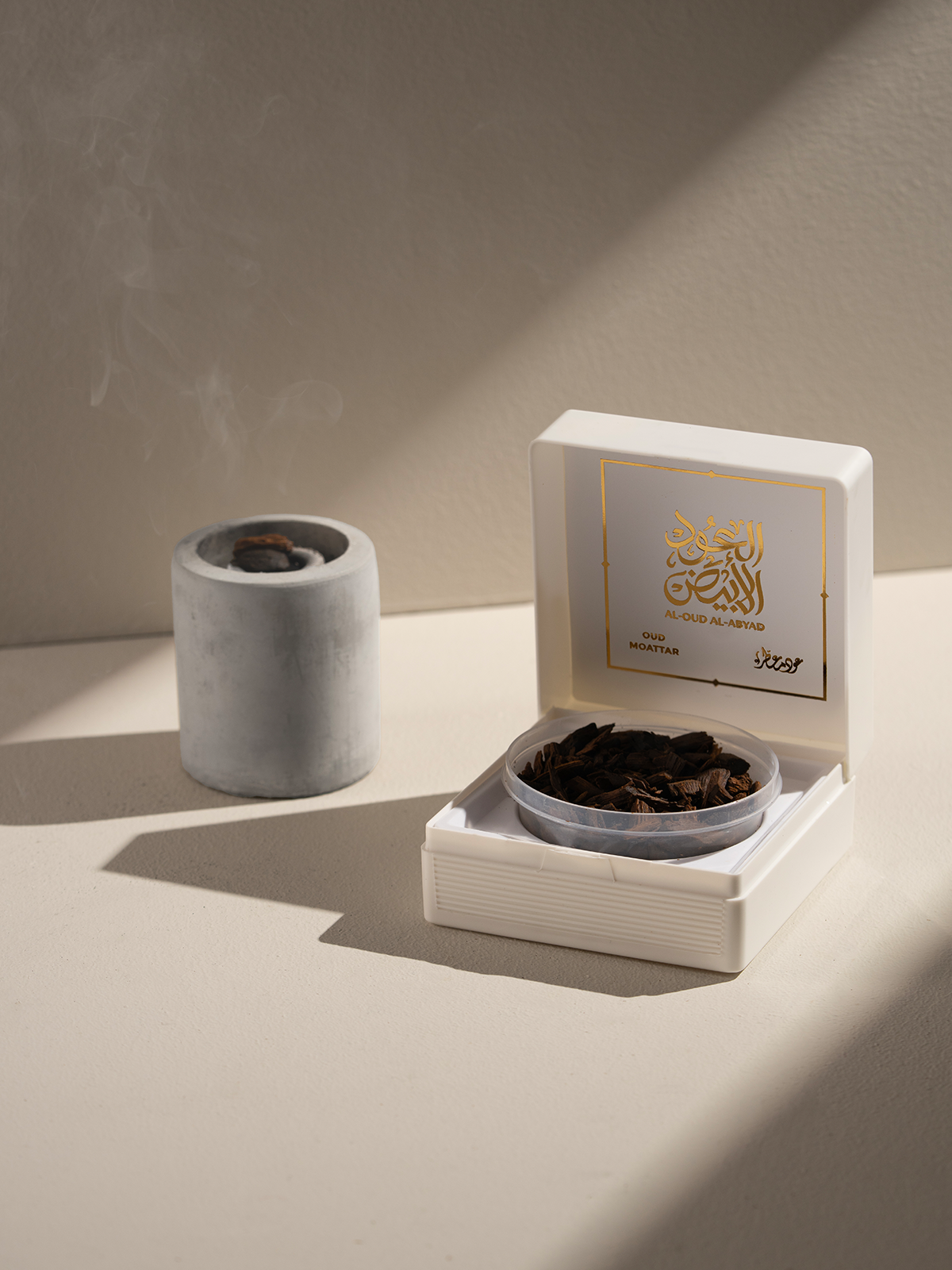
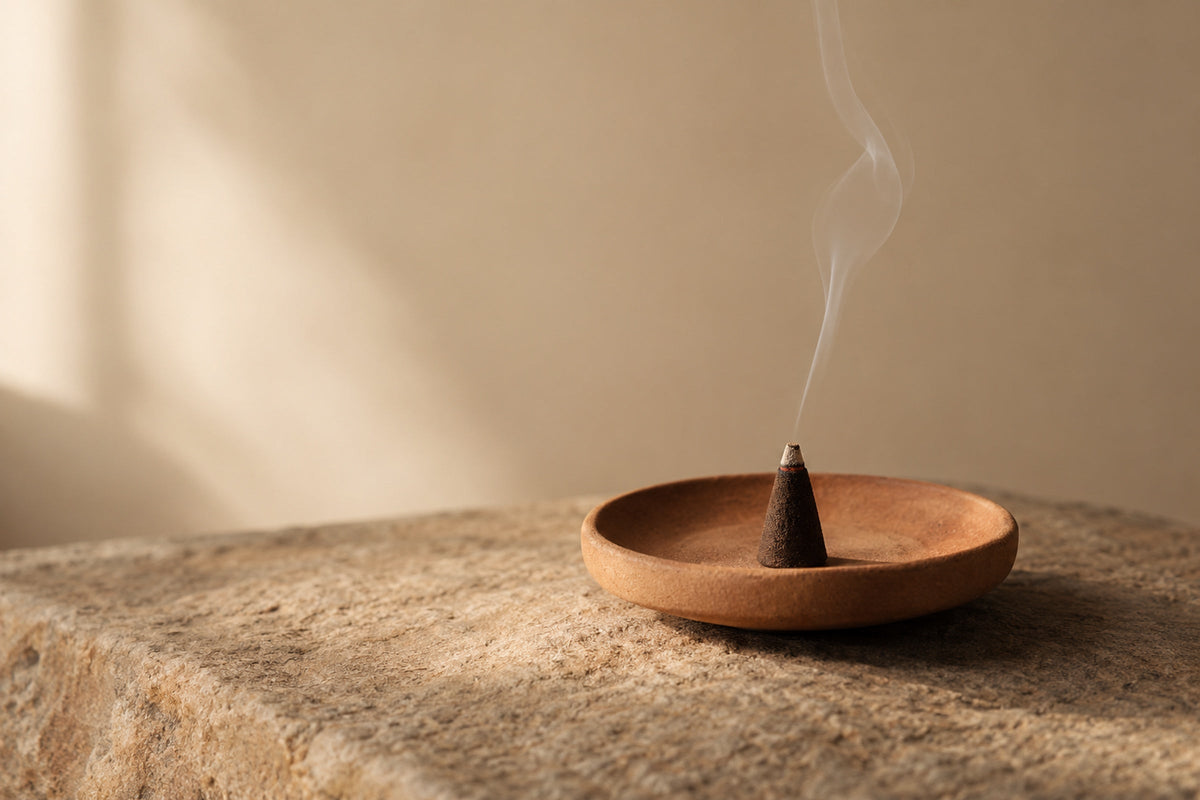
On a small clay dish sits a piece of incense the size of a fingertip, with a pointed tip. A flame is brought to the tip and then blown out, leaving a small glow from which a thin thread of smoke rises. There is no charcoal here and no burner. The glow works its way down on its own, little by little, until nothing is left of the piece but ash.
What is pyramid bakhoor?
Pyramid bakhoor is cone incense under another name: a small piece of incense blend with a wide base and a pointed tip. The cone is one of many forms incense comes in, alongside sticks, coils and powders [1].
Why does it burn without charcoal?
Because the ember left in its tip after the flame is put out works its way down the piece on its own. Arabian bakhoor in its usual form generally needs lit charcoal, while some forms of incense burn on their own [2], and the cone is one of them.
What happens after the flame is put out is called smouldering, or flameless combustion: a slow, low-temperature burn that takes place on the surface of the solid material, where oxygen reaches it, as in glowing charcoal and a cigarette [3]. Its heat is much lower than that of a flame, but it is still the heat of a real ember [3]. Combustion of this kind, in materials generally, is incomplete, so it gives off a higher proportion of irritant gases and particles than flaming combustion, and the ash left behind is the mineral matter that does not burn [3].
The closest thing to its blend that has been described is the incense stick, which also burns on its own. It typically contains herbal and wood powder, aromatic materials and an adhesive powder that holds the blend together [1], usually with charcoal powder or potassium nitrate [2]. The exact formula, including the binders and what helps the blend burn, differs from one maker to another.
How does it differ from maamoul, mabsous and oud?
The main difference is how it is burned: some incense is set alight directly, and some is heated with charcoal or electricity [4].
| Type | How it is burned | Does it need charcoal or a burner? |
|---|---|---|
| Pyramid bakhoor | The tip is lit with a flame, then the flame is put out and it burns on its own | No, a heat-resistant base is enough |
| Maamoul and mabsous in their usual form | Placed on charcoal or an electric burner, the way Arabian bakhoor is burned [4] | Yes: charcoal or an electric burner [2] [4] |
| Oud chips | Placed on charcoal or an electric burner, the way Arabian bakhoor is burned [4] | Yes |
| Incense sticks | The end is lit and left to smoke | No |
If you burn maamoul or oud on charcoal, lit charcoal gives off carbon monoxide, a gas with no color or smell [5]. So do not light it in a closed room or in a bedroom, and open a window or a door for as long as it is lit. An electric burner has no charcoal, so it spares you the charcoal gas, but the bakhoor smoke remains with it. The details are in the "Charcoal incense burner" section of our guide Making Bakhoor Scent Last at Home.
If you or anyone at home gets a headache, dizziness or nausea while the charcoal is lit, go out into the fresh air at once, put it out on your way if you can do so without delay, and get medical advice as soon as possible, and do not go back in before you have it. With difficulty breathing, sudden confusion, fainting, weakness, or pain in the chest or muscles, call an ambulance [6].
How do you light it?
You light its tip, put out the flame, and let it burn while you are present.
- Place the cone on a heat-resistant base on a stable surface it cannot fall from [7], such as a ceramic dish that catches the ash, or an incense burner with a bed of ash to stand it on [8].
- Light the tip of the cone, then put out the flame with a gentle puff [8], so that the tip is left glowing and smoke rises from it. How long to leave the flame before putting it out is given on the pack.
- Stay in the room until it finishes [7] [9].
- If it goes out before the end, light its tip again, and this time keep the flame on for as long as the pack says before you put it out. When it has finished, leave the ash and the base to cool before you move the base or dispose of the ash.

Do not put it right beside you. It belongs in the middle of the room or in a corner, and its scent is meant to be enjoyed from a distance [8].
How do you use it safely?
Treat it as you would a candle, because it is a small, exposed ember. What fire services advise for candles and incense sticks holds for it too [7] [9]:
- Keep it in sight while it is burning, and put it out before you leave the room and before you sleep.
- Keep it away from anything that can catch fire: curtains, papers, furniture, clothes, bedding and books.
- Keep flames, lighters and matches out of the reach of children and pets.
Incense smoke carries fine particles and gases [1], and it releases a large amount of particles compared with other indoor sources [10].
Cones may pollute the air more than incense sticks, judging by a test of a small number of products of both kinds [11].
So ventilate the home when you burn incense [1], burn less, and choose the larger space [2]. The first places to cut back are small, unventilated rooms, those under about 15 square meters (160 square feet) [4]. We advise against lighting a cone in a small closed room, or in a bedroom while someone is asleep there.
Anyone with asthma or allergies should consult their doctor before using incense.
How do you choose its scent and store it?
How do you choose the scent?
We advise choosing by the notes written on the pack or in the product description, not by general descriptions. If you know what you like in your perfumes, look for it among the cone's notes.
How do you store it?
Keep cones in their closed pack, in a cool, dry place away from sunlight.
Frequently asked questions
How long does one cone last?
Go by the burning time the maker writes on the pack; we know of no single figure that holds for all cones.
Read also
- Types of Bakhoor: A Guide to Oud, Frankincense, Maamoul and Mabsous
- Bakhoor Ingredients: What It Is Made Of and How to Read Its Label
- Making Bakhoor Scent Last at Home: Amount, Ventilation and Safety
- Harms of Perfume and Bakhoor: What the Evidence Says on Allergy and Smoke
- How to Store Bakhoor, Oud and Oud Oil: A Storage Guide
References
- Lin TC, Krishnaswamy G, Chi DS. Incense smoke: clinical, structural and molecular effects on airway disease. Clinical and Molecular Allergy. 2008;6:3. PMC2377255. Accessed 1 October 2026.
- Lee CW, Vo TTT, Wee Y, Chiang YC, Chi MC, Chen ML, Hsu LF, Fang ML, Lee KH, Guo SE, Cheng HC, Lee IT. The Adverse Impact of Incense Smoke on Human Health: From Mechanisms to Implications. Journal of Inflammation Research. 2021;14:5451–5472. doi:10.2147/JIR.S332771. PMC8548258. Accessed 1 October 2026.
- Rein G. Smouldering Combustion Phenomena in Science and Technology. International Review of Chemical Engineering. 2009;1:3–18. era.ed.ac.uk. Accessed 5 October 2026.
- Bu-Olayan AH, Thomas BV. Exposition of respiratory ailments from trace metals concentrations in incenses. Scientific Reports. 2021;11(1):10210. doi:10.1038/s41598-021-89493-w. PMC8140077. Accessed 5 October 2026.
- Centers for Disease Control and Prevention (CDC). Carbon Monoxide Poisoning Basics. Last reviewed: 12 January 2026. cdc.gov/carbon-monoxide/about. Accessed 5 October 2026.
- NHS. Carbon monoxide poisoning. Last reviewed: 16 December 2025. nhs.uk. Accessed 15 October 2026.
- London Fire Brigade. Candles: Fire safety at home. london-fire.gov.uk/safety/the-home/candles. Accessed 1 October 2026.
- Nippon Kodo Co., Ltd. Forms of Incense. nipponkodo.com/culture/fragrance.html. Accessed 5 October 2026.
- Seattle Fire Department. Be safe with candles and incense. Fire Line. 25 March 2022. fireline.seattle.gov. Accessed 1 October 2026.
- Jetter JJ, Guo Z, McBrian JA, Flynn MR. Characterization of emissions from burning incense. Science of the Total Environment. 2002;295(1–3):51–67. doi:10.1016/s0048-9697(02)00043-8. PMID: 12186292. Accessed 5 October 2026.
- Silva GV, Martins AO, Martins SDS. Indoor Air Quality: Assessment of Dangerous Substances in Incense Products. International Journal of Environmental Research and Public Health. 2021;18(15):8086. doi:10.3390/ijerph18158086. PMC8345624. Accessed 5 October 2026.
Prepared and edited by: Sedr Al-Khaleej Perfumes team
Last reviewed: 16 October 2026
Was this article helpful?
Leave a comment
Comments are reviewed before they appear. Your email address won’t be shown.