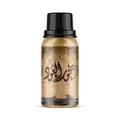
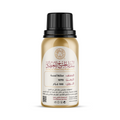
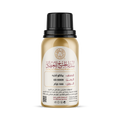
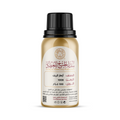
In short: A perfume label carries particulars required by regulation: the name and address of the responsible party, the country of manufacture, the volume, the batch number, the expiry date or the period after opening, and the ingredient list in standard international names, in descending order. The word Parfum covers all the scent materials, and the names after it, such as Linalool and Limonene, are declared allergens, listed whenever they exceed 0.001% in the perfume. Their presence does not mean the perfume causes allergy in everyone who uses it, and their absence does not mean it is free of them. The label does not state the concentration, the scent formula, or where a substance came from, and the barcode prefix does not indicate the country of manufacture.
Table of contents
- What the label must carry
- The ingredient list: which names, in which order
- Alcohol Denat., Aqua, and Parfum
- The names after Parfum: declared allergens
- Pack symbols and what they mean
- Batch number, barcode, and volume
- What the label does not tell you
- If you are allergic to a known substance: the order of reading
- Frequently asked questions
- Read also
- References
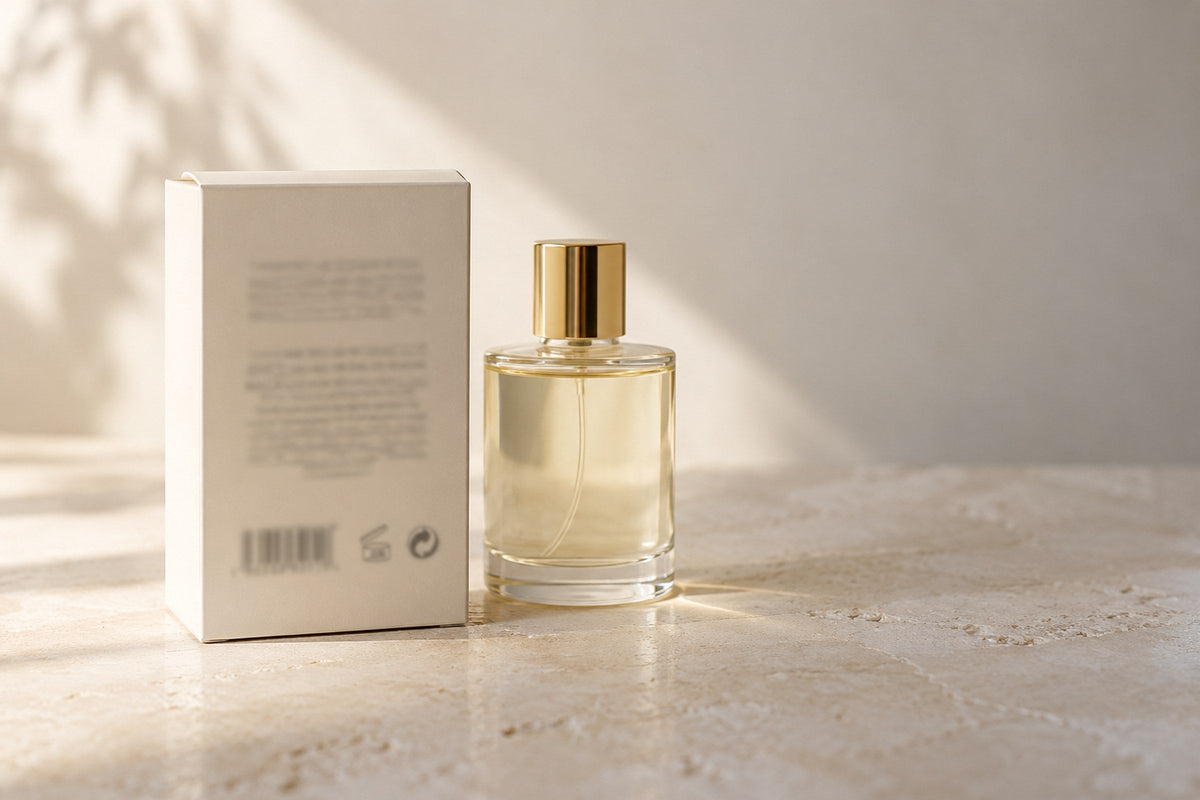
On the back of a perfume box are small lines: names in Latin letters, symbols, and numbers. Most of them are particulars required by a regulatory text, each with its place and meaning, and some are marks the manufacturer adds voluntarily. What no text requires, such as the concentration, you may not find written at all.
What the label must carry
In Saudi Arabia, the Cosmetic Products Law, issued by Royal Decree M/49 in 1436 AH, requires every cosmetic product to carry particulars or an identifying label as set out in its implementing regulations [1], and the Saudi Food and Drug Authority (SFDA) counts perfumes among cosmetic products [2]. For the details of the label, the Authority refers to the law's implementing regulations and to the Gulf technical regulation on safety requirements, SFDA.CO/GSO 1943 [3], and in June 2025 it announced the adoption of its 2024 edition [4].
What the Authority's inspectors check at ports of entry is published on its website, on a page dated September 2019 [5]: the product name and brand; the name and address of the manufacturer, or of the importer in Saudi Arabia; the ingredient list; the product's function if it is not evident; storage conditions; the batch number or production date; directions for use and warnings; the country of manufacture; the volume; and the expiry date. These are the items of that page as published in 2019, and the newer edition of the Gulf regulation may set them out in more detail or add to them. The Authority also requires the label to carry its own barcode, and not to refer to the product's listing with the Authority [3].
In the European Union these particulars are set out in Article 19 of the Cosmetic Products Regulation 1223/2009 [6]. It requires them to appear on the container and on the outer packaging in indelible, easily legible lettering, and allows the ingredient list to appear on the outer packaging alone. If you do not find the list on the bottle, look for it on the carton.
| Particular | In Saudi Arabia [5] | In the European Union [6] |
|---|---|---|
| Name and address | The manufacturer, or the importer in Saudi Arabia, in Arabic or in Arabic and English | The responsible person |
| Country of manufacture | Stated; if more than one country took part, the country with the highest cost in the manufacturing operations | The country of origin is stated for imported products |
| Volume | Stated, except below 5 ml or 5 g, with special requirements set by the Authority | Stated, except below 5 ml or 5 g, free samples, and single-application packs |
| Expiry | Month and year if the shelf life is under 30 months, and the period after opening, with its symbol, if it is longer | The date of minimum durability, not required if the shelf life exceeds 30 months, in which case the period after opening is stated |
| Batch | Batch number or production date | Batch number or a reference identifying the product |
| Ingredients | In INCI names | In the common names of the EU glossary, preceded by the word Ingredients |
| Language | Arabic, or Arabic and English, for the name, function, and storage conditions | The language of the country of sale for the volume, date, precautions, and function |

The ingredient list: which names, in which order
The names in the list come from the International Nomenclature of Cosmetic Ingredients (INCI). The Authority requires them in Saudi Arabia [5], and the EU glossary of common ingredient names follows them; its latest edition was issued in June 2025 and has applied since 30 July 2026 [7]. The EU regulation leaves to each country the language of the volume, the date, the precautions, and the product's function, and the ingredient list is not among the things it leaves to them [6], so an ingredient is written under the same name wherever the product is sold.
In the EU text, ingredients are listed in descending order of weight at the time they are added. Those at concentrations below 1% may be listed in any order after those above it [6]. So the first names are the most abundant in the bottle, and no order can be read from the end of the list. Colourants other than hair dyes may be listed in any order after the other ingredients, and where applicable they are written as numbers preceded by CI, short for Colour Index [6].
Alcohol Denat., Aqua, and Parfum
Alcohol Denat. is ethyl alcohol after denaturing, that is, after something has been added to make it unfit to drink. The word alcohol on its own on a cosmetic label means ethyl alcohol. "Fatty alcohols" such as cetyl alcohol and stearyl alcohol are other substances, and they may be present in a product labelled "alcohol free" [8].
Aqua is the name for water in ingredient lists, and it is an entry in the EU glossary [7].
Parfum is one word for all the scent materials. The EU text requires perfume and aromatic compositions and their raw materials to be named parfum or aroma [6]. In the United States they may be listed as Fragrance, and the U.S. Food and Drug Administration explains that the Fair Packaging and Labeling Act (FPLA) is not used to force companies to disclose trade secrets [9]. The list does not spell out which raw materials fall under the word.
The names after Parfum: declared allergens
After Parfum, some labels carry names such as Linalool, Limonene, Citronellol, and Geraniol. These are not additions on top of the perfume. They are among its materials, and the EU text requires them to be named alongside the word parfum whenever the concentration of any one of them exceeds 0.001% in a product that stays on the skin, or 0.01% in a product that is rinsed off [6] [10]. The two thresholds are announced in Saudi Arabia as well: the Authority published them in an awareness campaign in 2018, named perfumes among the products that stay on the skin, and counted failing to list these substances as a violation [2].
The EU regulation used to require 24 of these substances to be listed. Then Regulation 2023/1545 was issued in July 2023 and expanded the list, after the Scientific Committee on Consumer Safety had identified 56 additional allergens [10]. Among the additions are natural oils by name, such as lemon peel oil (Citrus Limon Peel Oil) and sandalwood oil (Santalum Album Oil) [10]. Packs that do not follow the new list could be placed on the EU market until 31 July 2026, and may remain on sale there until 31 July 2028 [10]. So a short list on an older pack does not mean that it contains fewer of these substances.
Reading these names has its limits. The presence of a substance does not mean the perfume causes allergy in everyone who uses it: the regulation states that people sensitised to fragrance substances in the Union can be estimated at between 1% and 9% of the population, and that the purpose of listing the name is to let a sensitised person avoid the substance they react to [10]. Its absence does not mean the perfume is free of it, since it may be present below the threshold. The symptoms of allergy and how it is tested are covered in Harms of Perfume and Bakhoor.
Pack symbols and what they mean
The first three symbols in the table come from Annex VII of the EU regulation [6], and the Authority in Saudi Arabia requires the period-after-opening symbol when the shelf life exceeds 30 months [5]. The rest come from other texts or from the bodies that license the marks.
| Symbol | What it means | Source |
|---|---|---|
| An open jar, with a period in months or years | The period during which the product remains safe to use after it is opened | Annex VII [6] |
| An hourglass | The date of minimum durability, followed by the month and year | Annex VII [6] |
| A hand pointing to an open book | The remaining particulars are in an enclosed leaflet or tag | Annex VII [6] |
| The letter ℮ next to the volume | A guarantee by the packer or importer that the pack meets the requirements of the EU directive on prepackaged products | Directive 76/211/EEC [11] |
| A number and an abbreviation, such as GL 70, PET 1, PAP 21, or ALU 41 | The packaging material: colourless glass, PET plastic, non-corrugated cardboard, or aluminium | Decision 97/129/EC, used voluntarily [12] |
| The Green Dot: two interlocking arrows in a circle | A financial contribution paid to a licensed national packaging recovery scheme | PRO Europe, the licensor of the mark [13] |
| A flame in a diamond with a red border | A flammable substance | One of the hazard pictograms of the chemical classification system [14], not a symbol of the cosmetics regulation |
The flame is not in Annex VII, which has three symbols and no more [6]. It is a hazard pictogram of the system for the classification, labelling and packaging of chemicals (CLP), and it indicates a flammable substance, as in the British version of the system [14]. The EU regulation for that system states that it does not apply to cosmetic products in the finished state, intended for the final user [15]. Aerosol dispensers have a directive of their own, which defines them as containers holding a gas compressed, liquefied, or dissolved under pressure, and requires them to carry the warning elements set by that system according to the flammability of their contents [16]. A perfume spray worked by a hand pump, without compressed gas, falls outside this definition. We found nothing in these texts that requires the flame on its box, so where you see it there, it is not one of the Annex VII symbols.
The numbers and abbreviations indicate the material alone. The EU decision that set them does not define the triangle of arrows that surrounds them on some packs, and does not say that the pack will be recycled [12]. The Green Dot is described by its licensor as a financing symbol, not an environmental one [13].

Batch number, barcode, and volume
The batch number identifies the run in which the pack was made. The EU text requires it, or a reference identifying the product, and allows it to appear on the outer packaging alone if the container is small [6]. The Authority asks for the batch number or the production date [5]. Neither text sets a format for the number, so the date of manufacture can be read from it only with the manufacturer's key.
The barcode is a number that identifies the product in trade. Its prefix indicates the GS1 member organisation that licensed the number to the company, such as 628 for GS1 Saudi Arabia and 300 to 379 for GS1 France. GS1 states that the prefix does not determine the product's country of origin, since the company may manufacture in any country [17]. The country of manufacture is read from its own written line.
Volume is written on most packs in millilitres (ml), and fl oz may appear beside it: the fluid ounce, the unit for liquids in US labelling rules [18]. The two figures are one content in two units.
What the label does not tell you
The proportion of perfume oil is not among the required particulars in the Saudi and European lists [5] [6]. Concentration names on the front are approximate: the Authority gave ranges for them in its campaign, including 5 to 15% for Eau de Toilette, 10 to 20% for Eau de Parfum (and with it Parfum de Toilette), and 15 to 40% for Extrait [2]. The ranges overlap, so the name does not give a figure.
The scent formula is a trade secret. The EU text obliges the responsible person to make the product's composition available to the public while protecting trade secrets. For perfume compositions, what is made available is the name and number of the composition and the identity of its supplier, and quantities are made available for hazardous substances only [6].
The origin of a substance does not show in its name. The text requires a substance to be listed whenever it is present above the threshold, and draws no distinction between one source and another [6], and the Authority notes that these substances occur naturally in essential oils [2]. So the name Linalool in the list does not tell you whether it came from a natural oil or from synthesis.
Front-of-pack phrases such as "dermatologically tested" and "does not cause allergies" are claims, not label particulars. EU Regulation 655/2013 requires every claim to be truthful and supported by adequate and verifiable evidence, and it contains no definition of these two phrases [19]. In Saudi Arabia there is a Gulf regulation on claims, adopted by the Authority [4], and one of the things its inspectors check is that the label carries no medical claim [5]. The U.S. Food and Drug Administration says of "hypoallergenic" that it has no regulatory standard for the term, and that it means whatever a particular company wants it to mean [20].
If you are allergic to a known substance: the order of reading
If your doctor has told you that you are allergic to a particular substance, this is the order of reading:
- Ask your doctor for the name of the substance as it is written in ingredient lists, that is, its INCI name in Latin letters.
- Look for the list on the carton before the bottle. If you see the hand-and-book symbol, the list is in an enclosed leaflet [6].
- Read what follows Parfum, name by name. If you find your substance, it is in the perfume.
- If you do not find it, do not take the perfume to be free of it: it may be present below the threshold, the pack may be labelled with the older list, or it may come from a market that does not require it to be listed.
- Do not rely on front-of-pack phrases; they are claims, not an ingredient list.
- If doubt remains, ask the manufacturer about the substance by name [9].
What you use and what you avoid after that is for your doctor to decide.
Frequently asked questions
Why are perfume ingredients written in Latin letters, even in Saudi Arabia?
Because they are written in the international INCI names, which the Saudi Food and Drug Authority requires and the EU glossary follows [5] [7]. If you know a substance by this name, you will find it under the same name on any pack.
Does Linalool or Limonene in the list mean the perfume causes allergy?
No. The name being listed means the substance is in the perfume; it must be listed whenever it exceeds 0.001%, and it is written for those who know they are allergic to it [6] [10]. The regulation states that people sensitised to fragrance substances can be estimated at between 1% and 9% of the EU population [10].
Can I tell where a perfume was made from its barcode?
No. The barcode prefix indicates the GS1 member organisation with which the company registered, and GS1 states that it does not determine the country of origin [17]. The country of manufacture is a separate particular on the label.
Why can't I find an expiry date on my perfume?
The EU text does not require a date when the shelf life exceeds 30 months, and in that case asks for the period after opening, with the open-jar symbol, except where that period has no meaning [6]. The rule in Saudi Arabia is close to it [5]. The signs that a perfume has changed are covered in How to Store Perfume.
Is the perfume's concentration written on the label?
It is not among the required particulars in the Saudi and European lists [5] [6]. What is written on the front is the name of a category, such as Eau de Parfum, and the ranges of the categories overlap [2].
Read also
- Harms of Perfume and Bakhoor: What the Evidence Says on Allergy and Smoke
- How to Store Perfume: Where to Keep It, How Long It Lasts, and How to Tell It Has Changed
- Perfume Ingredients: From Raw Material to Note
- Glossary of Perfume and Bakhoor Terms in English and Arabic
- Bakhoor Ingredients: What It Is Made Of and How to Read Its Label
References
- Saudi Food and Drug Authority (SFDA). Guidance on cosmetic products restricted to professional use (DS-G-106-V01), issued 9 October 2023, which reproduces Article 11 of the Cosmetic Products Law issued by Royal Decree No. M/49 dated 18/6/1436 AH. sfda.gov.sa. Accessed 14 October 2026.
- Saudi Food and Drug Authority (SFDA). SFDA launches an awareness campaign on the proper use of cosmetic products [in Arabic]. 24 June 2018. sfda.gov.sa. Accessed 14 October 2026.
- Saudi Food and Drug Authority (SFDA). Guide to the requirements for listing cosmetic products, version 4. sfda.gov.sa. Accessed 14 October 2026.
- Saudi Food and Drug Authority (SFDA). SFDA adopts new updates to the Gulf technical regulations for cosmetic products [in Arabic]. 24 June 2025. sfda.gov.sa. Accessed 14 October 2026.
- Saudi Food and Drug Authority (SFDA). What is the verification mechanism for cosmetic products followed by the Authority's inspectors at ports of entry? Frequently asked questions [in Arabic], 25 September 2019. sfda.gov.sa. Accessed 14 October 2026.
- Regulation (EC) No 1223/2009 of the European Parliament and of the Council of 30 November 2009 on cosmetic products. OJ L 342, 22.12.2009, p. 59. Consolidated text of 1 September 2025: Articles 19, 20, 21 and 33, and Annexes III and VII. eur-lex.europa.eu. Accessed 14 October 2026.
- Commission Implementing Decision (EU) 2025/1175 of 16 June 2025 laying down rules for the application of Regulation (EC) No 1223/2009 as regards the glossary of common ingredient names for use in the labelling of cosmetic products and repealing Commission Implementing Decision (EU) 2022/677. OJ L, 2025/1175, 10.7.2025. eur-lex.europa.eu. Accessed 14 October 2026.
- U.S. Food and Drug Administration. “Alcohol Free”. Content current as of 25 February 2022. fda.gov. Accessed 14 October 2026.
- U.S. Food and Drug Administration. Fragrances in Cosmetics. Content current as of 28 February 2022. fda.gov. Accessed 14 October 2026.
- Commission Regulation (EU) 2023/1545 of 26 July 2023 amending Regulation (EC) No 1223/2009 of the European Parliament and of the Council as regards labelling of fragrance allergens in cosmetic products. OJ L 188, 27.7.2023, p. 1. eur-lex.europa.eu. Accessed 14 October 2026.
- Council Directive 76/211/EEC of 20 January 1976 on the approximation of the laws of the Member States relating to the making-up by weight or by volume of certain prepackaged products. OJ L 46, 21.2.1976. Consolidated text of 26 July 2019, Annex I, point 3.3. eur-lex.europa.eu. Accessed 14 October 2026.
- Commission Decision 97/129/EC of 28 January 1997 establishing the identification system for packaging materials pursuant to European Parliament and Council Directive 94/62/EC on packaging and packaging waste. OJ L 50, 20.2.1997, pp. 28–31. eur-lex.europa.eu. Accessed 14 October 2026.
- PRO Europe (Packaging Recovery Organisation Europe). The Green Dot Trademark. pro-e.org. Accessed 14 October 2026.
- Health and Safety Executive (UK). Hazard pictograms (symbols). Last updated 11 February 2022. hse.gov.uk. Accessed 14 October 2026.
- Regulation (EC) No 1272/2008 of the European Parliament and of the Council of 16 December 2008 on classification, labelling and packaging of substances and mixtures. OJ L 353, 31.12.2008, p. 1. Article 1(5)(c). eur-lex.europa.eu. Accessed 14 October 2026.
- Council Directive 75/324/EEC of 20 May 1975 on the approximation of the laws of the Member States relating to aerosol dispensers. Consolidated text of 12 February 2018: Articles 2 and 8, and point 2.2 of the Annex. eur-lex.europa.eu. Accessed 14 October 2026.
- GS1. GS1 Company Prefix. gs1.org. Accessed 14 October 2026.
- U.S. Code of Federal Regulations, Title 21, § 701.13: Declaration of net quantity of contents. 2024 edition. govinfo.gov. Accessed 14 October 2026.
- Commission Regulation (EU) No 655/2013 of 10 July 2013 laying down common criteria for the justification of claims used in relation to cosmetic products. OJ L 190, 11.7.2013, p. 31. eur-lex.europa.eu. Accessed 14 October 2026.
- U.S. Food and Drug Administration. “Hypoallergenic” Cosmetics. Content current as of 25 February 2022. fda.gov. Accessed 14 October 2026.
Prepared and edited by: Sedr Al-Khaleej Perfumes team
Last reviewed: 14 October 2026
Was this article helpful?
Leave a comment
Comments are reviewed before they appear. Your email address won’t be shown.