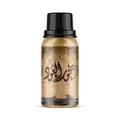
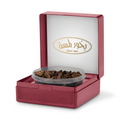
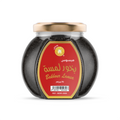
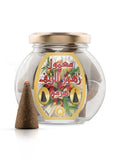
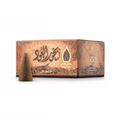
In short: Not every perfume oil is suitable for bakhoor, so choose one whose supplier says it is for scenting incense and explains how to heat it. A scent you know from the bottle can change on heat, so the note pyramid will not tell you what is left of it over charcoal. Take the amount and the drying time from the product’s directions; we know of no documented general rule for either. Do not put alcohol-based perfume on or near charcoal, and never burn charcoal indoors.
Table of contents
- What do we mean by bakhoor perfumes?
- What happens to the oil on heat?
- Which scents suit bakhoor?
- How are oud and bakhoor scented?
- Scenting oud pieces and unscented bakhoor
- Adding oil to maamoul when making it
- Charcoal or an electric burner?
- What should you be careful about?
- How do you choose a perfume oil?
- Frequently asked questions
- Read also
- References
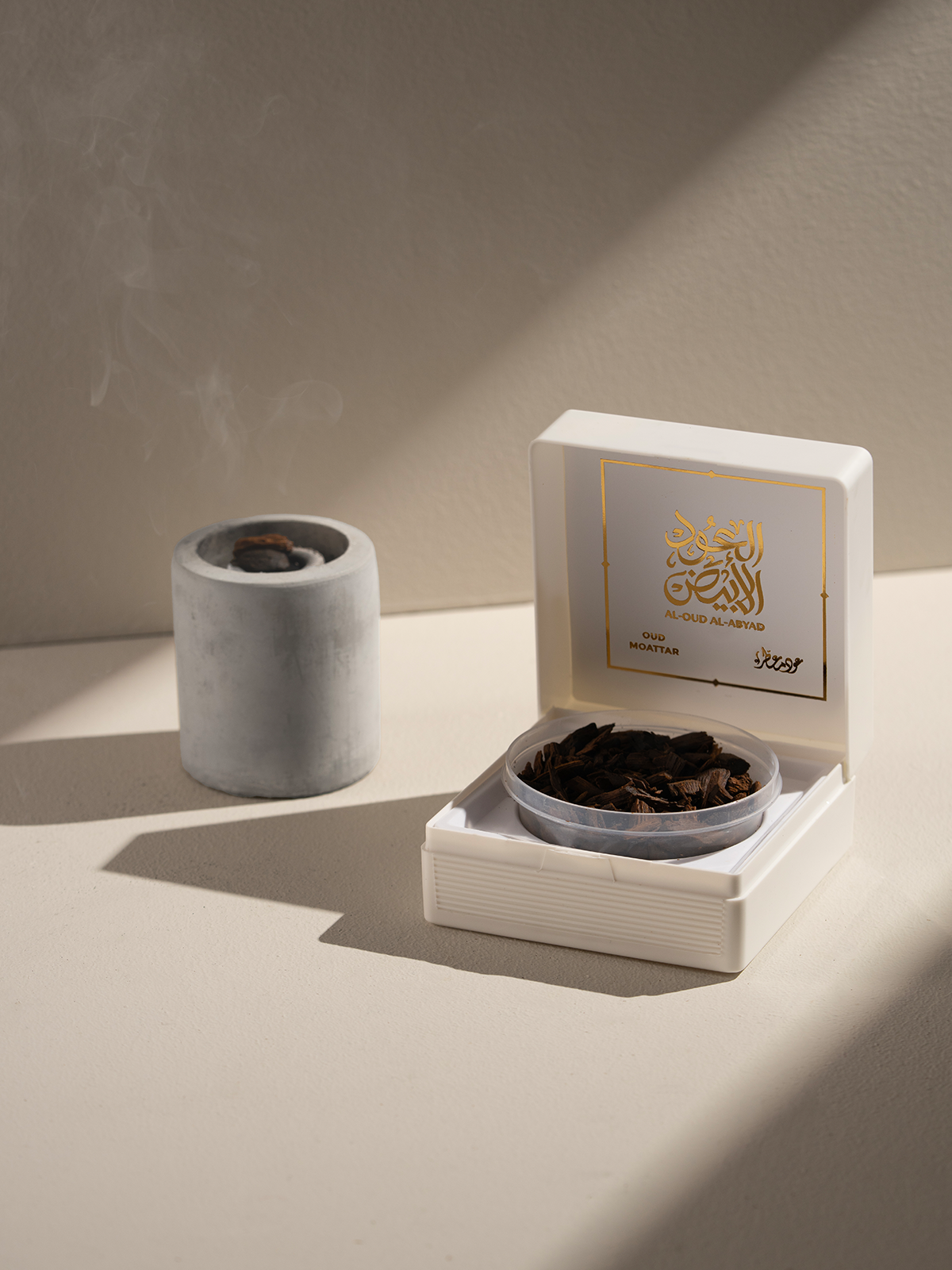
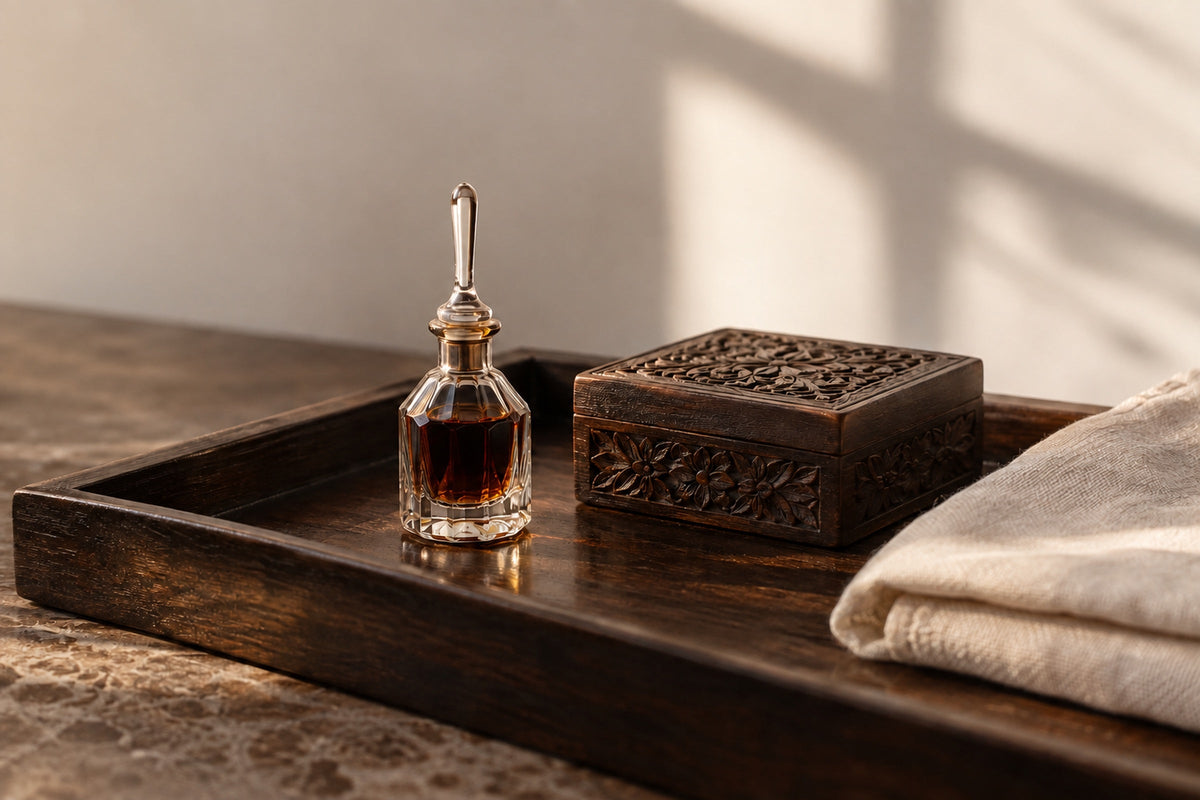
Just before the guests arrive, the host takes out a bottle of perfume oil the family loves, puts a drop of it on a piece of bakhoor and carries the piece to the burner. The smoke rises, and the majlis smells different from the bottle: some of it has stayed, some of it is gone, and something new is there that was not in it before. The bottle is the same, but heat and smoke have changed what reaches the nose.
What do we mean by bakhoor perfumes?
People who search for “bakhoor perfumes” or “bakhoor oils” usually mean a perfume oil they can use to scent oud or bakhoor themselves. The market calls these “perfume oils”, “aromatic oils” and “concentrated oils”, and some are called “dehn”. The best known is dehn al-oud, or oud oil, which is distilled from oud wood: in the traditional method, dark, resin-rich wood chips are soaked in water for two to three months and then boiled to collect their oil [1]. In the Middle East, oud is used both as a perfume oil and as incense [1].
A perfume oil is usually a blend of fragrance materials, not an essential oil extracted from a single plant; the difference between the two is explained in the guide to essential oils. IFRA, the International Fragrance Association, describes concentrated perfume oil (attar) as a fragrance format free of the ethanol that cologne and eau de toilette are made with, and one that may go into incense products [2]. It is mostly worn neat as a personal fragrance, various religious communities prefer it because it contains no ethanol, and it may be diluted or used in air fresheners [2]. So one perfume oil may be made for more than one use, and its name does not tell you which. An oil made for the skin is not necessarily suitable for heating, so check what its supplier made it for.
Scenting wood with oil is a well-known custom in the region: in many Middle Eastern countries aromatic wood is burned, some of it scented with oils and some not [3]. Arabian bakhoor contains frankincense, aromatic woods, herbs, flowers, essential oils and perfumes [4], and its materials are covered in the guide to bakhoor ingredients.
Three liquids may come to mind for someone scenting their own bakhoor:
- Perfume oil: our subject here.
- Essential oil: an oil from a single plant, which heat, light and oxygen change [5]. Not everything sold as the oil of a plant is actually extracted from it, as the sandalwood example in the section on choosing shows.
- Alcohol-based perfume (spray): it does not go on charcoal, for the reason given in the safety section.
What happens to the oil on heat?
Heating may change the scent, and the note pyramid cannot tell you what you will smell on charcoal. It describes conventional perfume: citrus at the top, flowers in the heart, amber and musk at the base [6], where sandalwood, myrrh and frankincense are also counted [7], along with patchouli, known for its longevity in perfume [8]. We found no one who has measured that order on bakhoor over charcoal.
Perfume on burning bakhoor is heated and burned at once. Heat affects the composition and stability of essential oils, as do light and oxygen [5], and incense smoke carries fine particles, gases including carbon monoxide, and volatile organic compounds [9]. So the order and duration of notes you know from skin may not hold on charcoal, and a base scent may not be the one that lasts longest in the smoke.
Oud shows that heat can create a scent that was not there before. When its wood is heated, small aromatic molecules appear in the vapor that are not present in the cold wood, some of them specific to its resin-rich parts [10]. Some come from a compound in oud, agarotetrol, which turns into them on heating and which, after distillation, stays in the leftover water rather than in the oil [10]. That may be why oud oil in the bottle is not oud on charcoal, and other materials are probably no different: what they smell like hot may not match what they smell like cold.

Which scents suit bakhoor?
No single scent suits every bakhoor. The table places the best-known scents roughly within the perfume pyramid; it tells you their character, not how long they will last when bakhoor is heated. The families are covered in the guide to fragrance families.
| Family | Examples | Grouping in perfume |
|---|---|---|
| Citrus | Lemon, bergamot and orange | Usually listed among top notes [6] [7] |
| Floral | Rose, jasmine and lavender | Flowers are heart notes [6] |
| Woody | Sandalwood, patchouli and cedarwood | Sandalwood and patchouli are base notes [7] [8] |
| Amber and musk | Amber and musk | Base notes [6] |
| Resinous | Frankincense and myrrh | Base notes [7] |
| Sweet | Vanilla | Vanilla is listed among base notes [7] |
Choose the character you like, then check that the product is made for bakhoor and for the way you will heat it.
Watch the names, too. Musk and amber are common descriptors in the classification of scents [6], and in the notes of a perfume oil they may indicate the character of the scent rather than the source of the material, as the guide to musk explains. And what is sold as “vanilla oil” is not a distilled oil; see the vanilla section.
How are oud and bakhoor scented?
There are many ways to scent oud and bakhoor, and no single amount or drying time that we know to be documented, so take the amount, the time and the heating method from the directions of the product in your hands. What holds for any product is the following.
Scenting oud pieces and unscented bakhoor
Oil-scented incense wood is sold on the market [3], but that does not mean any oil sold separately is suitable for scenting wood or for heating. Ask the supplier what the oil was made for, how much of it to use and how to prepare it. If they cannot tell you, do not try a perfume made for another purpose in its place.
The laboratory offers one example of drying: raw bakhoor scented with oil was left to dry under natural conditions for 10 to 15 days before it was analyzed [3]. That is how long researchers took to prepare a sample, not a rule for the home.
As for resin-rich oud, we see no need to scent it. In Middle Eastern and Asian markets its pieces are burned as they are, with no perfume added, and it is oud with less resin that is often blended with other aromatic materials [11]. The difference between natural, enhanced and scented oud is in the guide to types of bakhoor.
If you scent your own bakhoor:
- Check that the oil is made for scenting bakhoor, and use the amount its supplier specifies.
- Do not judge whether an oil is safe to heat by its smell; go by its supplier’s directions.
- Do not put a piece that is dripping with oil on the charcoal.
- Store the oil as its directions say, away from heat sources. There is more in the guide to storing bakhoor.
Adding oil to maamoul when making it
Essential oils and perfumes are ingredients in some kinds of Arabian bakhoor [4], including maamoul blends. As for how much oil to add and how to knead it, no recipe works for every oil and blend, so we give no amounts here. Maamoul, mabsoos (a loose, oil-moistened bakhoor) and other forms of bakhoor are covered in the guide to types of bakhoor.
Charcoal or an electric burner?
The heating method is part of what an oil is made for, so read its directions, and those of the bakhoor and the burner, before you put them together. A perfume oil being ethanol-free is no reason to add a drop of it to bakhoor. And do not pour perfume, of any kind, onto charcoal or a burning piece.
An electric burner heats bakhoor without charcoal, and it has been recommended in place of charcoal or an open flame [3]. That does not mean every oil is suitable for heating in one, or that electric heating rids bakhoor of its pollutants. The two methods are compared in the guide to making bakhoor scent last.
Charcoal has an effect of its own. When two kinds of Emirati bakhoor were burned in a test chamber, charcoal was the main source of the elevated carbon monoxide and nitrogen oxides, and the particles and these two gases exceeded regulatory limits [12]. Leaving out charcoal therefore removes a major source of these two gases, while the smoke of the bakhoor remains.
What should you be careful about?
Do not put an alcohol-based perfume on the charcoal, and do not spray it near the burner. Cologne and eau de toilette are made with ethanol [2], and ethanol is a highly flammable liquid with a flash point of about 13°C (55°F) [13]. The flash point is the lowest temperature at which a liquid gives off enough vapor to form an ignitable mixture with air [14], which means ethanol vapor can ignite at ordinary room temperature if it meets a flame or a spark.
A perfume oil being ethanol-free does not mean it cannot burn. Some perfume materials are flammable, including limonene, whose flash point is 48°C [15], and the flash point of a perfume oil depends on its ingredients. Keep the bottle away from charcoal and flames, and close it before you light the burner.

Do not put a perfume made for bakhoor on your skin unless its label says so. IFRA places incense and incense sticks in Category 12, the category for products not intended for direct skin contact [2], and some materials have no concentration limit there while being restricted in skin perfumes, oakmoss extracts for example [16]. For a concentrated perfume oil (attar) with several uses, the maker of the final product chooses the category according to its intended or reasonably foreseeable use, and when the use is not specified IFRA recommends the strictest outcome. A certificate of conformity with its standards does not replace a product safety assessment [2].
It is also advised to cut down on bakhoor scented with one or more oils at high concentrations, and on long exposure to it while preparing and burning it [3], though no safe amount for the home has been set.
Do not burn charcoal indoors, and do not bring it inside after lighting it outdoors: it gives off carbon monoxide at every stage of burning, and CDC advises against burning it in enclosed spaces [17]. Ventilation is not a substitute for this warning. Our guides cover smoke and ventilation, incense smoke indoors and fire and charcoal safety.
Anyone with asthma or a chest allergy should ask their doctor before burning bakhoor. In an Omani survey, parents reported that bakhoor made wheezing worse in 38% of the children with asthma, making it the fourth most common trigger after dust, weather and respiratory infections [4]. Children’s breathing was about three times more likely to be affected when bakhoor was used more than twice a week than when it was not used at all [4]. Its use was not linked to how common asthma itself was [4].
How do you choose a perfume oil?
First find out what is in the bottle and what it was made for, then choose the scent by your own taste. The label tells you whether it is a perfume oil, an essential oil or an alcohol-based perfume; if it does not, ask the seller, and buy from sellers who state the notes and the directions for use and storage. Labels can be wrong too: when six oils sold as sandalwood oil were analyzed, none met the international standard for sandalwood oil, the label was accurate for only three, and two were synthetic blends labeled 100% natural sandalwood oil [18].
The listed notes describe the scent you will like in the bottle; they do not guarantee that it lasts on charcoal, and neither the bottle nor the price tells you how it comes across there. So ask for a sample made for bakhoor if there is one, try it the way the supplier specifies, and do not breathe its smoke in directly. Think about the space as well: what suits a large majlis (reception room) may feel heavy in a small room.
Frequently asked questions
Should I put an alcohol-based perfume on bakhoor?
No, and do not spray it near the burner either. It contains ethanol [2], and ethanol vapor can ignite at room temperature if it meets a flame or a spark [13].
Is any perfume oil suitable for bakhoor?
Not necessarily. Neither its name nor being ethanol-free tells you that; what it was made for does, and IFRA categorization works the same way, following the use of the final product rather than the oil’s name [2]. Ask the supplier whether it is made for bakhoor and how it should be heated.
How many drops should I put on oud, and how long should I leave it?
We know of no documented general amount or waiting time, so take both from the directions of a product made for scenting bakhoor. The days researchers left their samples to dry in the laboratory are not a recipe for the home.
Does a citrus scent fade faster on charcoal than other scents?
Citrus is usually counted among the top notes of perfume [6], and that describes conventional perfume. On charcoal the perfume is heated and burned at once, so the order may not stay as it is.
Why does oud oil smell different from oud on charcoal?
The reason, it appears, is that heat produces aromatic substances in oud that are not present in its cold wood, and some of them come from a compound that stays in the water, not the oil, after distillation [10].
Should I scent resin-rich oud?
There is usually no need. It is burned as it is, with no perfume added; it is oud with less resin that gets blended with other aromatic materials [11].
Can I put a perfume made for bakhoor on my skin?
No, unless its label says so. IFRA counts bakhoor among products not intended for direct skin contact [2], and some materials restricted in skin perfumes have no limit in it [16].
Read also
- Bakhoor Ingredients: What It Is Made Of and How to Read Its Label
- Types of Bakhoor: A Guide to Oud, Frankincense, Maamoul and Mabsous
- Essential Oils in Perfumery: The Main Oils, Their Scents and Safety
- Making Bakhoor Scent Last at Home: Amount, Ventilation and Safety
- How to Store Bakhoor, Oud and Oud Oil: A Storage Guide
- Composing Perfume Oil Blends: How to Mix a Mukhallat Yourself
References
- Naziz PS, Das R, Sen S. The Scent of Stress: Evidence From the Unique Fragrance of Agarwood. Frontiers in Plant Science. 2019;10:840. doi:10.3389/fpls.2019.00840. PMC6646531. Accessed 5 October 2026.
- IFRA. Guidance for the use of IFRA Standards. 30 June 2023 (51st Amendment). Section 6.5.16 “Attars and attar-type fragrances” (pp. 39–40), and the table of product categories (pp. 52–54). Guidance document. Accessed 1 October 2026.
- Bu-Olayan AH, Thomas BV. Exposition of respiratory ailments from trace metals concentrations in incenses. Scientific Reports. 2021;11(1):10210. doi:10.1038/s41598-021-89493-w. PMC8140077. Accessed 1 October 2026.
- Al-Rawas OA, Al-Maniri AA, Al-Riyami BM. Home exposure to Arabian incense (bakhour) and asthma symptoms in children: a community survey in two regions in Oman. BMC Pulmonary Medicine. 2009;9:23. doi:10.1186/1471-2466-9-23. PMC2693130. Accessed 1 October 2026.
- Turek C, Stintzing FC. Stability of Essential Oils: A Review. Comprehensive Reviews in Food Science and Food Safety. 2013;12(1):40–53. doi:10.1111/1541-4337.12006. Accessed 1 October 2026.
- Rodrigues AE, Nogueira I, Faria RPV. Perfume and Flavor Engineering: A Chemical Engineering Perspective. Molecules. 2021;26(11):3095. doi:10.3390/molecules26113095. PMC8196857. Accessed 1 October 2026.
- Sharmeen JB, Mahomoodally FM, Zengin G, Maggi F. Essential Oils as Natural Sources of Fragrance Compounds for Cosmetics and Cosmeceuticals. Molecules. 2021;26(3):666. doi:10.3390/molecules26030666. PMC7865210. Accessed 1 October 2026.
- Swamy MK, Sinniah UR. A Comprehensive Review on the Phytochemical Constituents and Pharmacological Activities of Pogostemon cablin Benth.: An Aromatic Medicinal Plant of Industrial Importance. Molecules. 2015;20(5):8521–8547. PMC6272783. Accessed 1 October 2026.
- Lin TC, Krishnaswamy G, Chi DS. Incense smoke: clinical, structural and molecular effects on airway disease. Clinical and Molecular Allergy. 2008;6:3. PMC2377255. Accessed 1 October 2026.
- Takamatsu S, Ito M. Agarotetrol: a source compound for low molecular weight aromatic compounds from agarwood heating. Journal of Natural Medicines. 2018;72(2):537–541. doi:10.1007/s11418-018-1185-y. PMID: 29464509. Accessed 5 October 2026.
- López-Sampson A, Page T. History of Use and Trade of Agarwood. Economic Botany. 2018;72(1):107–129. doi:10.1007/s12231-018-9408-4. Open access: researchonline.jcu.edu.au/58720. Accessed 1 October 2026.
- Cohen R, Sexton KG, Yeatts KB. Hazard assessment of United Arab Emirates (UAE) incense smoke. Science of the Total Environment. 2013;458–460:176–186. doi:10.1016/j.scitotenv.2013.03.101. PMID: 23648447. Accessed 5 October 2026.
- NIOSH. NIOSH Pocket Guide to Chemical Hazards: Ethyl alcohol. Centers for Disease Control and Prevention. cdc.gov/niosh/npg/npgd0262.html. Accessed 1 October 2026.
- OSHA. 29 CFR 1910.106(a)(14): Flash point. Text of the regulation. Accessed 1 October 2026.
- ILO, WHO. International Chemical Safety Card ICSC 0918: d-Limonene. ICSC 0918 card. Accessed 1 October 2026.
- IFRA. IFRA Standard: Oakmoss extracts. Amendment 49. 2020. In force under the 51st Amendment (2023). Standard document. Accessed 1 October 2026.
- CDC. Carbon Monoxide Poisoning Basics. 12 January 2026. Official page. Accessed 4 October 2026.
- Kucharska M, Frydrych B, Wesolowski W, Szymanska JA, Kilanowicz A. A Comparison of the Composition of Selected Commercial Sandalwood Oils with the International Standard. Molecules. 2021;26(8):2249. doi:10.3390/molecules26082249. PMC8070282. Accessed 5 October 2026.
Prepared and edited by: Sedr Al-Khaleej Perfumes team
Last reviewed: 14 October 2026
Was this article helpful?
Leave a comment
Comments are reviewed before they appear. Your email address won’t be shown.