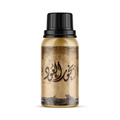
In short: A mukhallat, the Gulf name for a blended perfume, is a perfume oil composed of several materials, and there is no fixed ratio for blending it and no fixed time to wait before using it. The method is to test two materials in graded ratios on smelling strips, write down every trial, and judge after hours, not in the first minute. An essential oil does not go on the skin undiluted, nor do some pressed citrus oils, such as bergamot, before going out in the sun. Your blend has not been assessed against the standards of IFRA, the International Fragrance Association, so try it on a small area of skin before you wear it. An area that shows no irritation is not enough to show that the blend suits your skin.
Table of contents
- What is meant by blending perfume oils?
- Blending in the bottle and wearing perfumes together
- How is a blend built?
- The accord: a new scent from the mixture
- Top, heart and base
- Scents that often go together
- Blending steps
- What you need
- Ratios: a series of trials, not a fixed number
- Waiting and testing
- Does a blend need to rest?
- How to smell without tiring your nose
- Wearing more than one perfume on the skin
- Safety
- Frequently asked questions
- Read also
- References
You have dehn al-oud you have kept for years, a musk you love, and the memory of a mukhallat you smelled on a friend at a majlis, with something of both in it and something you could not place. You pour a little from each into a third bottle and put some on your wrist, and the scent is not what you wanted. You cannot tell which drops were too many, and you would not know how to make the blend again if you had liked it.
What is meant by blending perfume oils?
A “mukhallat” is a perfume oil composed of several materials. Arabian perfume oil is a perfume with an oil base that brings together materials such as oud, saffron, musk, amber and sandalwood [1]. Dehn al-oud, or oud oil, and oud powder, in their various kinds, are blended with one another, and usually with other materials, to make these perfumes [1].
Be careful with names. In perfume descriptions, the word “amber” usually means a warm composite scent, not ambergris, which comes from the whale. Likewise, musk in perfume names may describe the character of the scent rather than its source, as in White musk, Musk al-Tahara and black musk.
Blending in the bottle and wearing perfumes together
Blending perfumes usually means one of two things. The first is to put perfume oils or other oils together in a single bottle to make a mukhallat of your own, and this takes trials to find out what goes together and in what ratio. The second is to wear more than one perfume on your skin or clothing, such as dehn al-oud with another perfume on top of it, a practice known in English as layering.
How is a blend built?
The accord: a new scent from the mixture
To perfumers, an “accord” is a single new scent in which a mixture of two or more scents may be perceived, so that it does not resemble the scent of any material in it [2]. It is usually built on three or four scents, and then goes into a larger formula [2].
But a mixture can also go the other way, and a strong material covers the others until nothing of them can be smelled [2]. So you cannot tell what goes together from the names of the materials until you try them, and what is written about materials that are “harmonious by their chemical nature” is no substitute for smelling.
Even when you smell the mixture on the strip, your nose will not find it easy to break it down into its parts. A material is easier to name when it is smelled on its own; once it goes into a mixture, few people recognize it [3].
Top, heart and base
Perfume materials differ in how fast they evaporate. The light ones appear first and go quickly; they are the top. The heavy ones last longer and give the perfume its staying power; they are the base, and between them is the heart, that is, the middle materials [4]. Musk is one of the base materials [4], and dehn al-oud is used as a base too, because it evaporates slowly and lasts a long time [5].
You can find out for yourself where each material belongs. Put a drop of it on a smelling strip, write on the strip the date and time you applied it, and then write down when it began to lose its characteristic scent. In this way you classify your materials into base, middle materials and top. This is how the French perfumer Jean Carles taught his students [6].
A perfume changes continuously as it evaporates, so dividing it into three layers is a simplification [6].
Scents that often go together
Dehn al-oud and musk come together in Arabian perfume oils with amber, sandalwood and saffron [1]. After them, the table gives other materials and what goes with them in the fragrance families and among perfumers. These are examples, not a rule. If you have dehn al-oud and musk, start your trials with what goes with them, and test it on smelling strips before you pour it into the bottle.
| Material | Goes with it | Where they come together |
|---|---|---|
| Dehn al-oud | Amber and sandalwood, and saffron and musk | Mukhallats and Arabian perfume oils [1] |
| Musk | Oud, saffron, amber and sandalwood | Arabian perfume oils [1] |
| “Amber” in the sense of a composite scent | Vanilla, labdanum and animalic notes [7], or resins, flowers and vanilla [8] | The amber family |
| Patchouli | Oakmoss, labdanum and bergamot | The chypre family, whose foundation includes oakmoss and bergamot [7] |
| Lavender | Woods, oakmoss, coumarin, bergamot and geranium | The fougère family, whose foundation includes lavender, coumarin and oakmoss [7] |
| Rose | Rose is added to a base of oakmoss, an amber material and musk to soften the base’s first scent | Jean Carles’s method [6] |
Bergamot, in the table, is one of the pressed citrus oils that may make the skin react to the sun [15].
Blending steps
What you need
- The perfumes or oils you will blend, having smelled each of them on its own before blending, so that afterwards you know what each material brought.
- A dropper for each material, so that no material passes into another bottle.
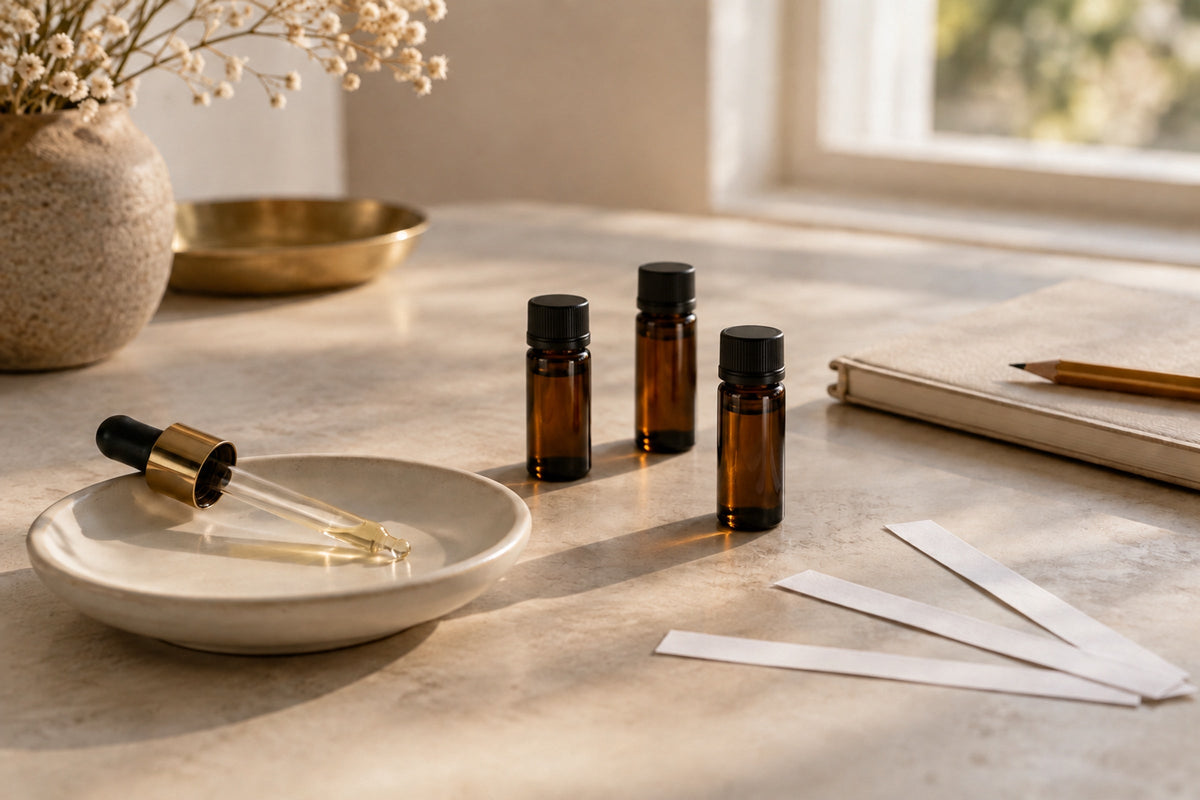
- Paper smelling strips, and a pen to write on each strip what you put on it and when [6].
- A small dark bottle with a tight cap, because air and light speed up changes in the materials [9]. Some perfume materials oxidize in air and become more allergenic, and this is reduced when their exposure to air during use and storage is reduced [10]. That is why we choose a bottle that the blend fills, not a large one that stays half full of air.
- A notebook in which you record each trial with a number.
Ratios: a series of trials, not a fixed number
There is no fixed ratio for blending perfume oils. The ratios in circulation online contradict one another, and some of them do not add up to 100%.
Carles’s method is a series of ratios. The perfumer picks two base materials and blends them in five ratios: 9 to 1, then 8 to 2, then 7 to 3, then 6 to 4, then 5 to 5. He stops at equal parts, because going further would build the accord on the second material rather than the first. Then he chooses one of the five and builds on it [6].

After the base come the lighter materials. In this method, a perfume’s staying power mostly depends on the proportion of base to the rest. A perfume with 20% base materials, 30% middle materials and 50% top has weak staying power because there is too little base. That is why ratios are chosen so that the perfume’s change as it evaporates is balanced [6].
It is a method for building a perfume from raw materials. Ready-made perfumes vary in strength, so Carles’s numbers should not be carried over to them as they are. What does carry over:
- Start with two materials, and add more once you know their effect.
- Start with a few drops, and if the blend works, scale it up in the same ratios.
- Change one thing in each trial, so that you know its effect.
- Write down the number of drops of each material, and the date and number of the trial.
- If you feel that a material is in excess, do not reduce it right away: an apparent excess may be a shortage of another material. And if a base material seems to need more, increase it two or three times, and even up to ten times, to see the effect of the increase, then reduce it at a later stage [6]. This is tested on smelling strips, not in a blend that goes on the skin.
- Do not try to hide every material that stands out. Carles holds that this produces a dull perfume with no character [6].
Waiting and testing
Does a blend need to rest?
There is no fixed resting time for a blend. It is commonly said that a blend should be left for days or weeks before use, and various periods are given for this. We found no reference for any of them in perfume oil blends.
In an alcohol-based perfume the materials react with one another, and with the alcohol, water and air, so the scent changes over time, and heat and daylight speed this up [9]. That is what has been studied in alcohol-based perfumes. Change is possible in perfume oils too, but you cannot know in advance whether it will improve the blend or harm it, or when it will stop. Smell the blend on the day you make it, then again after a few days, and write down the difference. If nothing notable has changed, there is no need to wait.
How to smell without tiring your nose
Smell the blend a little, then step away from it, and leave some time between one smell and the next. Do not judge it after smelling it several times in a row. If you smell a scent continuously, its intensity weakens for you, and it returns after you step away from it [11] [12].
Do not judge it in the first minute either. A base of oakmoss, an amber material and musk, for example, has a first scent on the strip that is unpleasant; it quickly fades and gives way to a pleasant scent that lasts [6]. Put a drop of the blend on a strip, write down the time, and smell it after a few minutes and then after a few hours, when the light materials have gone and the heavy ones remain [4].

When there are many materials, they become hard to tell apart. People rarely identify more than three scents in a mixture of eight, and training does not improve this much [2]. Professional perfumers are no different: when they were tested on mixtures of up to five substances, they identified no more than three or four [13]. This is a limit on what the nose can tell apart. A formula may combine more materials than that.
Wearing more than one perfume on the skin
If you put a perfume oil on your body, then scent your clothes with incense smoke, and finally put on a French perfume, you have worn your perfume in layers. Perfume traders in the UAE know this custom among people under forty, and some of them sometimes mix the French perfume with oud blends [1].
There is no documented order for these layers that makes an alcohol-based perfume over a perfume oil better than the reverse. What helps in blending helps here:
- Test the two perfumes on two strips close to each other before the skin.
- A strong perfume may cover the other [2], so start with a little of the stronger one.
- The heavy one lasts after the light one has gone [4], and what you smell after a few hours may be one of the two perfumes alone.
- If irritation appears after wearing two perfumes together, you will not know which one caused it, so try each of them on its own.
Safety
A homemade blend has not been assessed against the standards of IFRA, the International Fragrance Association, or against the limits for allergens. These precautions reduce its risk; they do not remove it:
- Essential oils are not applied to the skin neat. Before they touch the skin, they are diluted in an oil that carries them, called a carrier oil, and they are not swallowed [14].
- Pressed citrus oils and the sun. Some pressed citrus oils, such as bergamot and lemon, contain substances that make the skin react to the sun; tangerine oil is not one of them, and distilled oils do not cause this. If these oils exceed the set maximum in a product, avoid the sun for at least 12 hours after applying it [15]. The IFRA standard limits one of these substances, called bergapten, in products that stay on skin exposed to the sun [16].
- IFRA categories. Do not put on your skin an oil made for incense or for scenting the air unless its label says so. IFRA’s limits on restricted materials differ by product category, and incense is in the category for products not intended for direct skin contact [17]. The maker of an Arabian perfume oil is the one who chooses its category, and IFRA recommends the strictest limits when its use is not known [17]. Whoever blends at home is the maker of their own blend, and usually does not know the proportions of restricted materials in what they blend.
- Allergens on the label. A homemade blend comes with no ingredient list, so someone who knows they are allergic to a substance cannot tell whether it is in their blend unless they know the components of everything they blended. In the European Union, the fragrance allergens listed in its regulation are named in the ingredient list of cosmetic products when their concentration in the product exceeds a set limit. The aim is to let people who have developed an allergy to a substance avoid it, because contact allergy lasts for life, and once someone has it, a much smaller amount is enough to bring on symptoms [18].
- Testing on a small area. Before applying the blend to a large area, put a little of it on a small area of skin, and stop using it at any redness or itching. This test does not prove that the blend suits your skin and does not diagnose an allergy. Contact allergy may be slow to appear, and it is diagnosed at a doctor’s by a patch test. In this test, the test substances are left on the skin for two days, and the result is usually read on the third or fourth day and again on the seventh day [19].
- Label and storage. Write on the bottle what is in it and the date you made it. Keep it away from children [14], and away from heat and light [9], and close it after each use, because some common perfume materials, such as limonene and linalool, oxidize when exposed to air. Their oxidation products often cause allergic reactions in patients with contact dermatitis, while the materials rarely do before they oxidize [10].
Anyone with a known allergy to perfumes should ask their doctor before trying a blend.
Frequently asked questions
Can I blend an essential oil with a ready-made perfume oil?
They can be mixed in the bottle. But an essential oil is not applied to the skin neat [14], and some pressed citrus oils may make the skin react to the sun [15]; what is needed before using one is in the guide to essential oils.
Read also
- Essential Oils in Perfume: The Main Ones, Their Scents and Safety
- Perfume Ingredients: From Raw Material to Note
- Fragrance Families: A Guide to Types of Perfume Scents and How They Are Classified
- Bakhoor Perfume Oils: How to Choose Them and Scent Oud and Bakhoor
- Harms of Perfume and Bakhoor: What the Evidence Says on Allergy and Smoke
- Oriental Ingredients in Perfume: Oud, Amber, Saffron, Frankincense and Rose
- Oud (Agarwood): A Reference Guide to Its Formation, Types, Oil and Trade
References
- Antonopoulou M, Compton J, Perry LS, Al-Mubarak R. The Trade and Use of Agarwood (Oudh) in the United Arab Emirates. TRAFFIC Southeast Asia; 2010. Report document. Accessed 1 October 2026.
- Thomas-Danguin T, Sinding C, Romagny S, El Mountassir F, Atanasova B, Le Berre E, Le Bon AM, Coureaud G. The perception of odor objects in everyday life: a review on the processing of odor mixtures. Frontiers in Psychology. 2014;5:504. doi:10.3389/fpsyg.2014.00504. PMC4040494. Accessed 1 October 2026.
- Laing DG, Francis GW. The capacity of humans to identify odors in mixtures. Physiology & Behavior. 1989;46(5):809–814. doi:10.1016/0031-9384(89)90041-3. PMID 2628992. Accessed 3 October 2026.
- Rodrigues AE, Nogueira I, Faria RPV. Perfume and Flavor Engineering: A Chemical Engineering Perspective. Molecules. 2021;26(11):3095. doi:10.3390/molecules26113095. PMC8196857. Accessed 1 October 2026.
- López-Sampson A, Page T. History of Use and Trade of Agarwood. Economic Botany. 2018;72(1):107–129. doi:10.1007/s12231-018-9408-4. Open access: researchonline.jcu.edu.au/58720. Accessed 1 October 2026.
- Carles J. A method of creation in perfumery. Soap, Perfumery & Cosmetics. 1962;35:328–335. Accessed 1 October 2026.
- Société Française des Parfumeurs. Les familles olfactives. sfp-parfumeurs.com. Accessed 1 October 2026.
- Ilolahia C. From Oriental, to Amber: Why it was time to rename the Oriental fragrance families. Retail Beauty. Spring 2021:68–69. Archived copy on the Internet Archive. Accessed 16 October 2026.
- Blakeway JM, Frey ML, Lacroix S, Salerno MS. Chemical reactions in perfume ageing. International Journal of Cosmetic Science. 1987;9(5):203–214. doi:10.1111/j.1467-2494.1987.tb00475.x. Accessed 1 October 2026.
- Scientific Committee on Consumer Safety (SCCS). Opinion on fragrance allergens in cosmetic products. SCCS/1459/11. Adopted on 26–27 June 2012. Section 5.1 on substances that oxidize on exposure to air. Scientific opinion document. Accessed 3 October 2026.
- Dalton P. Psychophysical and Behavioral Characteristics of Olfactory Adaptation. Chemical Senses. 2000;25(4):487–492. doi:10.1093/chemse/25.4.487. Accessed 1 October 2026.
- Pellegrino R, Sinding C, de Wijk RA, Hummel T. Habituation and adaptation to odors in humans. Physiology & Behavior. 2017;177:13–19. doi:10.1016/j.physbeh.2017.04.006. Accessed 1 October 2026.
- Livermore A, Laing DG. Influence of training and experience on the perception of multicomponent odor mixtures. Journal of Experimental Psychology: Human Perception and Performance. 1996;22(2):267–277. doi:10.1037/0096-1523.22.2.267. PMID 8934843. Accessed 3 October 2026.
- Soloway RAG, Troutman WG. Essential Oils: Poisonous when Misused. National Capital Poison Center. poison.org. Accessed 1 October 2026.
- Dosoky NS, Setzer WN. Biological Activities and Safety of Citrus spp. Essential Oils. International Journal of Molecular Sciences. 2018;19(7):1966. doi:10.3390/ijms19071966. PMC6073409. Accessed 1 October 2026.
- IFRA. IFRA Standard: Citrus oils and other furocoumarins containing essential oils. Amendment 49. 2020. In force under Amendment 51 (2023). Standard document. Amendment 52 revises it, and is expected to be announced in January 2027: End of consultation letter, 31 August 2026. Accessed 1 October 2026.
- IFRA. Guidance for the use of IFRA Standards. 30 June 2023 (Amendment 51). Section 6.5.16 on Arabian perfume oils (attars), and the table of categories. Guidance document. Accessed 1 October 2026.
- European Commission. Commission Regulation (EU) 2023/1545 of 26 July 2023 amending Regulation (EC) No 1223/2009 as regards labelling of fragrance allergens in cosmetic products. Official Journal of the European Union. L 188, 27 July 2023. Recitals 2, 4, 5, 6 and 7, and the transitional provisions in the Annex. eur-lex.europa.eu. Accessed 3 October 2026.
- Sukakul T, Svedman C. What is New in Contact Allergy To Cosmetics for Physicians, Cosmetologists, and Cosmetic Users? Current Allergy and Asthma Reports. 2025;25(1):48. PMC12552389. Accessed 1 October 2026.
Prepared and edited by: Sedr Al-Khaleej Perfumes team
Last reviewed: 14 October 2026
Was this article helpful?
Leave a comment
Comments are reviewed before they appear. Your email address won’t be shown.