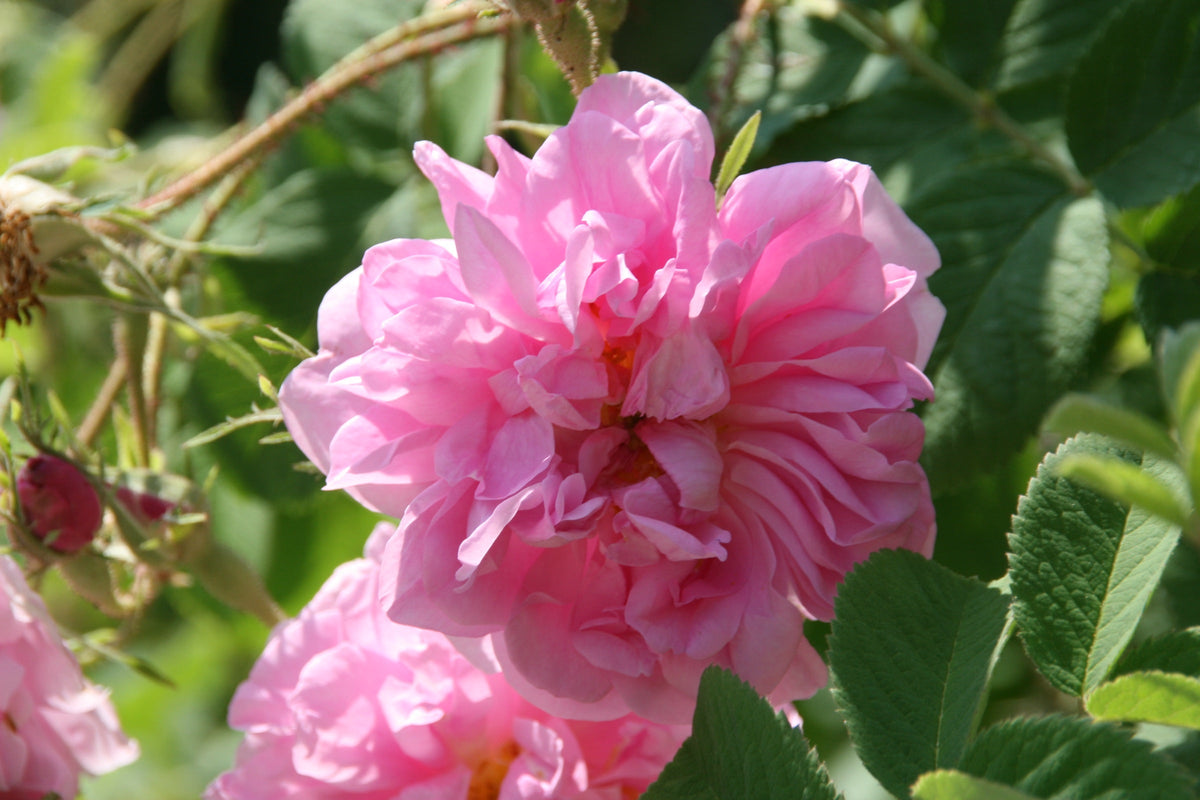
In short: Rose in perfumery rests on two species: the damask rose (Rosa × damascena), from which most of the world's rose oil is distilled, and the cabbage rose (Rosa × centifolia), which is grown mainly for absolute. The damask rose is an old hybrid of three wild species, and its Latin name dates from the eighteenth century and is no evidence that it arose in Damascus. Rose is extracted in two ways: distillation gives the oil and rose water, and solvent extraction gives the concrete, a waxy extract, and then the absolute, which is taken from it with alcohol. Its scent comes from about 300 compounds, and the largest effect on it may come from a compound present in a tiny amount, such as β-damascenone. Bulgaria, Turkey and Iran together produce more than 90% of the world's rose oil.
Table of contents
- The species of rose in perfumery
- How the oils of the four species differ
- The damask rose: an old hybrid
- Did the damask rose arise in Damascus?
- Bulgarian, Turkish, jouri and sultani: one rose?
- The cabbage rose and the rose of Grasse
- How rose is extracted
- Why do yield figures differ?
- What makes the scent of rose
- Where perfume roses are grown today
- Synthetic rose
- Is rose oil banned in Europe?
- Read also
- References
Rose appears in perfume descriptions under many names: damask, Bulgarian, Turkish, jouri, and rose de mai. Most of these names point to a single flower grown in different countries, and a few point to another species. What is in the bottle, though, depends on how it was extracted as much as on the flower it came from.
The species of rose in perfumery
The rose industry in perfumery rests on two species: the damask rose, from which most rose oil is distilled, and the cabbage rose, from which France, Morocco and Italy make the concrete, a waxy solvent extract, and the absolute, which is taken from it with alcohol [1]. In Bulgaria the oil of the white rose (Rosa alba) is also distilled, though it matters less to the industry [1].
How the oils of the four species differ
The oils of the damask, the white rose, the French rose (Rosa gallica) and the cabbage rose share their main compounds and differ in their proportions. The figures in the table are typical of oils from Bulgarian farms, not fixed values for each species [1].
| Compound (%) | Damask | White | French | Cabbage |
|---|---|---|---|---|
| citronellol | 28.72 | 16.65 | 9.22 | 9.22 |
| geraniol | 21.40 | 30.98 | 24.84 | 17.60 |
| nerol | 4.80 | 10.10 | 4.72 | 4.36 |
| methyl eugenol | 1.30 | 0.91 | 0.94 | 0.56 |
| phenylethyl alcohol | 0.40 | 0.25 | 0.36 | 0.09 |
| nonadecane | 11.10 | 12.14 | 22.67 | 8.10 |
The damask oil has about three times the citronellol of the cabbage rose oil, the white rose oil is the richest in geraniol and nerol, and the French rose oil has the most nonadecane, one of the paraffins, the heavy hydrocarbons that are abundant in rose oils [1].
The damask rose: an old hybrid
The damask rose is not a wild species but a hybrid of three species: Rosa moschata, Rosa gallica and Rosa fedtschenkoana, and genetic analysis shows that its mother is Rosa moschata [2]. Its oldest varieties carry a single genetic fingerprint, because they are propagated only vegetatively, that is, from parts of the plant and not from seed [2]. This three-parent hybrid appears to have arisen in the Middle East [3].
The bushes grown for production today in Bulgaria, Iran and India share one fingerprint that matches that of the old damask varieties in European gardens, which suggests that production roses come from a single origin and that their genetic base is narrow [4].

Did the damask rose arise in Damascus?
There is no evidence that it did. Damascena is a Latin adjective meaning "of Damascus", and the name was first published as Rosa × damascena in 1762, then as Rosa damascena in 1768 [5]. The name was given by eighteenth-century botanists and is no evidence of where the plant arose, and we found no peer-reviewed study linking the origin of the flower to Damascus.
It is often said that a crusader knight carried the rose from around Damascus to Europe. This story appears even in the specification of Bulgarian rose oil, attributed to "literary sources" with no reference [6].
Bulgarian, Turkish, jouri and sultani: one rose?
Bulgarian, Turkish and Iranian are names of origin for one rose, the damask. The most common Iranian strain is identical to the Bulgarian strain, and Iran has other strains as well [4][7], while the rose of Turkey is counted as Bulgarian without any samples of it having been tested [7]. "Shami" is an Arabic translation of its Latin name. The Taif rose has an article of its own: The Taif Rose.
"Jouri", "muhammadi", "baladi" and "sultani", on the other hand, are names whose meaning changes from one book to another and from one seller to another. "Sultani", for example, appears in a literary text as a synonym of shami and muhammadi, appears in a news report beside the Taif rose as though it were a different rose [8], and appears as a trade name for seedlings and perfumes.
The cabbage rose and the rose of Grasse
The cabbage rose (Rosa × centifolia) is the rose de mai ("May rose") of Grasse in southern France [22], and it is grown for absolute, not for oil. Its Latin name means "hundred petals". It is a complex hybrid, probably with Rosa gallica, Rosa moschata, Rosa canina and the damask rose among its parents [1]. Its oil is about a third of that of the damask, and it contains many paraffins that make it undesirable in perfumery, which is why concrete and absolute are made from it [1].
The growth of the perfume industry in Grasse was tied to the invention of hexane extraction, and in 2020 a geographical indication was registered for it under the name "Absolue Pays de Grasse", covering absolutes of perfume plants harvested and processed in the area [9]. Under the terms of this indication, the concrete is obtained with a volatile solvent, with a supercritical fluid, or by enfleurage, then treated with alcohol to become an absolute [9]. Before the geographical indication, in 2018, UNESCO inscribed the skills related to perfume in Pays de Grasse, from growing its plants to composing perfume, on the list of intangible cultural heritage [10].
How rose is extracted
Rose is extracted by distillation, which gives rose oil and rose water, or by solvent extraction, which gives the concrete and then the absolute.
In Bulgaria roses are picked from five or six in the morning until noon, and the flowers wait no more than 15 hours before distillation [6]. They are distilled with water and steam, then the water that comes out is distilled again to recover the oil left in it, and the oil is separated from the water in a separating vessel called a Florentine flask [6], so the oil is the product of two distillations [1].
Rose water is the water that comes out of distillation, holding 0.02 to 0.09% of oil [1], and the largest component of that oil is phenylethyl alcohol. This compound dissolves in water, so much of it goes with the water. In a laboratory experiment, this compound made up 98.2% of the oil extracted from the water left in the still after distillation, which is not the same as the rose water that comes out of it [11]. This is why it is abundant in the absolute and scarce in the oil [12], and the figures for the difference between them are in the article Perfume Ingredients: From Raw Material to Note.
In solvent extraction the flowers are soaked in hexane, which gives a waxy extract called the concrete, and then the part of it that dissolves in alcohol is taken, and that is the absolute [12]. The concrete is about 0.25% of the weight of the flowers, that is, one kilogram for every 400 kilograms, and the absolute is 55 to 68% of the concrete [11].
Distillation changes what is in the flower. In a laboratory experiment, rose furan and rose oxide together were about 0.2% of the compounds of the fresh flower and were not detected in the distilled oil [11], although rose oxide was isolated from Bulgarian rose oil in a tiny amount [17]. The longer the distillation, the more paraffins in the oil; they are its waxy part [11].

Why do yield figures differ?
Because they measure different things: the laboratory is not the distillery, one way of distilling is not another, and some figures are in liters and others in kilograms. The oil in the flowers is 0.03 to 0.04% of their weight, so a kilogram of it needs about 3.5 tonnes of flowers, or about one and a quarter million flowers [11], which is also the figure in the Bulgarian oil specification [6]. In a laboratory distillation in Iran the average was one liter for every 4 tonnes, reaching one liter for every 3.1 tonnes in flowers distilled on the day they were picked, and the average in Turkish and Bulgarian distilleries is one liter for every 4.5 tonnes by the same researchers' estimate [13]. In selected Indian strains a kilogram needed 2.2 to 3.3 tonnes, as in the article Essential Oils in Perfumery.
When only the floating oil is collected, without redistilling the water, as is often done in Iran, the yield drops to roughly one liter for every 14.7 tonnes [13].
What makes the scent of rose
In a calculation of each compound's share in the odor strength of Bulgarian rose oil, made by dividing its concentration by the lowest concentration at which it can be smelled, β-damascenone accounted for about 70%, while making up only 0.14% of the oil [14]. β-ionone is similar in its small amount and its importance to the scent [11].
Rose oil contains about 300 compounds [1], and by weight three alcohols dominate; their limits in the Bulgarian oil specification are: citronellol 24 to 35%, geraniol 13 to 22%, and nerol 5 to 12% [6].
Where perfume roses are grown today
The world produces about 5 to 5.5 tonnes of rose oil a year [15], more than 90% of it from Bulgaria, Turkey and Iran together [1]. Attempts to grow the damask rose for oil in France and Germany in the early nineteenth century, and later in Crimea, did not succeed [1].
In 2024 Turkey produced about 2,120 kilograms of oil, 13,000 kilograms of concrete and 2,100 kilograms of absolute, from 19,318 tonnes of flowers. Its farms are in the provinces of Isparta, Burdur, Afyonkarahisar and Denizli [15].
Bulgaria has grown roses for oil since the seventeenth century, in the Kazanlak and Karlovo valleys [6]. Its share of the world's oil changes from year to year: until the Second World War it was 70 to 90% of world consumption, then 40 to 50% in a 2007 report, with output of 1.5 to 2 tonnes a year [6]. Output of 2.5 to 4.5 tonnes was reported for the years before 2022 [16]. These figures come from different sources and years, so they should not be added to the figures for Turkey and the world, and the statement "Bulgaria produces most of the world's rose oil" is not accurate without a date.
Iran had about 31,000 hectares of damask rose in 2023, up from about 18,000 in 2016 [13].
Synthetic rose
A synthetic rose scent is built from synthetic versions of the three rose alcohols, citronellol, geraniol and phenylethyl alcohol, together with materials such as eugenol, linalool, rose oxide and cis-3-hexenal. Some perfume houses build the whole rose scent from these materials [12].
Most of these materials were known in rose oil before they were synthesized. Rose oxide was isolated from Bulgarian rose oil in 1959 [17]. Damascenone was identified in Bulgarian oil and synthesized in 1970, and the synthesis of related compounds named damascones was described along with it [18]. Today the International Fragrance Association (IFRA) has a single standard for these compounds under the name rose ketones, which sets one limit for the total of damascenone, the damascones and their isomers [19].
Synthetic materials are also used in adulteration: natural rose oil is adulterated with vegetable oils or with synthetic materials such as phenylethyl alcohol [12]. The word "rose" in a perfume description names the scent, whether its material is natural or synthetic.
Is rose oil banned in Europe?
It is not banned, but the European limit on one of its compounds, methyl eugenol, restricts the amount of rose oil in a perfume. The share of this compound in Bulgarian damask oil is 1.30% in the table above [1], and the Bulgarian oil specification allows no more than 2.0% [6]. In a laboratory experiment, methyl eugenol was about 1.2% of the oil extracted from rose water and was not found in the water left in the still after distillation [11]. The EU Cosmetics Regulation 1223/2009 sets its maximum in the finished product: 0.01% in fine fragrance, 0.004% in eau de toilette, 0.002% in fragrance cream, 0.001% in rinse-off products, and 0.0002% in other products [20]. IFRA restricts methyl eugenol as well [19].
Under the amendment 2023/1545, rose oil and rose extract are named in the ingredient list on a perfume label as Rose Flower Oil/Extract when they exceed a small threshold, and the name covers the damask, the cabbage rose, the white rose, the French rose and other species [21].
Read also
- The Taif Rose: What It Is, How It Is Distilled, and How to Read Its Name in a Perfume Description
- Oriental Ingredients in Perfume: Oud, Amber, Saffron, Frankincense and Rose
- Fragrance Families: A Guide to Perfume Scent Types and Their Classification
- Glossary of Perfume and Bakhoor Terms in English and Arabic
- Spring Fragrance Notes: Choosing Your Perfume in Saudi Arabia's Short Spring
- The History of Perfume: From the Incense Route to Synthetic Materials
References
- Mileva M, Ilieva Y, Jovtchev G, Gateva S, Zaharieva MM, Georgieva A, et al. Rose Flowers—A Delicate Perfume or a Natural Healer? Biomolecules. 2021;11(1):127. PMC7835869. Accessed 14 October 2026.
- Iwata H, Kato T, Ohno S. Triparental origin of Damask roses. Gene. 2000;259(1–2):53–59. doi:10.1016/S0378-1119(00)00487-X. Accessed 14 October 2026.
- Cui WH, Du XY, Zhong MC, Fang W, Suo ZQ, Wang D, Dong X, Jiang XD, Hu JY. Complex and reticulate origin of edible roses (Rosa, Rosaceae) in China. Horticulture Research. 2022;9:uhab051. doi:10.1093/hr/uhab051. Accessed 14 October 2026.
- Rusanov K, Kovacheva N, Vosman B, Zhang L, Rajapakse S, Atanassov A, Atanassov I. Microsatellite analysis of Rosa damascena Mill. accessions reveals genetic similarity between genotypes used for rose oil production and old Damask rose varieties. Theoretical and Applied Genetics. 2005;111(4):804–809. doi:10.1007/s00122-005-2066-9. Accessed 14 October 2026.
- International Plant Names Index (IPNI). Rosa × damascena Herrm., De Rosa 14 (1762): ipni.org. Rosa damascena Mill., Gard. Dict. ed. 8 (1768): ipni.org. Accessed 14 October 2026.
- Bulgarsko rozovo maslo (Bulgarian rose oil). Protected Geographical Indication, product specification; registered by Commission Implementing Regulation (EU) No 1020/2014. gov.uk. Accessed 14 October 2026.
- Babaei A, Tabaei-Aghdaei SR, Khosh-Khui M, Omidbaigi R, Naghavi MR, Esselink GD, Smulders MJM. Microsatellite analysis of Damask rose (Rosa damascena Mill.) accessions from various regions in Iran reveals multiple genotypes. BMC Plant Biology. 2007;7:12. PMC1832195. Accessed 14 October 2026.
- Al-Madina newspaper. 1 August 2026 [in Arabic]. al-madina.com. Accessed 14 October 2026.
- INPI (Institut national de la propriété industrielle). Communiqué de presse: indication géographique «Absolue Pays de Grasse». 6 novembre 2020. inpi.fr. Accessed 14 October 2026.
- UNESCO. The skills related to perfume in Pays de Grasse: the cultivation of perfume plants, the knowledge and processing of natural raw materials, and the art of perfume composition. Representative List of the Intangible Cultural Heritage of Humanity, 2018 (13.COM 10.B.14), file No. 01207. ich.unesco.org. Accessed 14 October 2026.
- Erbaş S, Baydar H. Variation in Scent Compounds of Oil-Bearing Rose (Rosa damascena Mill.) Produced by Headspace Solid Phase Microextraction, Hydrodistillation and Solvent Extraction. Records of Natural Products. 2016;10(5):555–565. acgpubs.org. Accessed 14 October 2026.
- Hupp AM. Determination of Rose Alcohol Composition in Extracts and Flowers via Headspace Solid-Phase Microextraction and GC-MS. ACS Measurement Science Au. 2025;5(6):932–941. PMC12715635. Accessed 14 October 2026.
- Sefidkon F, Samadi V, Rahimifard M, Azimi Atergeleh R, Taghizadeh A. Production and processing of Damask rose in Iran [in Persian]. Iran Nature. 2023;8(3):9–17. doi:10.22092/irn.2023.129557. Accessed 14 October 2026.
- Cotton S (University of Birmingham). Beta-Damascenone. Molecule of the Month, August 2015. University of Bristol, School of Chemistry. chm.bris.ac.uk. The page cites its figures from Ohloff G, Demole E. Journal of Chromatography. 1987;406:181–183. Accessed 14 October 2026.
- Kazaz S, Erbaş S. Oil-bearing rose (Rosa damascena Mill.) cultivation and rose oil sector in Türkiye. Acta Horticulturae. 2026;1461:187–196. doi:10.17660/ActaHortic.2026.1461.21. Accessed 14 October 2026.
- BTA (Bulgarian News Agency). Expert on Oil-Bearing Rose Production in Bulgaria. 3 September 2022. bta.bg. Accessed 14 October 2026.
- Seidel CF, Stoll M. Zur Kenntnis des Rosenöls. 1. Mitteilung. Über die tiefsiedenden Bestandteile des bulgarischen Rosenöls. Helvetica Chimica Acta. 1959;42(6):1830–1844. doi:10.1002/hlca.19590420611. Accessed 14 October 2026.
- Demole E, Enggist P, Säuberli U, Stoll M, Kováts ESz. Structure et synthèse de la damascénone, constituant odorant de l'essence de rose bulgare (Rosa damascena Mill.). Helvetica Chimica Acta. 1970;53(3):541–551. doi:10.1002/hlca.19700530310. Accessed 14 October 2026.
- IFRA (International Fragrance Association). IFRA Standards, 51st Amendment. 2023. Methyl eugenol standard; Rose ketones standard in the 49th Amendment (2020). ifrafragrance.org. Accessed 14 October 2026.
- Regulation (EC) No 1223/2009 of the European Parliament and of the Council of 30 November 2009 on cosmetic products. Annex III, entry 102 (Methyl eugenol). Consolidated version of 18 May 2026. eur-lex.europa.eu. Accessed 14 October 2026.
- Commission Regulation (EU) 2023/1545 amending Regulation (EC) No 1223/2009 as regards labelling of fragrance allergens in cosmetic products. Entry 366. eur-lex.europa.eu. Accessed 14 October 2026.
- dsm-firmenich. Rose Centifolia IG Grasse Absolute. Product page. studio.dsm-firmenich.com. Accessed 14 October 2026.
Cover photo: David J. Stang, via Wikimedia Commons, licensed under CC BY-SA 4.0.

Prepared and edited by: Sedr Al-Khaleej Perfumes team
Last reviewed: 14 October 2026
Was this article helpful?
Leave a comment
Comments are reviewed before they appear. Your email address won’t be shown.