In short: The Taif rose is grown in the highlands and valleys of Taif, best known from al-Hada and al-Shafa, and picked in the early morning in a short season that begins in March. It is distilled in copper pots and gives a great deal of rose water and very little oil, and the most abundant compounds in its oil are citronellol and geraniol. "Taif rose" in a perfume description is the name of a scent, and on its own it does not mean that the perfume contains natural oil.
Table of contents
- What the Taif rose is
- Where it is grown and when it is picked
- Distillation: from the copper pot to the oil
- How many roses in a tola?
- What makes its scent
- Rose oil, rose water, absolute, and the rose accord
- How to read "Taif rose" in a perfume description
- What is documented of its history
- Frequently asked questions
- Read also
- References
Every March the rose harvest begins in the highlands of Taif, and it lasts thirty-five to forty-five days [1]. What is gathered in those weeks goes to market or to the distilling pots, and out of the pots comes rose water that fills bottles, and a little oil. The name travels farther than the material: "Taif rose" is written in the descriptions of many perfumes.
What the Taif rose is
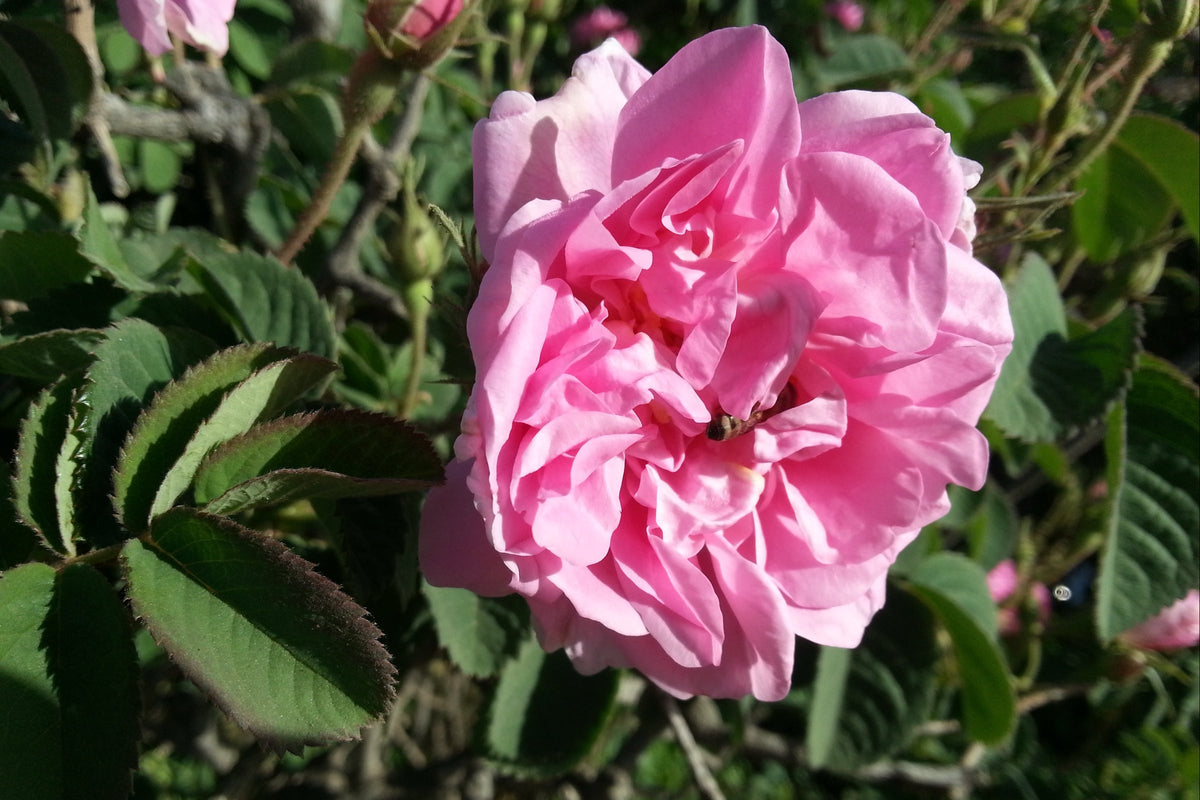
A rose grown in the highlands and valleys of Taif, with the botanical name Rosa damascena var. trigintipetala [2] [3]. What has been examined of its shrubs is alike: in 25 leaf samples from al-Hada, al-Shafa, Maysan, and Abha, the sequence of one plastid gene was the same, with no difference from one place to another [2].
When it reached Taif, and from where, is told only as a possibility, with no date and no source [2].
Where it is grown and when it is picked
It is grown in the highlands and valleys of Taif Governorate. Its best-known sites are al-Hada and al-Shafa, and with them Wadi Mahram, al-Talhat, Wadi al-A'maq, Wadi al-Bani, Bilad Tuwairiq, and al-Makhadah [4]; the Saudi Reef program adds al-Hasba, al-Qudairin, al-Hawiyah, al-Sail, and the south of Taif [5]. The variety is grown outside Taif as well, and some of the samples mentioned above were taken at Abha [2].
The figures for farms and production change with the year and with the body that announced them. In April 2025 the Ministry of Environment, Water and Agriculture reported more than 910 farms covering over 193 hectares and producing more than 960 million roses a year [4], and in March 2026 the Saudi Reef program reported about 1,300 farms on 700 hectares producing about 500 million roses, along with 36 perfume-making workshops in Taif [5].
The rose year begins months before the harvest. From December to February the shrubs are fertilized, watered, and pruned, and cuttings are planted; then the harvest begins in March and continues for 35 to 45 days [1]. The shrub flowers once a year, and its flowering lasts 40 to 50 days [6]. The flowers open a few at a time each day, so those that have opened are picked in the early hours of the morning. Farmers, their families, and their friends share in the picking, and the roses are then carried to market or to homes to be distilled [1] [6].

Distillation: from the copper pot to the oil
In Taif the rose is distilled with water in copper pots. In the account of a local expert reported by the Saudi Press Agency, the roses are placed in the pot, its lid, which has a dome at the top, is sealed, and they stay in it for 10 to 12 hours. The steam rises from the dome through pipes that pass through coolers filled with cold water, where it condenses and comes down in drops [6].
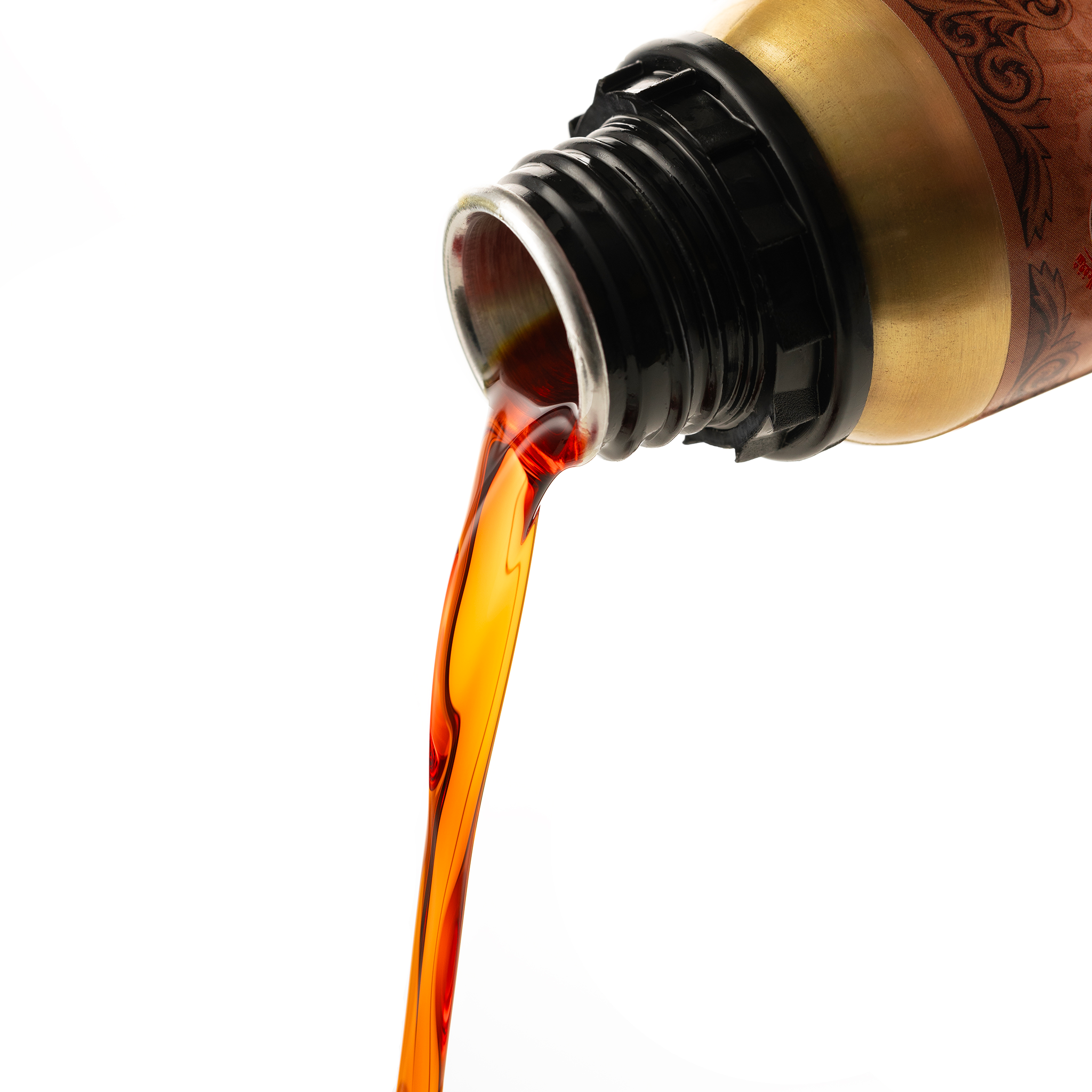
The water of the first distillation comes out laden with oil, so it is added to a second pot holding fresh roses and the process is repeated, and a more concentrated water comes out of it. In this account the products are three: ordinary rose water, a concentrated water that he calls ma' al-arus ("the bride's water"), and rose oil [6]. In another account, published in the magazine Saudi Aramco World in 1997, al-arus ("the bride") is the name of the water of the first distillation, and al-thino is the name of what comes from distilling it again [7]. After the redistilled water cools, the oil gathers and floats on its surface, and is decanted from it [7]; the story of its discovery is in our article on the history of perfume. Rose water goes into foods and drinks, and both it and the oil go into cosmetics [1].

How many roses in a tola?
A press account puts it at between 10,000 and 15,000 roses for a tola, depending on the weather [7]. A tola is about 11.62 grams [8], and it is defined in the glossary of perfume terms. We found no measurement of this count in an official source or a peer-reviewed study, nor of the oil yield of Taif roses.
What makes its scent
The most abundant constituents of Taif rose oil are two alcohols: citronellol and geraniol. In seven samples from al-Shafa, al-Hada, and Taif, more than 120 compounds were counted; citronellol was between 19.64 and 28.13%, and geraniol between 18.29 and 27.23%, followed by nerol (7.02 to 14.27%) and linalool (2.93 to 7.55%) [9]. Alongside these alcohols there are paraffins, which are heavy hydrocarbons, making up 13.53 to 30.85% of the oil [9]. Close to this is what was found in two samples obtained from two merchants in Riyadh in 2011: citronellol between 23 and 28%, geraniol between 14 and 20%, nerol between 6 and 11%, and, among the paraffins, nonadecane between 11 and 16% [3].
Rose oil, rose water, absolute, and the rose accord
Four names share the scent of the rose, and they differ in how they are made and in what they contain.
| Name | How it is made | What predominates in it |
|---|---|---|
| Rose oil (in Arabic, dehn al-ward) | The flowers are distilled with water or with steam [11] | Citronellol and geraniol together 26 to 62%, and phenylethyl alcohol 0.88 to 2.2% [11] |
| Rose water, which is the hydrosol | A by-product of distilling the oil, or distilled from a smaller quantity of roses [10] | It contains 0.02 to 0.09% oil, and its oil is rich in phenylethyl alcohol [10] |
| Absolute | The flowers are extracted with a solvent such as hexane, which gives a first extract called the concrete, and then the part of it that dissolves in alcohol is taken [10] [11] | Phenylethyl alcohol 50 to 79%, and citronellol and geraniol together 6.5 to 33% [11] |
| Rose accord | Blended from synthetic materials, among them the three rose alcohols [11] | Whatever the perfumer chooses, and it may contain no flower at all |
Phenylethyl alcohol is the third of the rose alcohols, with citronellol and geraniol, and it dissolves in water. In distillation, then, most of it goes with the rose water and little of it is left in the oil, while it stays in the absolute [10] [11]. This is why the oil smells different from the absolute although the flower is the same, and the details are in the article Perfume Ingredients: From Raw Material to Note.
How to read "Taif rose" in a perfume description
The name in a description describes a scent, and on its own it does not tell you what is in the bottle. A note is a name for what is smelled, and it may be built from materials that do not carry its name. Some perfume houses compose the whole scent of rose from synthetic materials, and natural rose oil is often adulterated with cheaper materials, among them vegetable oils and synthetic phenylethyl alcohol [11].
The list of ingredients helps a little. In the European Union, the Cosmetics Regulation 1223/2009 requires citronellol and geraniol to be named in the list of ingredients when either of them exceeds 0.001% in what stays on the skin or 0.01% in what is rinsed off [12]. The amending Regulation 2023/1545 added rose oil and rose extract to the list under the name Rose Flower Oil/Extract, with the same two limits, and products placed on the market before 31 July 2026 that do not name it may remain on sale until 31 July 2028 [13]. The appearance of citronellol or geraniol in the list does not indicate natural rose, because both are also made synthetically [11], and the name Rose Flower Oil/Extract covers more than one kind of rose, and does not state the country of the flower [13].
The word "Taif" is originally a name of origin, and we read it in a perfume description as describing a scent, until the maker of the perfume states that it contains oil from Taif.
What is documented of its history
In the late summer of 1814 the Swiss traveler John Lewis Burckhardt stayed for some days in Taif, and wrote that its gardens were renowned for the abundance of their roses, and that the roses were carried from them to all parts of the Hejaz, as its grapes were. He noted that rose-buds from the gardens of Taif were a considerable article of trade among the druggists of Jeddah and Mecca, and that the sellers of sweet-oils in Jeddah sold rose water from Fayoum in Egypt [14].
Today the Taif rose has a place in the washing of the Holy Kaaba. According to what the Saudi Press Agency published in July 2025 on the stages of the washing, Taif rose water goes into the preparation of the washing water, and Taif rose oil is among the things with which the Kaaba is perfumed afterward [15].
In 2024 UNESCO inscribed "Cultural practices related to Taif roses" on the Representative List of the Intangible Cultural Heritage of Humanity in the name of the Kingdom of Saudi Arabia, after the element had entered the national inventory in 2021. What is inscribed is practices, not a flower: tending the shrubs, picking together, distilling, and giving roses and scattering them to welcome guests. This knowledge is passed on within families, and organizations and cooperative societies hold training courses in growing the rose [1].
Frequently asked questions
Is the Taif rose a kind found only in Taif?
No. It is grown in other parts of the Kingdom, Abha among them [2]. What belongs to Taif is the origin, and the way its people grow and distill the rose.
What is the difference between rose oil and rose water?
Both come out of the same pot. The oil is a small quantity of oil separated from the distilled water, and rose water is that water, which contains only 0.02 to 0.09% oil [10].
How many roses does a tola of rose oil take?
Between 10,000 and 15,000 roses, according to a press account from 1997 [7].
When is the Taif rose season?
Picking begins in March and continues for 35 to 45 days, and it is done in the early morning [1].
Does "Taif rose" in a perfume description mean that it contains rose oil from Taif?
Not necessarily. The description names a scent, and the scent of rose is sometimes composed of synthetic materials [11].
Read also
- Oriental Ingredients in Perfume: Oud, Amber, Saffron, Frankincense and Rose
- Essential Oils in Perfumery: The Main Oils, Their Scents and Safety
- Spring Fragrance Notes: Choosing Your Perfume in Saudi Arabia's Short Spring
- Amber in Perfumery: Ambergris, Fossil Amber, Ambrox, and Why the Name Gets Confused
References
- UNESCO. Cultural practices related to Taif roses. Representative List of the Intangible Cultural Heritage of Humanity, 2024 (19.COM), file No. 02089. ich.unesco.org. Inscription decision 19.COM 7.b.5: ich.unesco.org. Accessed 14 October 2026.
- Alamer KH, Amer SAM. Molecular variability of Rosa damascena Mill. growing in Taif region of Saudi Arabia. Bangladesh Journal of Botany. 2018;47(2):205–209. bdbotsociety.org. Accessed 14 October 2026.
- Kurkcuoglu M, Abdel-Megeed A, Baser KHC. The composition of Taif rose oil. Journal of Essential Oil Research. 2013;25(5):364–367. doi:10.1080/10412905.2013.809322. Accessed 14 October 2026.
- Ministry of Environment, Water and Agriculture. The Taif rose: a fragrance that spreads across the Kingdom, with production exceeding 960 million roses a year [in Arabic]. 18 Shawwal 1446 AH (April 2025). mewa.gov.sa. Accessed 14 October 2026.
- Saudi Press Agency (SPA). "Saudi Reef": the rose sector records growth of more than 15% a year, and global demand for local production rises [in Arabic]. Riyadh, 29 March 2026. spa.gov.sa. Accessed 14 October 2026.
- Saudi Press Agency (SPA). Report: The Taif rose, historical details and a long heritage of one of the most important aromatic shrubs [in Arabic]. Taif, 8 February 2024. spa.gov.sa. Accessed 14 October 2026.
- Hayward MR. The Roses of Taif. Saudi Aramco World. 1997;48(6):2–9. archive.aramcoworld.com. Accessed 14 October 2026.
- Antonopoulou M, Compton J, Perry LS, Al-Mubarak R. The Trade and Use of Agarwood (Oudh) in the United Arab Emirates. Petaling Jaya, Selangor, Malaysia: TRAFFIC Southeast Asia; 2010. traffic.org. Accessed 14 October 2026.
- Dobreva A, Getchovska K, Nedeltcheva-Antonova D. A comparative study of Saudi Arabia and Bulgarian Rose oil chemical profile: The effect of the technology and geographic origin. Flavour and Fragrance Journal. 2020;35(5):584–596. doi:10.1002/ffj.3601. Accessed 14 October 2026.
- Mileva M, Ilieva Y, Jovtchev G, Gateva S, Zaharieva MM, Georgieva A, et al. Rose Flowers—A Delicate Perfume or a Natural Healer? Biomolecules. 2021;11(1):127. PMC7835869. Accessed 14 October 2026.
- Hupp AM. Determination of Rose Alcohol Composition in Extracts and Flowers via Headspace Solid-Phase Microextraction and GC-MS. ACS Measurement Science Au. 2025;5(6):932–941. PMC12715635. Accessed 14 October 2026.
- Regulation (EC) No 1223/2009 of the European Parliament and of the Council of 30 November 2009 on cosmetic products. Official Journal of the European Union. 2009;L 342:59–209. Annex III (entries 78 and 86). eur-lex.europa.eu. The text as published in 2009, not the consolidated version with its amendments. Accessed 14 October 2026.
- Commission Regulation (EU) 2023/1545 of 26 July 2023 amending Regulation (EC) No 1223/2009 of the European Parliament and of the Council as regards labelling of fragrance allergens in cosmetic products. Official Journal of the European Union. L 188, 27.7.2023. eur-lex.europa.eu. Accessed 14 October 2026.
- Burckhardt JL. Travels in Arabia. London: Henry Colburn; 1829. Project Gutenberg edition, ebook No. 9457. gutenberg.org. Accessed 14 October 2026.
- Saudi Press Agency (SPA). The stages of washing the Kaaba: care and precision that reflect the honor and sanctity of the place [in Arabic]. Makkah, 10 July 2025. spa.gov.sa. Accessed 14 October 2026.
Cover photo: Abutalah, via Wikimedia Commons, licensed under CC BY-SA 3.0, cropped.

Prepared and edited by: Sedr Al-Khaleej Perfumes team
Last reviewed: 14 October 2026
Was this article helpful?
Leave a comment
Comments are reviewed before they appear. Your email address won’t be shown.